
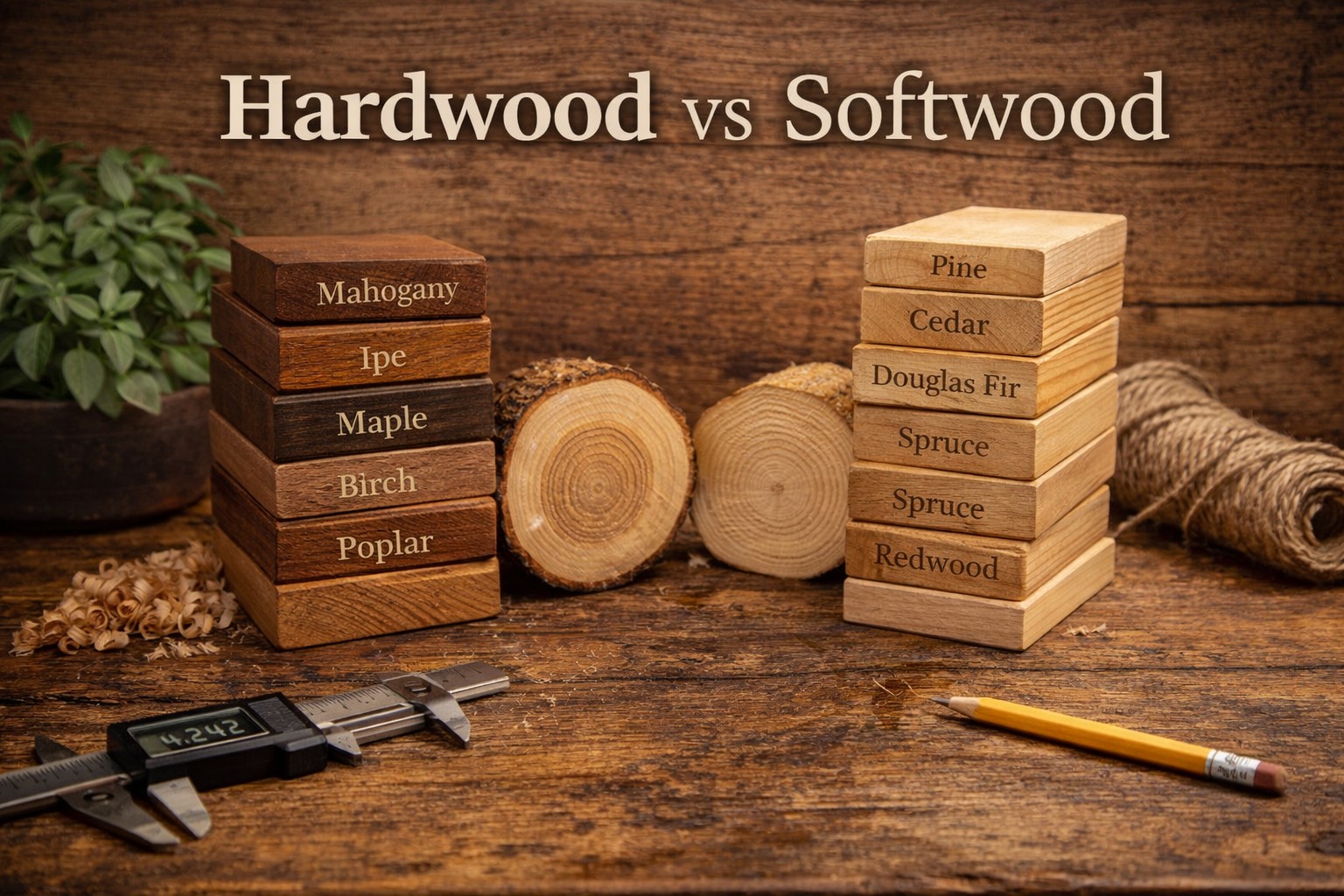
Hardwood vs Softwood: Key Differences Explained
The distinction between hardwoods and softwoods is one of the most fundamental concepts in woodworking and lumber identification. Despite the names, hardwood does not always mean harder, and softwood does not always mean softer.
These terms refer to the type of tree the wood comes from, rather than its actual density or strength. Understanding the differences between hardwoods and softwoods is essential for selecting the right material for woodworking, construction, and specialty applications.
What Is Hardwood?
Softwoods come from coniferous trees, which are usually evergreen and produce cones instead of flowers. These trees tend to grow faster and are commonly used in construction and structural applications.
Common softwood species include pine, spruce, fir, and cedar. Softwoods are widely used in framing, paneling, and general building materials.
Hardwood vs Softwood: Key Differences
| Characteristic | Hardwood | Softwood |
| Tree Type | Deciduous (broadleaf) | Coniferous (needle-bearing) |
| Growth Rate | Slower | Faster |
| Density | Typically higher | Typically lower |
| Grain Structure | Complex | Simpler |
| Durability | Often more durable | Varies widely |
| Common Uses | Furniture flooring cabinetry | Construction framing paneling |
| Cost | Often higher | Usually lower |
Hardness vs Classification (Important Clarification)
The terms hardwood and softwood can be misleading. Some hardwoods are relatively soft, while some softwoods can be quite hard.
For example, Balsa is classified as a hardwood but is extremely soft, while certain softwoods like Yew can be relatively dense and durable.
This is why measurements such as Janka hardness and wood density provide a more accurate understanding of a wood’s physical properties.
Compare Wood Properties
See how different species rank in density and hardness using our Wood Density & Janka Hardness Chart. You can also explore Hardest Woods, Softest Woods, and Most Dense Woods for quick comparisons
Sourcing Materials:
Looking to find these species or similar materials? View recommended suppliers on our Where to Buy Exotic Woods page.
Building a Collection:
For those building a physical reference library, explore our Wood Collecting & Preservation guide.