
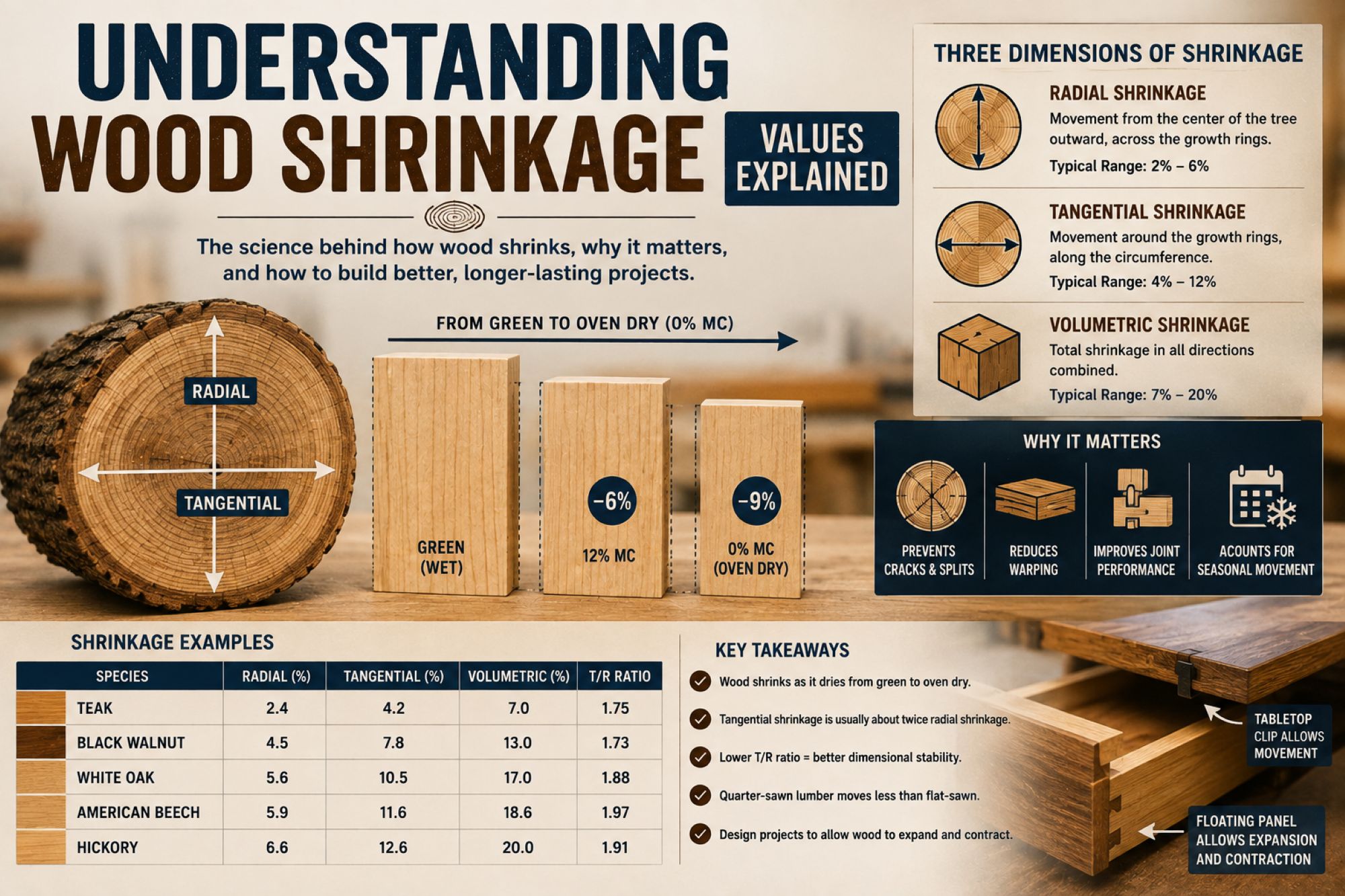
Understanding Wood Shrinkage Values Explained
A comprehensive guide to radial, tangential, and volumetric shrinkage, how wood shrinkage values are measured, and why they are essential for predicting wood movement and selecting the right species for woodworking projects.
Overview
Every wood species expands and contracts as it gains or loses moisture. While this movement is a natural property of wood, not all species behave the same. Some remain remarkably stable, while others experience significant seasonal movement.
Wood shrinkage values provide a standardized way to measure how much a species changes in size as it dries from a green (freshly cut) condition to its oven-dry state. These values help woodworkers, furniture makers, flooring manufacturers, cabinet builders, and collectors predict dimensional changes and choose the right wood for each application.
Understanding shrinkage values allows you to anticipate wood movement before beginning a project, reducing the risk of warping, cupping, cracking, joint failure, and seasonal expansion problems.
What Are Wood Shrinkage Values?
Wood shrinkage values measure the percentage of size reduction that occurs as wood dries from its green condition (above the fiber saturation point) to oven dry (0% moisture content).
Because wood does not shrink equally in every direction, separate measurements are recorded for three different dimensions:
- Radial Shrinkage
- Tangential Shrinkage
- Volumetric Shrinkage
These values are expressed as percentages.
Why Wood Shrinks
Living trees contain large amounts of water.
As lumber dries:
- Free water leaves the cell cavities first.
- Bound water then leaves the cell walls.
- The cell walls begin shrinking.
- The board becomes smaller.
Most measurable shrinkage begins after the wood reaches the Fiber Saturation Point (FSP), which is typically around 28–30% moisture content for most species.
Above the FSP, wood loses water but experiences very little dimensional change.
Radial Shrinkage
Radial shrinkage measures movement:
From the center of the tree outward
This direction crosses the annual growth rings.
Typical radial shrinkage values:
- 2–6%
Examples:
- Eastern White Pine: ~3%
- Black Walnut: ~5%
- White Oak: ~5.6%
Because radial movement is relatively small, quarter-sawn lumber—which moves primarily in this direction—is more dimensionally stable.
Tangential Shrinkage
Tangential shrinkage measures movement:
Around the growth rings
This is the direction where most movement occurs.
Typical tangential values:
- 4–12%
Examples:
- Eastern White Pine: ~6%
- Black Walnut: ~7.8%
- White Oak: ~10.5%
Most flatsawn boards shrink primarily in this direction.
Volumetric Shrinkage
Volumetric shrinkage combines shrinkage in all directions to estimate the total reduction in wood volume.
Typical values:
- 7–20%
Examples:
- Teak: Low
- Walnut: Moderate
- Hickory: High
- Beech: High
Although useful for comparing overall dimensional change, volumetric shrinkage is generally less useful than radial and tangential values when designing furniture.
Tangential vs. Radial Shrinkage
One of the most important relationships is the ratio between tangential and radial shrinkage.
In most species:
Tangential shrinkage is about twice radial shrinkage.
Example:
Species A
- Radial: 4%
- Tangential: 8%
This uneven movement causes:
- Cupping
- Twisting
- Surface distortion
Species with more balanced shrinkage ratios generally remain flatter over time.
The Tangential-to-Radial Ratio (T/R Ratio)
Wood scientists often calculate the Tangential-to-Radial Ratio (T/R Ratio) to estimate dimensional stability.
Formula:
Tangential Shrinkage ÷ Radial Shrinkage
Examples:
Excellent Stability
- Ratio below 1.5
Good Stability
- 1.5–1.8
Average Stability
- 1.8–2.2
Less Stable
- Above 2.2
Lower ratios generally indicate wood that is less prone to cupping and distortion.
Why Shrinkage Values Matter
Understanding shrinkage values helps predict:
- Seasonal expansion
- Seasonal contraction
- Board stability
- Joint performance
- Panel movement
- Flooring behavior
- Furniture longevity
Woodworkers often compare shrinkage values before selecting lumber for:
- Tabletops
- Cabinet doors
- Flooring
- Musical instruments
- Turning projects
- Exterior applications
High-Shrinkage Woods
Species with relatively high shrinkage include:
These woods require careful project design to accommodate seasonal movement.
Low-Shrinkage Woods
Species known for good dimensional stability include:
These woods are often preferred for outdoor projects, boatbuilding, and fine furniture.
Does Higher Density Mean More Shrinkage?
Not always.
While many dense hardwoods exhibit greater shrinkage, density alone does not determine dimensional stability.
Examples:
- Teak is dense but remarkably stable.
- Hickory is dense and exhibits relatively high movement.
- Mahogany has moderate density with excellent stability.
Each species should be evaluated individually.
Shrinkage and Board Orientation
Board orientation dramatically influences how shrinkage affects lumber.
Flatsawn Lumber
- Greater tangential movement
- More likely to cup
- Larger seasonal width changes
Quarter-Sawn Lumber
- Primarily radial movement
- Better dimensional stability
- Reduced cupping
Rift-Sawn Lumber
- Very uniform movement
- Excellent stability
- Straight grain
Shrinkage vs. Seasonal Movement
A common misconception is that published shrinkage values describe yearly movement.
They do not.
Shrinkage values measure:
Green wood → Oven dry
Most furniture never experiences this full moisture range.
Actual seasonal movement is usually much smaller but follows the same principles.
Factors That Influence Shrinkage
Wood movement depends on more than species alone.
Important factors include:
- Moisture content
- Relative humidity
- Temperature
- Board width
- Grain orientation
- Drying method
- Growth rate
- Presence of juvenile wood
- Internal stresses
How Woodworkers Use Shrinkage Values
Professional woodworkers use shrinkage data when designing:
- Floating panels
- Tabletops
- Cabinet doors
- Breadboard ends
- Flooring
- Drawers
- Woodturning projects
- Musical instruments
These values help determine:
- Expansion gaps
- Fastener placement
- Joinery design
- Material selection
Common Myths
“Wood only shrinks once.”
False.
Wood expands and contracts throughout its life as humidity changes.
“Kiln drying eliminates shrinkage.”
False.
Kiln drying removes moisture but does not prevent future movement.
“Shrinkage values tell you how much a tabletop moves each year.”
False.
Published values represent total shrinkage from green to oven dry.
Seasonal movement is much smaller.
“All hardwoods shrink more than softwoods.”
False.
Many softwoods move more than some hardwoods.
Species characteristics matter more than whether a wood is classified as hardwood or softwood.
Frequently Asked Questions
Which shrinkage value is most important?
For most woodworking applications, radial and tangential shrinkage values are the most useful because they predict how boards will move across their width.
What is considered a stable wood?
Species with relatively low shrinkage values and a low tangential-to-radial ratio generally offer the best dimensional stability.
Why do quarter-sawn boards move less?
Quarter-sawn lumber shrinks primarily in the radial direction, where movement is naturally lower than tangential movement.
Is shrinkage the same as wood movement?
Shrinkage values measure the total dimensional change from green to oven dry. Seasonal wood movement refers to the smaller expansion and contraction that occurs as wood responds to changes in humidity after it has been dried.
Related Educational & Technical Guides
- Understanding Wood Movement and Seasonal Expansion
- Wood Moisture Content Guide
- Quarter-Sawn vs. Rift-Sawn vs. Flatsawn Lumber
- Wood Density and Janka Hardness Explained
- Wood Drying and Kiln-Drying Guide
- Understanding Heartwood and Sapwood
- Wood Grain Patterns and Figure Explained
- Wood Identification Guide
Collector Notes
Shrinkage values reveal much more than simple percentages—they provide insight into how a species behaves over its lifetime. Two woods may appear nearly identical in color and grain yet perform very differently as humidity changes. For collectors and woodworkers alike, understanding radial, tangential, and volumetric shrinkage helps explain why certain species have earned reputations for exceptional stability while others require careful design to prevent movement-related problems.
A solid understanding of shrinkage values is one of the foundations of successful woodworking and one of the key characteristics that separates species beyond appearance alone.