
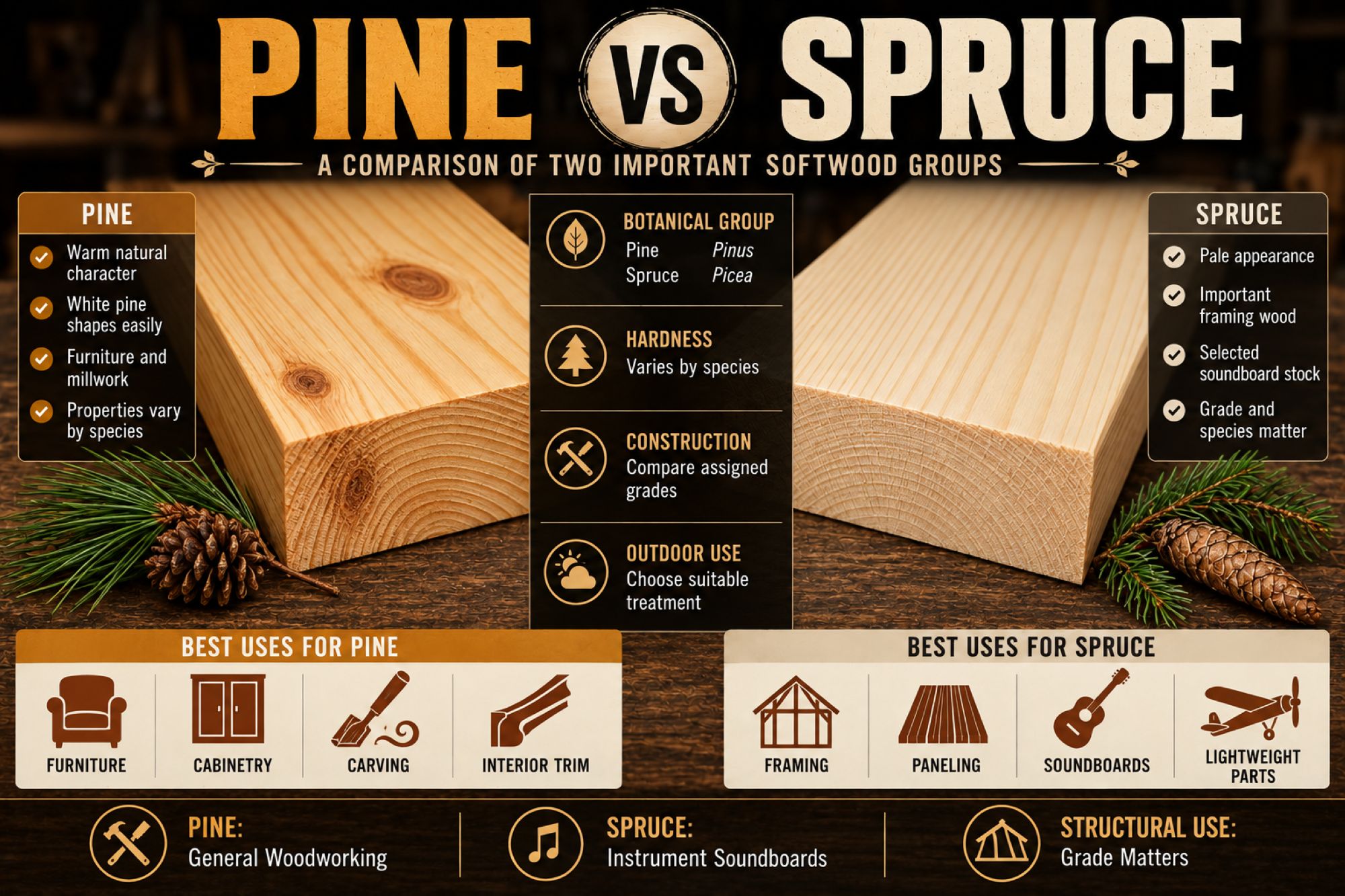
Pine vs. Spruce
A side-by-side comparison of Pine and Spruce, two important softwood groups used for construction, furniture, millwork, paneling, musical instruments, and general woodworking.
Overview
Pine and Spruce are familiar woodworking materials, but neither name identifies a single species.
Pines belong to Pinus, while spruces belong to Picea. Both genera belong to the Pinaceae family.
This comparison discusses the broader groups and uses Eastern White Pine (Pinus strobus) and Norway Spruce (Picea abies) as familiar examples.
Pine is particularly appealing for furniture, carving, and interior millwork. Spruce has an important role in construction and selected musical-instrument applications. However, the species, grade, moisture condition, and individual board matter more than a simple Pine-versus-Spruce label.
Category recommendations below reflect typical project priorities rather than universal rankings.
Species Overview
| Characteristic | Pine | Spruce |
|---|---|---|
| Genus | Pinus | Picea |
| Family | Pinaceae | Pinaceae |
| Wood type | Softwood | Softwood |
| Benchmark species | Eastern White Pine | Norway Spruce |
| Benchmark scientific name | Pinus strobus | Picea abies |
| General appearance | Pale cream, yellow, or brown; varies substantially | Commonly pale cream to light yellowish brown |
| Representative dried weight | Eastern White Pine: approximately 25 lb/ft³ | Norway Spruce: approximately 28 lb/ft³ |
| Common project roles | Furniture, carving, trim, construction | Construction, paneling, instrument soundboards |
The benchmark values do not represent every Pine or Spruce. Dense pines can behave very differently from lightweight white pines.
Appearance
Pine
Pine can provide a warm, visibly woody appearance. Knots, growth-ring contrast, and heartwood coloration contribute to the character of individual boards.
Spruce
Spruce is often selected for a pale appearance with relatively little visible distinction between heartwood and sapwood.
In commercial Scots Pine, heartwood is more visibly differentiated from sapwood than it is in Norway Spruce. This distinction should not be applied identically to every species.
🏆 Appearance Winner: Tie
Choose Pine for the character of the available boards and Spruce when a pale, restrained appearance suits the design.
Grain & Texture
Both groups can supply straight-grained stock. Knots, grain deviation, and growing conditions can create more practical differences than the genus name.
For visible work, inspect:
- Grain direction
- Knot size and condition
- Growth-ring contrast
- Surface quality
- Color consistency
🏆 Grain & Texture Winner: Board-Dependent
Hardness
There is no reliable group-wide winner.
Pine includes both relatively soft white pines and substantially harder commercial species. Spruce also varies, and reference values overlap with those of softer pines.
🏆 Hardness Winner: Species-Dependent
Compare exact species when resistance to dents matters.
Density
The benchmark Eastern White Pine is lighter than the benchmark Norway Spruce. That relationship does not establish that Pine is always lighter.
🏆 Lower Weight Winner: Species-Dependent
For portable furniture, models, or components handled frequently, compare actual dry stock.
Strength
Construction decisions should follow the lumber’s assigned grade, strength class, dimensions, and applicable design requirements.
Swedish Wood notes that commercial Pine and Spruce can be treated comparably for structural purposes when appropriately classified. A species name alone does not establish a board’s load capacity.
🏆 Structural Strength Winner: Grade-Dependent
Natural Durability
Neither group should receive a blanket claim of outdoor durability.
Pine heartwood and sapwood can behave differently, and treatment response also matters. Spruce has low natural durability in ground contact, even though appropriately designed above-ground applications can perform differently.
🏆 Natural Durability Winner: Species and Exposure-Dependent
Outdoor Use
Select an exterior product according to:
- Intended exposure
- Ground-contact requirements
- Treatment specification
- Drainage and ventilation
- Protective finish
- Local product standards
Some Pine products are readily available with preservative treatment. That does not make every Pine board suitable for exterior use or mean all Spruce products are unsuitable.
🏆 Outdoor Recommendation: The Correctly Specified Product
Dimensional Stability
Both require appropriate drying, acclimation, and allowance for movement.
For furniture, prioritize stock that is:
- Dry enough for the intended environment
- Free from significant distortion
- Suitable in grain orientation
- Properly stored before machining
🏆 Stability Winner: Stock-Dependent
A dry, well-selected board is preferable to poorly conditioned material from the nominally favored group.
Workability
Pine
Eastern White Pine is particularly useful when easy cutting and shaping are priorities. It has established applications in furniture, doors, trim, and millwork.
Spruce
Norway Spruce also works readily with suitable tools and is used for interior woodworking as well as construction.
🏆 General Hand-Tool Recommendation: Clear Eastern White Pine
This recommendation applies to the named benchmark rather than all pines.
Gluing
For either material, prepare clean, accurately fitted joints and follow the adhesive’s instructions.
Check moisture condition and inspect resinous areas before assembly. A trial joint is useful when the stock or adhesive combination is unfamiliar.
🏆 Gluing Winner: Tie
Finishing
For a clear finish, compare offcuts before committing to a whole project.
For stain or paint, evaluate:
- Uneven color absorption
- Knot appearance
- Resinous areas
- Surface preparation
- Compatibility with the intended coating
🏆 Finishing Winner: Test-Dependent
Furniture
Pine Furniture
Eastern White Pine has a documented history in furniture production and related interior products.
Consider it for:
- Cabinets
- Shelves
- Chests
- Tables
- Painted furniture
- Decorative panels
Spruce Furniture
Spruce can be useful where its available grade, appearance, and weight suit the piece. Select clear stock carefully for visible components.
🏆 General Furniture Recommendation: Pine
This recommendation particularly favors furniture-grade white pine rather than unspecified construction lumber.
Cabinetry
For solid-wood cabinetry, clear Pine is the practical starting recommendation because of its established use in cabinet work and millwork.
Spruce remains an option when the available stock meets the design requirements.
🏆 Cabinetry Recommendation: Pine
Interior Trim & Millwork
Eastern White Pine is widely used for moldings, doors, paneling, and trim. Western White Pine is also valued for moldings and similar work.
🏆 Trim & Millwork Recommendation: Pine
Select the species and grade appropriate to the desired finish.
Construction
Both groups have major construction roles.
Choose framing and engineered products according to their specified performance, rather than assuming one genus is inherently superior.
🏆 Construction Winner: Tie When Equivalently Graded
Flooring
A soft surface may acquire dents and wear marks relatively quickly.
If Pine is being considered, identify the exact species: a dense flooring pine is a different proposition from Eastern White Pine. Spruce should likewise be assessed by the particular product and intended wear conditions.
🏆 Flooring Recommendation: Species-Specific
There is no defensible winner for the two entire groups.
Turning
For a simple turned project, clear white pine is a reasonable starting choice when easy shaping is the priority.
With either wood, avoid assuming that a knotty construction offcut will behave like a carefully selected turning blank.
🏆 Beginner Turning Recommendation: Clear White Pine
Carving
Clear Eastern White Pine is the recommended starting material for larger carved forms where easy material removal matters.
Inspect for knots and grain changes before planning detailed areas.
🏆 Carving Recommendation: Clear White Pine
Musical Instruments
Selected Spruce has an established role in guitar, violin-family, mandolin, and piano soundboards.
Instrument-grade selection considers stiffness, weight, grain orientation, defects, and seasoning. Ordinary construction Spruce is not automatically suitable.
🏆 Soundboard Recommendation: Spruce
The recommendation concerns suitable species and selected instrument stock.
Decorative Boxes
For painted, carved, or visibly knotty designs, Pine is the recommended starting choice.
Spruce may suit a box requiring a pale appearance, provided the stock machines and finishes cleanly.
🏆 Decorative Box Recommendation: Pine
Availability
Availability depends on region and grade.
A supplier may have plentiful construction material but little clear furniture stock. Another may specialize in instrument Spruce rather than general lumber.
🏆 Availability Winner: Local-Supply Dependent
Cost
Compare equivalent stock:
- Same thickness
- Similar clear yield
- Comparable moisture condition
- Appropriate grade
- Delivered quantity
Instrument-grade Spruce and ordinary framing lumber should not be compared as interchangeable products.
🏆 Cost / Value Winner: Quote-Dependent
Sustainability & Conservation
Both groups include managed commercial resources and species with more restricted distributions.
Responsible sourcing considers:
- Exact species
- Country and region of origin
- Forest management
- Harvesting authorization
- Certification where available
- Product suitability and expected service life
🏆 Sustainability Winner: Source-Dependent
Best Uses
Pine
- Furniture
- Cabinetry
- Interior trim
- Moldings
- Doors
- Paneling
- Carving
- Decorative boxes
- Properly graded construction products
Spruce
- Properly graded structural lumber
- Engineered construction products
- Interior paneling
- Selected instrument soundboards
- Lightweight components
- General woodworking where suitable stock is available
Pros & Cons
Pine
Pros
- Wide range of species and appearances
- Excellent white-pine options for shaping
- Established furniture and millwork uses
- Useful clear and character grades
Cons
- Properties vary considerably
- Soft species dent readily
- Knots can complicate finishing and machining
- Exterior suitability requires specific assessment
Spruce
Pros
- Pale appearance
- Important structural applications
- Selected stock valued for soundboards
- Useful strength relative to weight in appropriate material
Cons
- Construction grade may not suit visible woodworking
- Limited natural durability in wet exposure
- Soft surfaces can acquire wear marks
- Instrument suitability requires specialized selection
Which Wood Should You Choose?
Choose Pine, particularly clear white pine, when your priorities are:
- Easy shaping
- Carving
- Furniture
- Cabinetry
- Interior trim
- Painted or character-rich projects
Choose Spruce when your priorities are:
- Selected instrument soundboards
- A pale appearance
- A specified structural product
- Suitable lightweight components
For construction, choose the required grade and specification first.
Final Verdict
| Category | Winner or Recommendation |
|---|---|
| Appearance | Tie |
| Grain & Texture | Board-dependent |
| Hardness | Species-dependent |
| Density | Species-dependent |
| Structural Strength | Grade-dependent |
| Natural Durability | Species and exposure-dependent |
| Outdoor Use | Correctly specified product |
| Stability | Stock-dependent |
| Easy Hand-Tool Shaping | Clear Eastern White Pine |
| Gluing | Tie |
| Finishing | Test-dependent |
| Furniture | Pine |
| Cabinetry | Pine |
| Interior Trim | Pine |
| Construction | Tie when equivalently graded |
| Flooring | Species-specific |
| Beginner Turning | Clear White Pine |
| Carving | Clear White Pine |
| Instrument Soundboards | Selected Spruce |
| Decorative Boxes | Pine |
| Availability | Local-supply dependent |
| Cost / Value | Quote-dependent |
| Sustainability | Source-dependent |
🏆 General Woodworking Recommendation: Pine
For furniture, carving, cabinetry, and interior trim, suitable Pine—especially clear white pine—is the practical starting recommendation.
Spruce receives the recommendation for selected instrument soundboards. In structural work, properly specified Pine and Spruce products should be compared by their assigned performance.
Related Guides
- Pine Species Guide
- Spruce Species Guide
- Fir Species Guide
- Wood Density & Janka Hardness Chart
- Wood Comparison Guides
Collector Notes
Pine and Spruce make a useful comparison because familiar commercial names conceal substantial species-level variation.
Record exact scientific names with samples. A collection containing several pines and spruces will explain the differences more effectively than one unidentified example of each.
Where possible, include clear and knotty material, along with end-grain photographs. Keep construction grades and instrument grades separately documented so that material selection remains part of the comparison.