
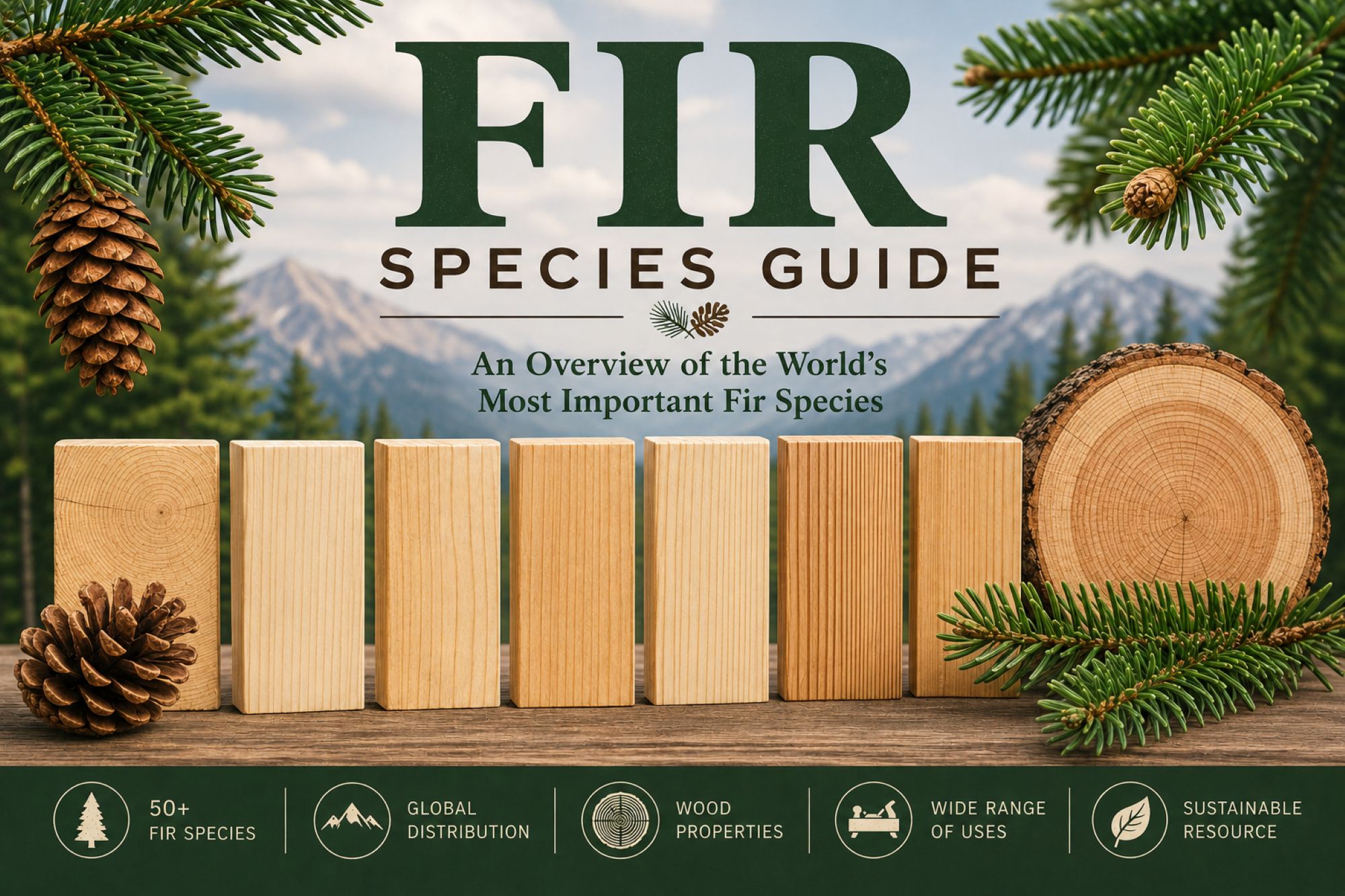
Fir Species Guide
Overview of major Fir species valued for their straight grain, dimensional stability, strength-to-weight ratio, and widespread use in construction, millwork, plywood, musical instruments, and specialty woodworking.
Overview
The Abies genus, commonly known as Fir, represents one of the world’s most important groups of commercial softwoods. Native primarily to the mountainous regions of North America, Europe, Asia, and North Africa, Fir species are prized for their light weight, straight grain, excellent workability, and reliable structural performance.
Although many people simply refer to lumber as “fir,” the genus contains more than 50 recognized species, each with its own appearance, density, growth characteristics, and geographic range. Douglas-fir, despite its name, is not a true fir and belongs to a separate genus.
This page serves as an overview of the Fir group and its most notable timber-producing species.
The Abies Genus
Abies belongs to the Pinaceae family, which also includes pines, spruces, cedars, larches, hemlocks, and Douglas-fir.
Many Fir species are known for:
- Straight grain
- Uniform texture
- Excellent dimensional stability
- Lightweight yet strong wood
- Easy machining
- Good nail and screw holding
- Excellent structural performance
- Fast growth in suitable climates
Because several species are harvested commercially and marketed together, lumber sold simply as “Fir” may originate from multiple closely related species.
Distribution and Habitat
Fir trees naturally occur throughout the cooler regions of the Northern Hemisphere.
Native populations are found across:
- North America
- Europe
- Asia
- North Africa
Most Fir species thrive in:
- Mountain forests
- Cool temperate climates
- High elevations
- Moist valleys
- Mixed conifer forests
Many species play an important ecological role while also supplying valuable commercial timber.
Notable Fir Species
The Fir group contains numerous species valued for construction, forestry, woodworking, and ornamental planting.
Featured Fir Species
Balsam Fir (Abies balsamea)
One of eastern North America’s best-known firs, Balsam Fir produces lightweight lumber and is also widely recognized as one of the most popular Christmas trees.
White Fir (Abies concolor)
Known for its pale wood, straight grain, and excellent workability, White Fir is commonly used in construction lumber, millwork, and interior applications.
Grand Fir (Abies grandis)
A large western North American species valued for dimensional lumber, plywood, and general construction.
Noble Fir (Abies procera)
Native to the Pacific Northwest, Noble Fir is prized both as a premium Christmas tree and for specialty lumber applications.
Silver Fir (Abies alba)
Europe’s best-known fir species, Silver Fir has long been used in structural timber, furniture, millwork, and musical instruments.
Additional Fir Species
North American Firs
- Pacific Silver Fir (Abies amabilis)
- California Red Fir (Abies magnifica)
- Subalpine Fir (Abies lasiocarpa)
- Corkbark Fir (Abies lasiocarpa var. arizonica)
- Fraser Fir (Abies fraseri)
- Rocky Mountain Fir (Abies bifolia)
- Bracted Fir (Abies bracteata)
- Arizona Fir (Abies arizonica)
European & Mediterranean Firs
- Greek Fir (Abies cephalonica)
- Bulgarian Fir (Abies borisii-regis)
- Spanish Fir (Abies pinsapo)
- Sicilian Fir (Abies nebrodensis)
- Nordmann Fir (Abies nordmanniana)
- Cilician Fir (Abies cilicica)
Asian Firs
- Japanese Fir (Abies firma)
- Momi Fir (Abies firma)
- Nikko Fir (Abies homolepis)
- Veitch Fir (Abies veitchii)
- Maries’ Fir (Abies mariesii)
- Korean Fir (Abies koreana)
- Manchurian Fir (Abies holophylla)
- Siberian Fir (Abies sibirica)
- Sakhalin Fir (Abies sachalinensis)
- Khingan Fir (Abies nephrolepis)
- Farges Fir (Abies fargesii)
- Delavay Fir (Abies delavayi)
- Himalayan Fir (Abies spectabilis)
- Bhutan Fir (Abies densa)
- Chinese Fir (Abies fabri)
- Forrest’s Fir (Abies forrestii)
- Yunnan Fir (Abies georgei)
- Fansipan Fir (Abies delavayi subsp. fansipanensis)
As additional Fir species are added to the Exotic Woods of the World archive, they will be incorporated into this guide and linked to their individual species pages.
Common Characteristics of Fir Woods
Although individual species vary, most Firs share several defining characteristics.
Common Fir Traits
- Softwood structure
- Straight grain
- Fine to medium texture
- Uniform appearance
- Low resin content
- Lightweight to medium density
- Excellent dimensional stability
- Good machining characteristics
- Moderate strength
- Good finishing properties
Fir wood is generally lighter in color than many other commercial softwoods and often lacks the prominent resin canals found in Pine.
Common Uses
Fir has long been valued for both structural and decorative applications.
Common Applications
- Construction lumber
- Framing
- Roof trusses
- Plywood
- Millwork
- Interior trim
- Doors
- Windows
- Furniture
- Veneer
- Musical instruments
- Paper pulp
- Packaging
- Engineered wood products
- Christmas trees
- General woodworking
Its excellent strength-to-weight ratio makes Fir one of the world’s most important structural softwoods.
Fir Identification Characteristics
Most Fir species share several visual characteristics that aid identification.
Common Identification Traits
- Pale cream to light brown heartwood
- Nearly white sapwood
- Straight grain
- Fine, even texture
- Small resin pockets
- Subtle growth rings
- Smooth, uniform appearance
- Mild odor
Species-level identification often requires examination of needles, cones, bark, and geographic origin in addition to the wood itself.
Sustainability and Conservation
Many Fir species remain common and are managed under sustainable forestry practices throughout their native ranges. However, some localized or endemic species have experienced population declines due to habitat loss, climate change, insects, or disease.
Sustainability considerations may vary depending on:
- Species
- Geographic region
- Forest management practices
- Harvest intensity
- Certification programs
Many commercially harvested Fir forests are managed under long-term sustainable forestry standards.
Woods Commonly Mistaken for Fir
Several commercially important woods include “fir” in their common names but are not true members of the Abies genus.
Notable Examples
- Douglas-fir (Pseudotsuga menziesii) — belongs to the genus Pseudotsuga and is one of North America’s most important structural timbers.
- Chinese Fir (Cunninghamia lanceolata) — belongs to the cypress family (Cupressaceae), not the true firs.
- Kauri (Agathis spp.) — sometimes compared with firs because of its appearance but belongs to the Araucariaceae family.
Related Wood Family and Trade Group Pages
Explore additional wood family and trade-group guides:
- Pine Species Guide
- Spruce Species Guide
- Cedar Species Guide
- Hemlock Species Guide
- Cypress Species Guide
- Wood Families & Trade Groups
Compare Wood Properties
Compare Fir woods alongside hundreds of hardwood and softwood species using the Exotic Woods of the World database.
Related resources:
- Wood Density and Janka Hardness Chart
- Hardest Woods in the World
- Most Dense Woods in the World
- Wood Grain Patterns and Figure Explained
Collector Notes
Fir represents one of the world’s most valuable groups of commercial softwoods. While often overshadowed by pine in public recognition, true firs provide some of the finest structural lumber available thanks to their straight grain, stability, and excellent strength-to-weight ratio.
Understanding the diversity within the Abies genus allows woodworkers, collectors, and forestry enthusiasts to appreciate a remarkable group of trees that have shaped construction, woodworking, and sustainable forestry throughout the Northern Hemisphere.