
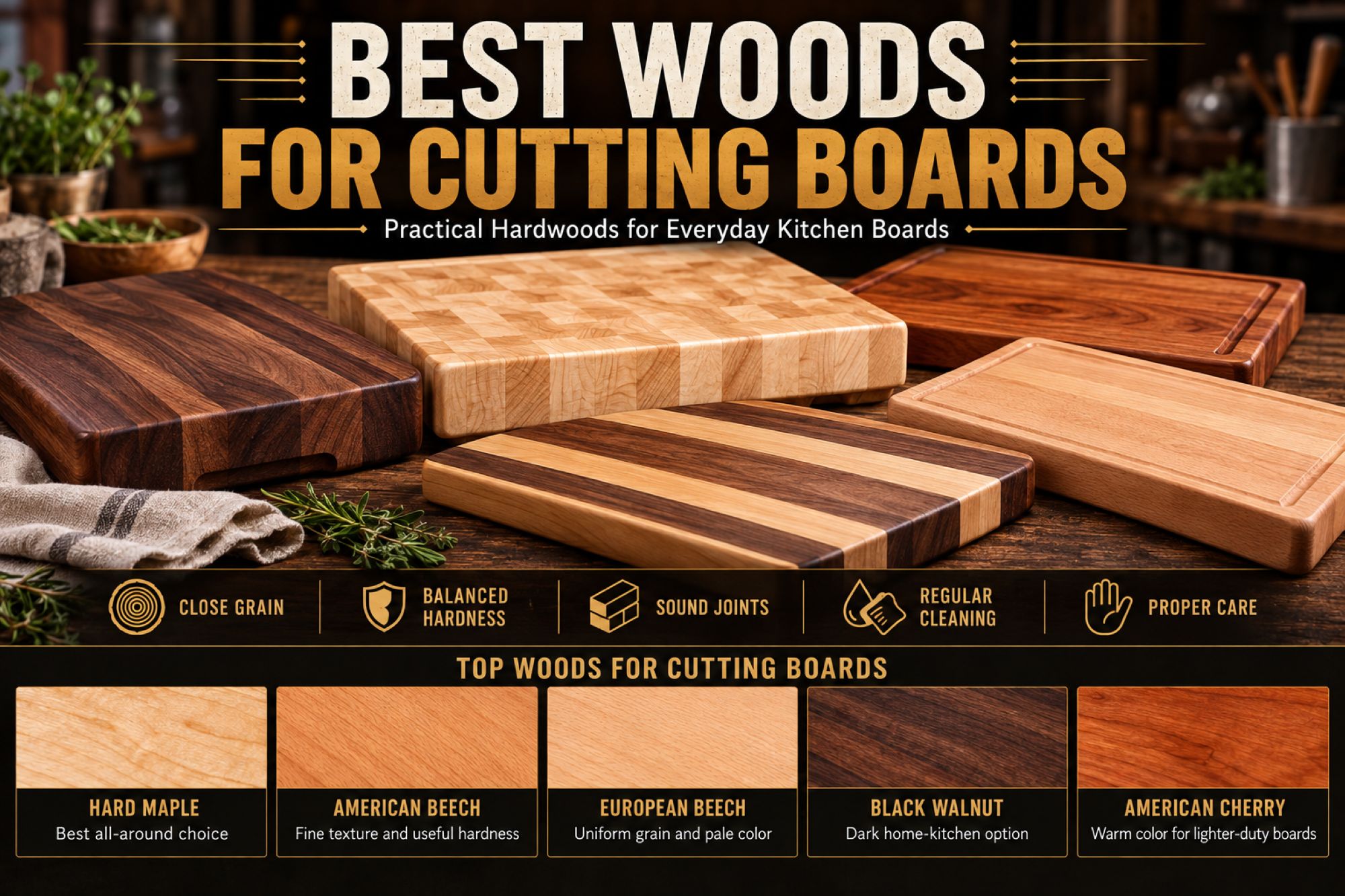
Best Woods for Cutting Boards
A comprehensive guide to selecting woods for cutting boards, including grain structure, hardness, stability, knife-edge considerations, construction, finishes, and everyday maintenance.
Overview
A cutting board needs more than attractive grain. It must provide a dependable cutting surface, tolerate repeated cleaning, and remain free from cracks and open joints that make maintenance difficult.
The best choices balance resistance to wear with practical workability and a surface suitable for regular knife contact.
Hard Maple is the strongest all-around starting recommendation. Beech is another practical choice, while Black Walnut and American Cherry offer attractive alternatives for home kitchens where their softer surfaces are acceptable.
Wood selection is only part of the result. Dry lumber, sound construction, suitable adhesive, and proper care are equally important.
What Makes a Good Cutting Board Wood?
Important Characteristics
- Fine, relatively close grain
- Adequate resistance to cutting and denting
- Sound wood without cracks or loose knots
- Reliable species identification
- Appropriate drying and conditioning
- Good glue-joint performance
- A smooth, maintainable surface
- Suitability for the intended food-contact application
The FDA Food Code specifically identifies Hard Maple or an equivalently hard, close-grained wood for cutting boards and related utensils. This is a model standard for food establishments, rather than blanket approval of every species used in home woodworking. Commercial users should check locally adopted requirements.
Best Overall Woods for Cutting Boards
Hard Maple / Sugar Maple (Acer saccharum)
Best overall recommendation
Hard Maple combines fine, diffuse-porous grain with useful hardness and an established history in butcher blocks and cutting boards.
Its light coloration also provides a straightforward appearance that works well in both simple and decorative designs.
Strengths
- Fine, uniform texture
- Good resistance to indentation
- Established cutting-board use
- Suitable for edge-grain and end-grain construction
- Attractive natural color
Considerations
- Requires sharp tools
- Can burn during machining
- Needs moisture-conscious construction and care
Representative Janka hardness: approximately 1,450 lbf.
American Beech (Fagus grandifolia)
A practical pale hardwood option
American Beech is worth considering when locally available clear stock offers good value. Select thoroughly dried material and plan carefully for moisture movement.
Strengths
- Fine-textured appearance
- Useful hardness
- Subdued grain
- Suitable for a traditional kitchen-board design
Considerations
- Drying quality matters
- Repeated wetting and uneven drying can cause problems
- Clear, sound stock is preferable to highly figured material
European Beech (Fagus sylvatica)
A useful European alternative
European Beech offers fine, even texture and pale cream to pinkish-brown coloration. Its diffuse-porous structure lacks the large earlywood pore bands found in ring-porous woods.
Strengths
- Fine, uniform grain
- Good machining and gluing characteristics
- Useful surface hardness
- Readily recognizable traditional appearance
Considerations
- Can move substantially with moisture changes
- Requires careful drying and storage
- Should not be selected for natural decay resistance
Representative Janka hardness: approximately 1,450 lbf.
Black Walnut (Juglans nigra)
Best recommendation for a dark home-kitchen board
Black Walnut is an appealing option when rich brown color is important. Its softer surface should be accepted as part of the choice rather than compared directly with Maple for wear resistance.
Strengths
- Dark natural appearance
- Strong decorative appeal
- Useful contrast with Maple
- Appropriate for carefully built home cutting and serving boards
Considerations
- Shows knife marks and dents more readily than Hard Maple
- Requires the same cleaning discipline as lighter woods
- Should not be presented as automatically equivalent to Hard Maple under commercial food codes
American Cherry (Prunus serotina)
Best recommendation for warm color
American Cherry is a useful home-board option when the design calls for warm reddish-brown tones and a relatively understated grain.
Strengths
- Warm natural coloration
- Attractive aging
- Useful decorative contrast
- Practical for lighter-duty cutting and serving boards
Considerations
- Softer than Hard Maple
- Develops visible cutting marks
- Requires regular inspection and maintenance
Walnut and Cherry are home-project recommendations here, rather than claims of universal commercial approval.
Quick Comparison
| Wood | Main Advantage | Main Consideration | Recommended Role |
|---|---|---|---|
| Hard Maple | Balanced hardness and fine grain | More demanding machining | Everyday cutting board |
| American Beech | Fine texture and useful hardness | Moisture movement | Traditional kitchen board |
| European Beech | Uniform grain and workable stock | Careful drying and care | Everyday board |
| Black Walnut | Dark decorative appearance | Softer cutting surface | Home cutting and serving board |
| American Cherry | Warm color | More visible knife wear | Lighter-duty home board |
These rankings are practical selections, not a substitute for evaluating the actual lumber and intended use.
Best Domestic Woods
For a North American project, start with:
A simple board made from well-selected stock is preferable to an elaborate board assembled from questionable offcuts.
Exotic Woods and Decorative Accents
An exotic hardwood’s usefulness for flooring, knife handles, or furniture does not establish its suitability for repeated cutting and food contact.
Before choosing an unfamiliar species, establish:
- Exact botanical identity
- Reliable evidence supporting its intended use
- Any relevant extractive, odor, or irritation concerns
- Gluing and finishing compatibility
- Whether its hardness suits the cutting surface
For a first board, Maple or Beech provides a more straightforward starting point than a collection of unidentified tropical woods.
A small decorative strip still forms part of the food-contact surface.
Edge Grain vs. End Grain
Edge-Grain Boards
Edge-grain boards present long-grain surfaces to the knife and are commonly assembled from parallel strips.
Advantages
- Straightforward layout
- Fewer fabrication steps
- Easier first-board project
- Practical material use
Recommendation: A good starting design for most beginning board makers.
End-Grain Boards
End-grain boards expose the ends of the wood fibers across the cutting surface.
Advantages
- Distinctive block-pattern appearance
- Substantial chopping-block designs
- Opportunities for decorative layouts
Considerations
- More glue joints
- More demanding flattening
- Careful grain alignment
- Greater fabrication complexity
End-grain boards are sometimes described as “self-healing,” but they still wear and require cleaning, inspection, and eventual resurfacing.
Hardness and Knife Edges
The hardest available wood is not automatically the best cutting-board material.
Consider the complete balance between:
- Board wear
- Cutting feel
- Knife maintenance
- Wood anatomy
- Surface condition
- Ease of resurfacing
Janka hardness measures resistance to indentation. It does not directly measure sanitation performance or establish how quickly a particular knife will dull.
Moisture and Construction
A board is repeatedly exposed to moisture during use and washing. Its design should allow for that reality.
Construction Priorities
- Use appropriately dried lumber.
- Acclimate stock before assembly.
- Remove defects from the cutting area.
- Prepare accurately fitted glue joints.
- Keep grain orientation consistent.
- Allow adhesive to cure fully.
- Flatten and smooth both faces.
Avoid trapping a moving solid-wood panel inside a rigid cross-grain frame.
Cutting Board Adhesives
Choose an adhesive whose manufacturer specifically permits the intended food-contact application after full cure.
Check:
- Whether cutting boards are an approved use
- Water-resistance classification
- Clamping requirements
- Full cure time
- Cleaning limitations
“Waterproof” alone is not a food-contact suitability statement. A suitable adhesive also cannot compensate for badly fitted joints.
Cutting Board Finishes
Food-Grade Mineral Oil
Food-grade mineral oil is a straightforward maintenance option. USDA guidance includes mineral oil among cutting-board care measures.
Apply according to the product instructions and remove excess.
Cutting Board Wax Blends
Commercial board conditioners often combine mineral oil and wax. Choose products intended for cutting boards and follow their directions.
Other Finishes
Do not assume every furniture oil, varnish, resin, or stabilized-wood treatment is appropriate for a surface repeatedly cut with knives.
Use only a system supported by its manufacturer for the intended application.
Finishing does not replace cleaning or make a board waterproof.
Woods and Materials to Approach Cautiously
Unidentified or Reclaimed Lumber
Avoid material with unknown species, treatment, contamination, or previous use.
Pressure-Treated Wood
Do not use construction lumber treated with preservatives for a food-preparation board.
Cracked, Decayed, or Loose-Knotted Stock
Defects can compromise both the surface and the structure.
Soft Construction Woods
Pine, Spruce, and similar soft stock are generally poor starting choices for a long-lasting everyday cutting surface.
Very Open-Grained Woods
Large pores and pronounced surface openings make these less straightforward choices than Maple or Beech. Oil alone does not convert an open surface into a permanently sealed one.
Resin-Stabilized Wood
A resin suitable for a knife handle should not automatically be assumed suitable for a cutting board.
Cleaning and Maintenance
USDA recommends washing cutting boards with hot, soapy water after use, rinsing, and drying them. Use separate boards for raw meat, poultry, and seafood and for foods such as produce and bread.
For wooden boards:
- Hand-wash promptly.
- Avoid prolonged soaking.
- Follow the maker’s cleaning instructions.
- Let the board dry with air reaching both faces.
- Recondition when needed.
- Inspect joints, cracks, and worn areas.
Hand-washing is the conservative choice for glued wooden boards; dishwasher heat and moisture can damage laminated construction.
Replace a board when wear creates grooves or cracks that cannot be effectively cleaned. Commercial rules may allow appropriate resurfacing where a sound, cleanable surface can be restored.
Cutting Boards vs. Serving Boards
A serving board may experience little knife contact. A working cutting board is repeatedly scored and washed.
Keep that distinction clear when selecting:
- Decorative accents
- Coatings
- Resin-filled features
- Live edges
- Handle shapes
- Surface details
A visually attractive serving piece is not automatically suitable for daily chopping.
Frequently Asked Questions
What is the best wood for cutting boards?
Hard Maple is the best all-around starting recommendation, combining useful hardness, fine grain, and established cutting-board use.
Is Walnut suitable?
Black Walnut is a practical home-board option when its darker appearance and softer surface suit the intended use. Do not assume that this establishes commercial-code acceptance.
Is Cherry suitable?
American Cherry can suit lighter-duty home boards and serving boards. Expect more surface marking than with Hard Maple.
Is Beech a good choice?
Beech is a useful candidate with fine texture and good hardness. Careful drying, sound construction, and moisture management matter.
Are end-grain boards always better?
No. An accurately made edge-grain board is preferable to a poorly constructed end-grain board.
Does oil sanitize a cutting board?
No. Conditioning and sanitation are different tasks.
Can wooden boards be used for raw meat?
USDA allows consumers to choose wood or suitable nonporous boards. Prevent cross-contamination through separation, cleaning, and maintenance.
Is a hardwood automatically suitable?
No. Botanical classification, hardness, and attractive appearance do not establish suitability for the intended food-contact use.
Final Recommendations
| Priority | Starting Recommendation |
|---|---|
| Best overall | Hard Maple |
| Pale traditional alternative | American or European Beech |
| Dark home-kitchen board | Black Walnut |
| Warm-colored lighter-duty board | American Cherry |
| First woodworking project | Simple Maple edge-grain board |
| Decorative chopping block | Carefully constructed Maple end-grain board |
| Commercial kitchen | Material and construction accepted by the applicable authority |
Related Guides
- Maple Species Guide
- Beech Species Guide
- Walnut Species Guide
- Wood Density & Janka Hardness Chart
- Best Woods for Knife Handles
Collector Notes
Cutting boards demonstrate that a useful wood is not necessarily the hardest, heaviest, or most vividly colored.
Maple, Beech, Walnut, and Cherry offer useful comparisons in texture, hardness, appearance, and wear. Keep reference samples separate from working kitchen boards, and document the species and construction of finished pieces.
For an everyday board, prioritize dependable material, sound joints, and a surface that can be maintained throughout its service life.