
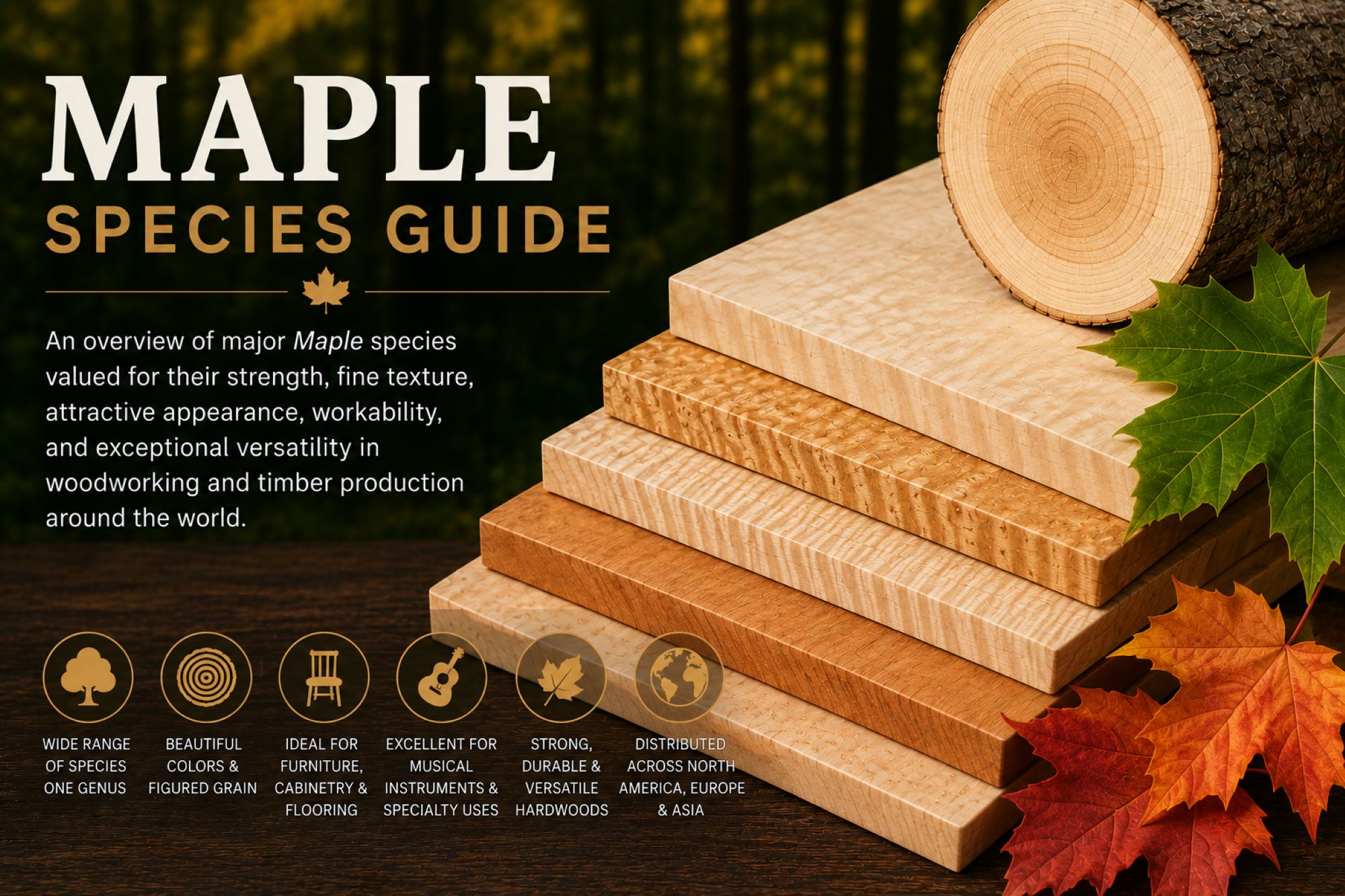
Maple Species Guide
Overview of major Maple species used in furniture making, flooring, cabinetry, musical instruments, specialty woodworking, and commercial timber production throughout the world.
Overview
The Acer genus, commonly known as Maple, contains some of the most important and widely used hardwood species in the world. Native primarily to North America, Europe, and Asia, Maple trees are valued for their strength, durability, attractive appearance, and exceptional versatility.
Maple wood has long been prized for furniture, flooring, cabinetry, butcher blocks, musical instruments, sporting goods, and decorative woodworking. Certain species are also famous for producing highly figured wood displaying birdseye, curly, quilted, and fiddleback patterns.
This guide serves as an overview of the broader Maple group and its most notable timber-producing species.
The Acer Genus
The Acer genus belongs to the Sapindaceae family and contains more than 130 recognized species distributed throughout the Northern Hemisphere.
Maple species are known for:
- Excellent strength properties
- Fine, uniform texture
- Attractive light coloration
- Good wear resistance
- Outstanding workability
- Decorative figured wood
- Strong commercial demand
- Valuable timber production
Many species are also important ornamental trees valued for their fall color and landscape appeal.
Notable Maple Species
The Maple genus contains numerous commercially important timber species.
Featured Maple Species
Sugar Maple (Acer saccharum)
The most commercially important North American Maple species, Sugar Maple is valued for flooring, furniture, cabinetry, butcher blocks, and sporting goods. It is also the primary source of maple syrup.
Red Maple (Acer rubrum)
A widespread North American species known for attractive coloration, versatility, and importance in both forestry and landscaping.
Silver Maple (Acer saccharinum)
A fast-growing species frequently used for furniture, millwork, and general woodworking applications.
Black Maple (Acer nigrum)
Closely related to Sugar Maple and often marketed alongside it in commercial lumber production.
Bigleaf Maple (Acer macrophyllum)
A Pacific Coast species famous for producing highly figured wood, including quilted and curly grain patterns.
Boxelder (Acer negundo)
A distinctive Maple species known for decorative figure, spalting, and unique coloration often used in turning and specialty woodworking.
The following species are notable members of the Acer genus and may be added to the Exotic Woods of the World archive in the future:
- Norway Maple (Acer platanoides)
- Sycamore Maple (Acer pseudoplatanus)
- Field Maple (Acer campestre)
- Japanese Maple (Acer palmatum)
- Amur Maple (Acer ginnala)
- Rocky Mountain Maple (Acer glabrum)
- Striped Maple (Acer pensylvanicum)
- Mountain Maple (Acer spicatum)
- Freeman Maple (Acer × freemanii)
- Vine Maple (Acer circinatum)
- Trident Maple (Acer buergerianum)
- Paperbark Maple (Acer griseum)
As additional Maple species are added to Exotic Woods of the World, they will be incorporated into this guide and linked to their individual species pages.
Common Characteristics of Maple Woods
Although individual species vary, many Maples share several recognizable characteristics.
Common Maple Traits
- Medium to high-density hardwood structure
- Fine, uniform texture
- Light cream to pale brown coloration
- Excellent machining characteristics
- Good wear resistance
- Strong dimensional stability
- Smooth finishing qualities
- Attractive figured grain potential
Many Maple species are among the most versatile hardwoods available to woodworkers.
Common Uses
Maple woods are used throughout the world in both residential and commercial applications.
Common Applications
- Furniture
- Cabinetry
- Flooring
- Butcher blocks
- Cutting boards
- Musical instruments
- Bowling alleys
- Sporting goods
- Millwork
- Turned objects
- Veneer
- Decorative woodworking
Their combination of durability and appearance makes them suitable for a wide range of projects.
Figured Maple
One of the most desirable aspects of Maple is its ability to produce spectacular figured wood.
Common figured forms include:
- Birdseye Maple
- Curly Maple
- Tiger Maple
- Fiddleback Maple
- Quilted Maple
- Flame Maple
These figured forms are highly prized for musical instruments, furniture, veneers, and collector-grade woodworking projects.
Identification Characteristics
Many Maple woods share visual characteristics that help distinguish them from other hardwood groups.
Common Identification Traits
- Cream to pale brown heartwood
- Fine, uniform texture
- Closed grain structure
- Smooth appearance
- Subtle growth rings
- Excellent finishing qualities
- Frequent decorative figure
Maple is often recognized by its clean appearance and exceptionally smooth texture.
Sustainability and Conservation
Most commercially harvested Maple species remain abundant throughout their native ranges and are managed through established forestry practices.
Sustainability considerations may vary depending on:
- Species
- Harvest region
- Forest management practices
- Certification programs
- Conservation regulations
Many Maple forests benefit from long-term sustainable forestry programs throughout North America, Europe, and Asia.
Related Wood Family and Trade Group Pages
Explore additional wood family and trade-group guides:
- Hickory Species Guide
- Eucalyptus Species Overview
- Acacia Species Guide
- Pterocarpus Species Guide
- Wood Families & Trade Groups
Compare Wood Properties
Compare Maple woods alongside hundreds of hardwood species using the Exotic Woods of the World database.
Related resources:
- Wood Density and Janka Hardness Chart
- Hardest Woods in the World
- Most Dense Woods in the World
- Wood Grain Patterns and Figure Explained
Collector Notes
Maple represents one of the most important hardwood groups in the world. From the hard and durable Sugar Maple to the spectacular figured wood of Bigleaf Maple, the Acer genus offers extraordinary diversity for collectors and woodworkers alike. Understanding the broader Maple group helps place individual species within their proper botanical context while highlighting the remarkable versatility that has made Maple a cornerstone of woodworking for centuries.