
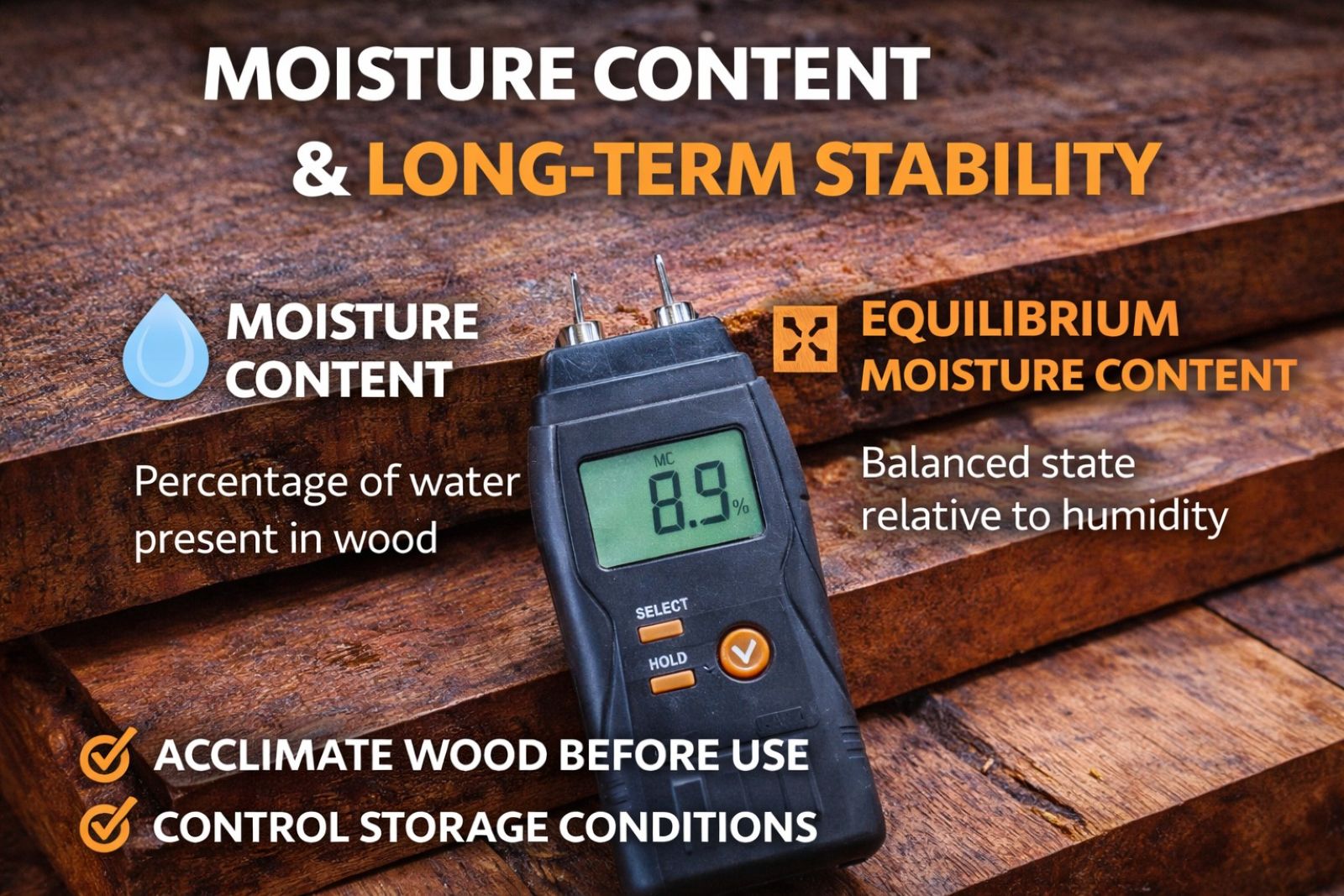
Moisture Content & Long-Term Stability
Moisture content is one of the most critical factors influencing the structural behavior of exotic hardwoods. Even dense tropical species respond to changes in humidity over time.
Understanding how moisture interacts with wood fiber structure is essential for long-term dimensional stability, joint integrity, and preservation.
This guide explains equilibrium moisture content, movement behavior, and how to maintain stability in both projects and collections.
What Is Moisture Content?
Moisture content (MC) is the percentage of water present in wood relative to its oven-dry weight.
For example:
If a board weighs 10 pounds dry and contains 1 pound of water, its moisture content is 10%.
Freshly cut wood may exceed 30–100% moisture content.
Properly dried interior hardwood typically ranges between:
6–9% MC, depending on region and climate.
Equilibrium Moisture Content (EMC)
Wood naturally seeks balance with surrounding air.
Equilibrium moisture content is the point at which wood is neither gaining nor losing moisture relative to ambient humidity.
EMC varies by climate.
For example:
Dry interior climates → lower EMC
Humid environments → higher EMC
Stable performance depends on allowing wood to reach equilibrium before use.
How Moisture Affects Stability
As moisture content changes, wood expands or contracts.
Movement occurs primarily across the grain, not along its length.
Effects may include:
- Warping
- Cupping
- Twisting
- Joint separation
- Surface checking
Dense tropical hardwoods may move less dramatically than softer species, but movement still occurs.
Radial vs Tangential Movement
Wood expands differently depending on grain orientation.
Tangential movement (flat-sawn boards) is typically greater than radial movement (quarter-sawn boards).
Understanding cut orientation helps predict dimensional behavior.
Quarter-sawn material generally exhibits:
- Improved stability
- Reduced cupping
- More uniform expansion
Why Density Does Not Eliminate Movement
High density does not mean zero movement.
Dense tropical hardwoods may:
- Resist compression
- Resist denting
- Still respond to humidity shifts
Moisture behavior is governed by cellular structure, not hardness alone.
While dense tropical hardwoods such as Ipe, Cumaru, Massaranduba, Jatoba, and White Oak often demonstrate strong mechanical performance, they still respond to humidity shifts over time. Even species known for dimensional stability must reach equilibrium moisture content before installation to prevent joint stress, seasonal movement, and long-term structural distortion.
Long-Term Stability in Finished Projects
In furniture and flooring:
- Improper acclimation leads to joint stress
- Seasonal humidity swings cause expansion and contraction
- Finish may slow moisture exchange but not prevent it
Allowing proper acclimation before installation is essential.
Storage Stability for Collectors
For wood sample collections:
Maintain:
Temperature between 60–75°F
Relative humidity between 35–55%
Avoid:
- Attics
- Basements without climate control
- Direct airflow vents
Stable environments reduce stress cycles.
Moisture Measurement Tools
Moisture meters provide practical monitoring.
Pin-type meters measure electrical resistance.
Pinless meters scan density and electromagnetic response.
For dense exotic species:
Calibration adjustments may be necessary.
Always confirm meter settings when possible.
Seasonal Movement Expectations
In temperate climates:
Winter → lower indoor humidity → shrinkage
Summer → higher humidity → expansion
Planning for seasonal movement prevents structural failure.
Design should allow controlled expansion space where appropriate.
Glue Joints and Moisture
Wood glued at improper moisture content may fail when equilibrium shifts.
For reliable bonding:
- Ensure boards are acclimated
- Avoid gluing overly wet lumber
- Maintain consistent workshop humidity
Stable moisture equals stable joints.
Long-Term Preservation Strategy
For archival purposes:
- Maintain consistent humidity
- Avoid repeated environmental cycling
- Inspect periodically for movement
- Document acquisition moisture if possible
Reducing stress cycles extends sample integrity.
Institutional Note
Moisture content is the primary driver of long-term dimensional behavior in hardwoods. Density, hardness, and grain structure influence performance, but stability ultimately depends on environmental equilibrium. Proper acclimation and controlled storage conditions are fundamental to both structural reliability and archival preservation.
Compare Wood Properties
See how different species rank in density and hardness using our Wood Density & Janka Hardness Chart. You can also explore Hardest Woods, Softest Woods, and Most Dense Woods for quick comparisons
Sourcing Materials:
Looking to find these species or similar materials? View recommended suppliers on our Where to Buy Exotic Woods page.
Building a Collection:
For those building a physical reference library, explore our Wood Collecting & Preservation guide.