
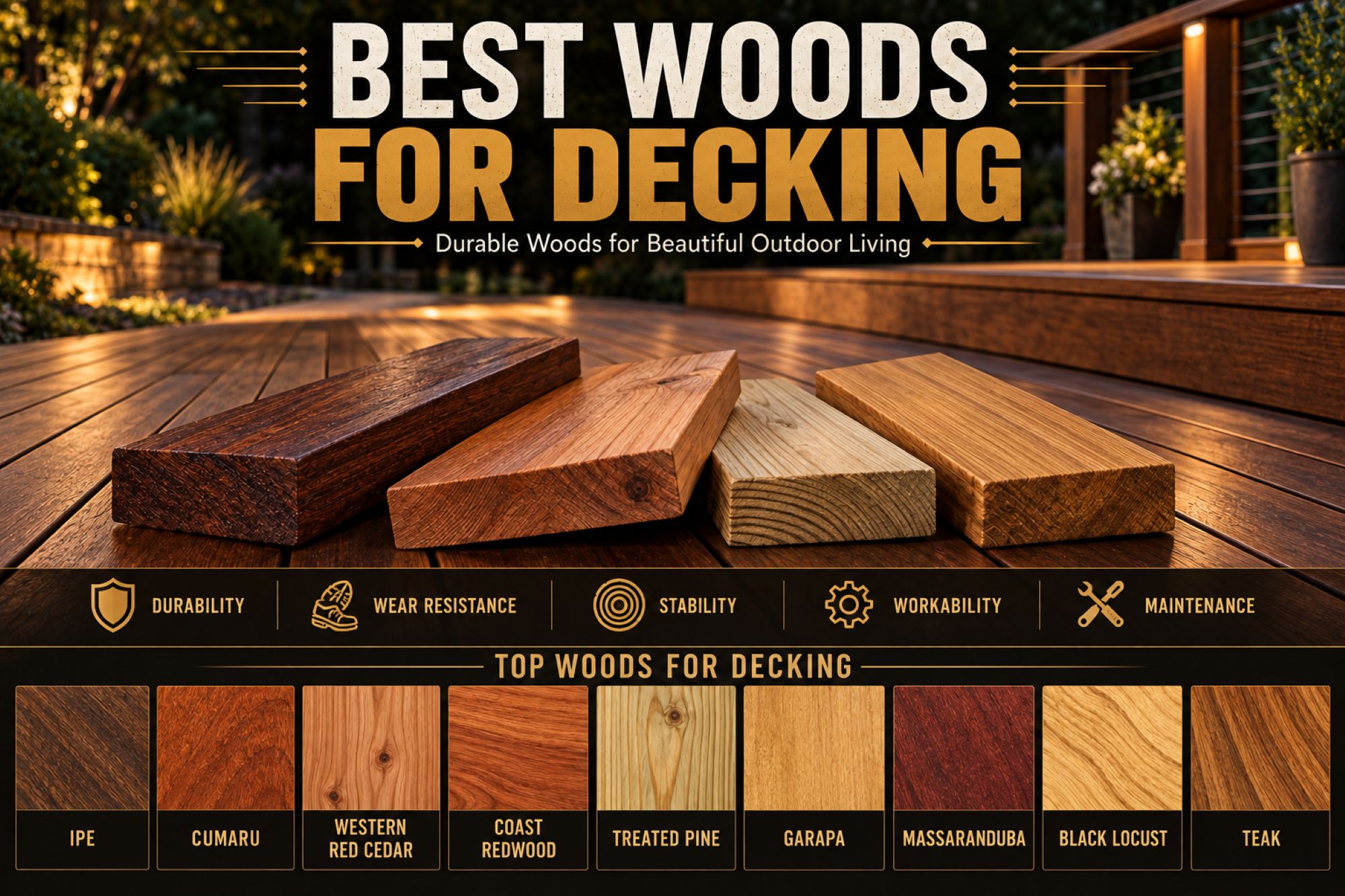
Best Woods for Decking
Explore durable woods for outdoor decks, comparing weather resistance, appearance, workability, maintenance, and practical installation considerations.
Overview
Decking faces demanding conditions. Rain, sunlight, changing humidity, foot traffic, and repeated wetting and drying can affect even high-quality lumber.
The best decking wood depends on your climate, budget, preferred appearance, and willingness to maintain the surface. Dense tropical hardwoods offer excellent wear resistance, while cedar and redwood provide lighter, easier-to-work alternatives. Properly pressure-treated lumber remains a practical option when affordability and availability matter.
This guide focuses on walking surfaces. Posts, beams, joists, connections, and foundations require their own structural specifications.
What Makes a Good Decking Wood?
A successful decking material combines several useful characteristics:
- Decay resistance: Natural heartwood durability or suitable preservative treatment.
- Wear resistance: Ability to withstand foot traffic, furniture, and everyday use.
- Dimensional stability: Manageable movement as moisture conditions change.
- Surface quality: Boards that can be maintained without excessive splintering or checking.
- Practical availability: Suitable grades, lengths, thicknesses, and replacement boards.
- Workability: Installation requirements that fit the project’s tools and budget.
Natural decay resistance varies among species and between heartwood and sapwood. A durable species name alone does not guarantee that every board will perform equally well.
Best Overall Woods for Decking
Ipe
Best for: Premium hardwood decking and demanding walking surfaces
Ipe is a leading choice for projects that prioritize durability, strength, and resistance to surface wear. Its olive-brown to dark brown coloring creates a rich, substantial appearance.
The name Ipe covers several closely related commercial timber species, so appearance and properties can vary between shipments.
Strengths
- Excellent natural heartwood durability.
- Very high resistance to dents and everyday wear.
- Rich brown coloring.
- Established use in exterior decking and boardwalks.
Considerations
Ipe is heavy and demanding to machine. Predrilling and appropriate tooling add installation time. Maintaining its brown color also requires ongoing finish maintenance; unfinished boards gradually weather gray.
Best applications: Premium residential decks, steps, and heavily used outdoor walking surfaces.
Cumaru
Best for: Dense hardwood decking with warm color variation
Cumaru offers a hard, substantial surface with golden-brown to reddish-brown coloring. It is often considered alongside Ipe when comparing tropical hardwood decking.
Strengths
- High surface hardness.
- Durable heartwood.
- Attractive variation between boards.
- Suitable for demanding exterior applications.
Considerations
Cumaru requires careful attention to moisture condition, board selection, fastening, and spacing. Its density makes installation more demanding than cedar or treated pine.
Best applications: Residential hardwood decks and outdoor spaces where warm color and wear resistance are priorities.
Western Red Cedar
Best for: Lightweight decking and straightforward woodworking
Western Red Cedar provides a lighter alternative to dense tropical hardwoods. Its reddish-brown tones and distinctive grain suit traditional decks, garden spaces, and woodland settings.
Strengths
- Lightweight and relatively easy to cut and fasten.
- Naturally decay-resistant heartwood.
- Attractive grain and color.
- Easier handling during installation.
Considerations
Cedar dents and scratches more readily than dense hardwoods. Heartwood content and lumber grade matter, and a suitable penetrating deck finish can help preserve the desired appearance.
Best applications: Residential decks, garden decks, and projects where ease of handling matters.
Coast Redwood
Best for: Traditional decking with warm natural color
Coast Redwood is valued for its reddish coloring, relatively low weight, and workable nature. It is especially worth considering where quality decking grades are locally available.
Strengths
- Attractive red to reddish-brown heartwood.
- Easy machining compared with dense tropical hardwoods.
- Naturally durable heartwood.
- Well-established outdoor use.
Considerations
Redwood is softer than many hardwood decking options. Select the grade carefully, particularly when comparing heartwood-rich boards with lumber containing substantial sapwood.
Best applications: Residential decks, patios, and outdoor living spaces with a traditional wood appearance.
Pressure-Treated Pine
Best for: Budget-conscious decking and broad availability
Pressure-treated pine is a practical choice for many residential decks. Its exterior performance comes from preservative treatment rather than exceptional natural decay resistance.
Southern Pine is commonly used in the United States, although the species and treatment systems available vary by region.
Strengths
- Often an economical starting option.
- Widely available in standard decking sizes.
- Relatively easy to cut and install.
- Replacement boards are commonly accessible.
Considerations
Inspect the treatment label and select material suitable for its intended exposure. Wet treated boards can shrink as they dry, so installation spacing must account for their moisture condition.
Fasteners and connectors must also be compatible with the treatment system. Treatment requirements for framing and ground-contact components may differ from those for the walking surface.
Best applications: General residential decks and projects where initial cost and local supply are major considerations.
Additional Woods Worth Considering
Garapa
Best for: A lighter-colored tropical hardwood deck
Garapa offers golden-yellow to honey-brown coloring for homeowners who want a hardwood deck without the darker appearance of Ipe.
It provides a hard walking surface and is commercially used for exterior decking. Predrilling and suitable tooling remain important.
Main consideration: Select decking-grade material and follow the supplier’s installation instructions.
Massaranduba
Best for: Dense decking with a reddish-brown appearance
Massaranduba is a heavy tropical hardwood used where a hard surface and rich color are desirable.
Main consideration: Its density and moisture movement require careful installation. Board dimensions, ventilation, fastening, and spacing deserve particular attention.
Black Locust
Best for: Naturally durable North American hardwood decking
Black Locust is a useful option for buyers seeking a hard, naturally durable domestic hardwood. Its yellow-green to brown heartwood develops a more subdued appearance with exposure.
Main consideration: Decking supply can be regional. Straight, well-dried boards in consistent lengths may require a specialist supplier.
Teak
Best for: Specialty projects where appearance and stability justify the cost
Teak combines attractive golden-brown coloring with established exterior uses. It can suit smaller luxury decks and carefully detailed outdoor spaces.
Main consideration: Grade, origin, heartwood content, and price vary substantially. Compare the actual lumber offered rather than relying on the name alone.
Quick Decking Wood Comparison
| Wood | Main advantage | Main consideration | Suggested use |
|---|---|---|---|
| Ipe | Durability and wear resistance | Heavy; demanding installation | Premium decks and busy walking surfaces |
| Cumaru | Hard surface and warm color | Moisture movement and careful fastening | Residential hardwood decks |
| Western Red Cedar | Low weight and easy workability | Dents more easily | Garden and residential decks |
| Coast Redwood | Traditional appearance and easy machining | Grade and heartwood content | Residential outdoor living spaces |
| Pressure-Treated Pine | Affordability and availability | Treatment rating and drying movement | Budget-conscious decks |
| Garapa | Golden hardwood appearance | Dense material requiring suitable tooling | Lighter-colored hardwood decks |
| Massaranduba | Hard surface and reddish coloring | Movement and installation requirements | Carefully installed hardwood decks |
| Black Locust | Durable domestic heartwood | Regional supply and board quality | Domestic hardwood decking |
| Teak | Exterior performance and appearance | Cost and variable grades | Specialty decks |
These are practical selection categories. Actual performance depends on the lumber supplied, site conditions, and installation.
Hardness vs. Decay Resistance
Hardness describes resistance to indentation. It does not directly measure resistance to fungal decay.
A hard wood may resist chair legs and dropped objects while still performing poorly in persistently damp conditions. Conversely, a softer wood can have useful natural decay resistance.
Use hardness to compare likely denting and surface wear. Evaluate outdoor durability separately through species properties, heartwood content, treatment, and moisture management.
Choosing Deck Boards
Check the Grade
Look for boards sold and graded for decking. Evaluate knots, splits, grain irregularities, distortion, and the quality of the walking face.
For naturally durable woods, ask about heartwood content.
Compare Installed Cost
Lumber price is only part of the project.
Include:
- Delivery and material waste.
- Fasteners and fastening systems.
- Predrilling and tooling.
- Installation labor.
- Finishing and future maintenance.
A dense hardwood that costs more to install may still suit the project, but compare complete estimates.
Consider Local Conditions
A shaded, damp deck behaves differently from one exposed to strong sun and steady airflow.
Discuss drainage, ventilation, moisture conditions, and the intended fastening system with the decking supplier before ordering.
Buy From a Traceable Source
For imported hardwoods, request reliable species identification and sourcing documentation. Clear product information also makes it easier to obtain matching replacement boards later.
Installation Details That Matter
Good material selection works best alongside good construction.
- Provide drainage: Avoid details that trap water or debris.
- Allow airflow: Restricted ventilation can create uneven moisture conditions.
- Use appropriate spacing: Follow instructions for the species, board dimensions, and moisture condition supplied.
- Use compatible fasteners: Match them to the wood, preservative treatment, exposure, and fastening system.
- Predrill where required: Especially near board ends and in dense hardwoods.
- Follow approved span guidance: Board thickness and species affect permissible support spacing.
Do not assume the same installation method suits every decking product. Structural framing and connections should follow locally applicable requirements.
Finishing and Maintenance
Keeping the Original Color
A suitable pigmented penetrating deck finish can help retain a brown, red, or golden appearance. Reapplication depends on sunlight, weather, foot traffic, surface preparation, and the finish used.
Clear finishes generally provide less protection against color change than appropriately pigmented products.
Allowing Natural Weathering
Unfinished wood commonly develops a gray surface outdoors. This can be an intentional appearance choice, but the deck still needs cleaning and inspection.
Cleaning the Surface
Remove leaves and debris, keep gaps clear, and use a cleaning method appropriate for the wood. Aggressive pressure washing can damage the surface, particularly on softer decking.
Inspecting for Wear
Periodically check for raised fasteners, damaged boards, splinters, and areas that remain damp. Repair problems before they spread.
Frequently Asked Questions
What is the best wood for decking overall?
Ipe is a strong candidate when durability and wear resistance are the main priorities. Cedar, redwood, and pressure-treated pine may be better fits when weight, workability, availability, or budget matter more.
What is the best budget decking wood?
Properly specified pressure-treated pine is often a practical starting point. Compare local installed prices and account for future maintenance.
Is cedar better than pressure-treated pine?
Cedar offers low weight, easy machining, and naturally durable heartwood. Pressure-treated pine often offers a lower initial cost and broad availability. The better choice depends on grade, exposure, appearance, and budget.
Can untreated pine be used for an exposed deck?
Ordinary untreated pine should not be assumed to provide adequate decay resistance. Choose an appropriately treated decking product or a suitable naturally durable alternative.
Does decking need to be oiled every year?
There is no universal schedule. Follow the finish manufacturer’s guidance and assess the surface condition. Maintaining the original color usually requires more finish upkeep than accepting natural weathering.
Which decking wood is best around a pool?
Choose based on surface condition, drainage, maintenance, and the specific product’s suitability for the setting. No wood should be assumed slip-proof when wet or covered with algae.
How long will a wood deck last?
There is no dependable lifespan based on species alone. Lumber quality, moisture exposure, construction, maintenance, and the condition of the supporting structure all influence service life.
Recommended Choices by Project
| Project priority | Woods to consider |
|---|---|
| Premium durability and wear resistance | Ipe, Cumaru |
| Lighter tropical hardwood color | Garapa |
| Easy handling and machining | Western Red Cedar, Coast Redwood |
| Lower initial cost | Pressure-Treated Pine |
| Naturally durable domestic hardwood | Black Locust |
| Reddish-brown hardwood appearance | Cumaru, Massaranduba |
| Specialty luxury project | Teak |
Related Guides
- Best Woods for Outdoor Use
- Cedar Species Guide
- Pine Species Guide
- Wood Density & Janka Hardness Chart
- Wood Families & Trade Groups
Collector Notes
Decking samples offer useful comparisons between dense tropical hardwoods, lightweight naturally durable softwoods, and preservative-treated lumber.
Keep an unexposed reference sample alongside a weathered piece when possible. Record the species, supplier, treatment or finish, and exposure conditions. These details help explain changes in color, texture, checking, and surface wear over time.