

Ceylon Ebony
Scientific name: Diospyros ebenum
Overview
Ceylon Ebony is one of the most historically prized ebony species in the world. Native to Sri Lanka and parts of southern India, it is renowned for its deep black heartwood, fine texture, and exceptional density.
Historically used in fine furniture, carving, and luxury decorative work, Ceylon Ebony has long been associated with high craftsmanship and ornamental woodworking.
Quick Facts
- Common Name: Ceylon Ebony
- Scientific Name: Diospyros ebenum
- Region: Asian Hardwoods (Sri Lanka & Southern India)
- Tree Size: 60–80 ft tall, 1–2 ft trunk diameter
- Average Dried Weight: 65 lbs/ft³ (1,040 kg/m³)
- Janka Hardness: 3,220 lbf
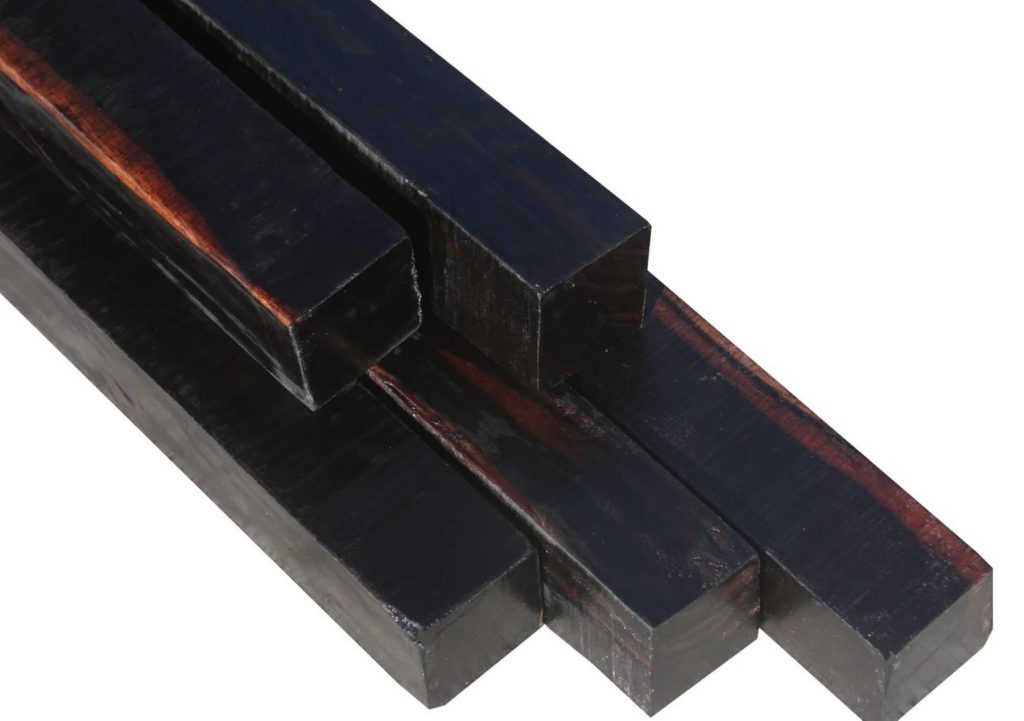
- Color: Jet black heartwood, sometimes with dark brown streaks
- Grain: Usually straight
- Texture: Very fine and smooth
Identification Characteristics
Ceylon Ebony is identified by its rich black heartwood and fine, uniform texture. It is often very consistent in color, though occasional brown streaking may appear.
It is typically very smooth when finished due to its tight grain.
Key identification traits include:
- Deep black heartwood
- Fine, even texture
- Heavy and dense feel
- Minimal visible grain pattern
- Strong contrast with pale sapwood

Working Properties
Ceylon Ebony is dense and can be difficult to machine.
- Dulls cutting tools quickly
- Requires sharp carbide tooling
- Sands to a polished, glass-like finish
- Excellent for carving and turning
- Pre-drilling required for fasteners
Its density allows for precise detailing in small components.
Safety Note
Dust from Ceylon Ebony may cause skin irritation or respiratory sensitivity. Fine dust particles are common when sanding. Proper dust collection and respiratory protection are recommended.
Common Uses


Ceylon Ebony is commonly used in:
- Fine furniture
- Carving
- Musical instruments
- Decorative inlay
- Turned objects
Its uniform black appearance makes it especially valued in high-end decorative work.
Ceylon Ebony has historically been associated with luxury and ornamental craftsmanship.
Sustainability & Notes
Ceylon Ebony has faced harvesting pressure due to its desirability. Availability may be limited, and trade regulations may apply depending on region.
Responsible sourcing and documentation are strongly encouraged.
Comparative Notes & Related Species
Macassar Ebony – Another ebony species known for its dark coloration with contrasting brown streaks, commonly used in musical instruments and fine decorative woodworking.
Mun Ebony – A dense Southeast Asian ebony valued for its deep dark color and use in carving, turning, and specialty woodworking.
Cocuswood – A very hard tropical hardwood prized for its dark color and historical use in fine furniture and decorative objects.
Related Guides
How to Start a Wood Collection
Highlights the importance of collecting rare and historically significant Asian species like Ceylon Ebony as part of a curated wood sample collection due to its density, color, and limited availability.
Gluing Exotic Woods: Challenges and Solutions
Learn how to properly prepare and bond dense, oily hardwoods to achieve strong, reliable glue joints in exotic wood projects.
Understanding CITES & Protected Species
Many ebony species are protected or regulated due to historical overharvesting and conservation concerns.
Compare Wood Properties
See how this species ranks in density and hardness using our Wood Density & Janka Hardness Chart. You can also explore Hardest Woods, Softest Woods, and Most Dense Woods for quick comparisons.
Collector Notes
Ceylon Ebony is highly valued among collectors for its historic use and deep black coloration. Boards with consistent color and minimal defects are typically preferred.
Well-seasoned material is especially desirable due to reduced risk of cracking.
Share Your Photos of This Species
Do you have lumber, wood samples, tree photographs, woodworking projects, furniture, carvings, turnings, musical instruments, or other items made from this species?
Exotic Woods of the World welcomes photographs from woodworkers, collectors, sawyers, researchers, and wood enthusiasts around the world. Selected submissions may be featured on this page and throughout our website to help document and showcase real-world examples of this species.
When submitting photos, please include the common name, scientific name (if known), a brief description, and any information you would like us to share with the image.
Wood Sample Collection
This species is part of an ongoing effort to document and preserve wood samples from around the world.
Learn more about contributing to the collection:
Resources
Authoritative botanical and forestry references used in compiling information about this species include:
• USDA Forest Service – Wood Handbook: Wood as an Engineering Material
https://www.fpl.fs.usda.gov/products/publications/
• The Wood Database – Global reference for wood identification, physical properties, and woodworking characteristics
https://www.wood-database.com/
• Royal Botanic Gardens, Kew – Plants of the World Online – Botanical taxonomy and species distribution database
https://powo.science.kew.org/
• International Union for Conservation of Nature (IUCN Red List) – Global conservation status assessments
https://www.iucnredlist.org/
• Convention on International Trade in Endangered Species (CITES) – International trade regulations for protected plant species
https://cites.org/
Additional forestry publications, academic research papers, and regional timber studies may also be referenced where available.
Love This Species?
Enjoy learning about this wood species?
Help support the continued growth of Exotic Woods of the World by participating in our Adopt a Species program. Your support helps fund species research, educational content, photography, videos, and future conservation awareness initiatives.
Support Forest Conservation
This species is part of the growing Exotic Woods of the World reference archive, dedicated to documenting and preserving knowledge of the world’s wood species.
Through the Adopt a Species program, visitors can help support ongoing species research, educational content, photography, video production, and future conservation awareness initiatives.
Contributions help fund the continued expansion of this archive while promoting sustainable forestry education and the long-term appreciation of the world’s forests.
Interested in supporting this species? Visit our Adopt a Species and Conservation Partners pages to learn more.
Availability & Where to Buy
Exotic hardwood availability can vary significantly depending on region, sustainability regulations, and supplier inventory.
As this archive grows, recommended suppliers and specialty wood retailers will be listed here to help woodworkers locate responsibly sourced material.
Lumber Suppliers:
Availability varies — see the Where to Buy Exotic Woods page for current sources.
Related Tools & Products:
• Gorilla All Purpose Wood Filler, Natural Finish (16 oz) for filling cracks, holes, gouges, and imperfections before sanding, staining, or painting woodworking projects
https://amzn.to/3R3eCCg
• DEWALT DPG82 Concealer Anti-Fog Safety Goggles for protecting your eyes from sawdust, wood chips, and flying debris during cutting, sanding, and routing
https://amzn.to/4uTlqQZ
• WORKPRO Folding Roller Stand with Adjustable Height for supporting long boards, plywood, and lumber during table saw, miter saw, and woodworking operations
https://amzn.to/4eKR2lO
Share This Wood Species
Stay Connected
Follow the latest species additions, educational resources, videos, conservation initiatives, and major project milestones through our Site Updates archive.
The Site Updates archive provides a permanent record of new content, library growth, and future developments across Exotic Woods of the World.