
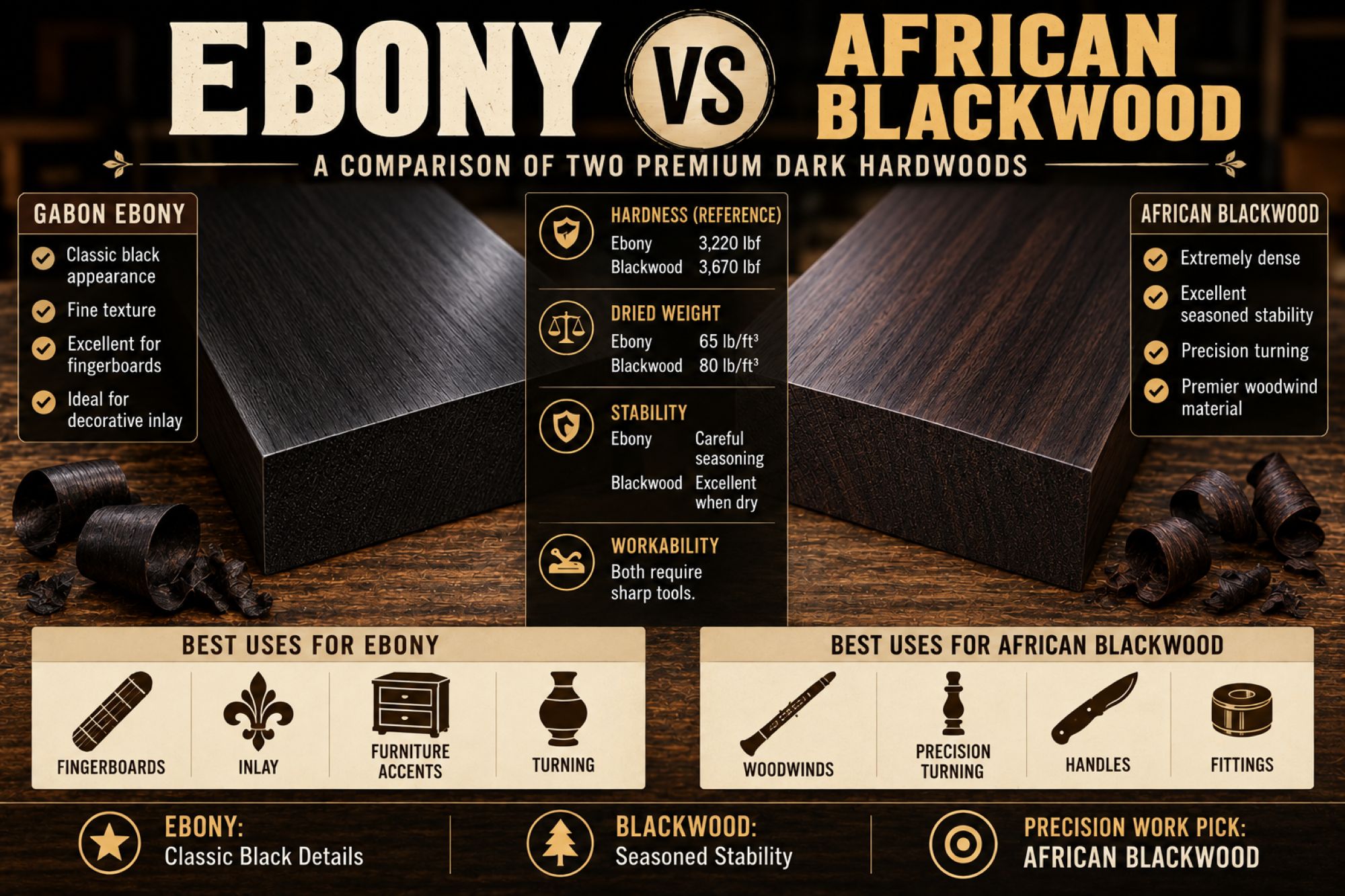
Ebony vs. African Blackwood
A side-by-side comparison of Ebony and African Blackwood, two exceptionally dense, dark hardwoods valued for musical instruments, precision turning, carving, knife handles, inlay, and fine decorative work.
Overview
Ebony and African Blackwood can look remarkably similar, but they belong to different botanical families and behave differently during drying, machining, and use.
Ebony includes numerous species within Diospyros. For this comparison, Gabon Ebony (Diospyros crassiflora)—also called Gaboon Ebony—serves as the benchmark.
African Blackwood (Dalbergia melanoxylon) belongs to the rosewood genus. It is also known as Grenadilla or Mpingo.
Both can produce nearly black surfaces and finely detailed objects. African Blackwood is generally heavier and particularly important for woodwind instruments, while Ebony has a longstanding role in fingerboards, decorative details, and polished black components.
The recommendations below apply to these two benchmarks. They should not be extended automatically to every wood marketed as Ebony.
Species Overview
| Characteristic | Gabon Ebony | African Blackwood |
|---|---|---|
| Scientific name | Diospyros crassiflora | Dalbergia melanoxylon |
| Family | Ebenaceae | Fabaceae |
| Botanical group | True ebony | Rosewood genus |
| General appearance | Black to black-brown, sometimes streaked | Dark brown to purplish-black |
| Texture | Fine | Very fine and even |
| Representative dried weight | Approximately 65 lb/ft³ | Approximately 80 lb/ft³ |
| Published Janka reference value | Approximately 3,220 lbf | Approximately 3,670 lbf |
| Typical specialty role | Fingerboards, inlay, decorative components | Woodwinds, precision turning, small components |
The hardness figures are reference values published in the species profiles. Test methods and reported results vary between references; they should not be treated as measurements of every piece.
Appearance
Ebony
Selected Gabon Ebony can provide a nearly uniform black surface. Other pieces contain brown coloration or visible streaking.
African Blackwood
African Blackwood can also appear nearly black, with brown or purplish undertones becoming more apparent under strong lighting.
🏆 Appearance Winner: Tie
Select the actual blank for its appearance rather than assuming either species guarantees uniform black.
Grain & Texture
Both woods can produce smooth surfaces with understated grain.
For a small polished object, the condition and grain direction of the individual blank may matter more than the difference between their already fine textures.
🏆 Grain & Texture Winner: Tie
Hardness
The published reference figures place African Blackwood above Gabon Ebony. Both, however, are exceptionally hard woodworking materials.
Neither requires a hardness advantage to qualify for demanding small components.
🏆 Reference Hardness Winner: African Blackwood
Hardness alone does not establish toughness, resistance to cracking, or suitability for a particular design.
Density
African Blackwood is generally the heavier material. PROTA reports heartwood density of approximately 1,230–1,330 kg/m³ at 12% moisture content, compared with approximately 900–1,010 kg/m³ for Gabon Ebony.
🏆 Higher Density Winner: African Blackwood
For portable objects or larger components, additional weight may be a disadvantage.
Natural Durability
African Blackwood heartwood is described as very durable in the PROTA account. Gabon Ebony is described as moderately durable.
These ratings concern biological deterioration and should be distinguished from resistance to dents or abrasion.
🏆 Natural Durability Winner: African Blackwood
Neither should be regarded as waterproof.
Dimensional Stability
African Blackwood has a strong advantage once properly seasoned. Its reported shrinkage is comparatively low, and it is described as very stable in service.
Gabon Ebony requires particular care during drying and can remain movement-prone. Its higher shrinkage and checking risk deserve attention in precision work.
🏆 Stability Winner: African Blackwood
Proper seasoning remains essential for both.
Workability
Ebony
Plan for:
- Slow material removal
- Sharp cutting edges
- Careful grain inspection
- Predrilled fastener holes
- Close inspection for checks
African Blackwood
Plan for:
- Substantial cutting resistance
- Frequent attention to tool sharpness
- Careful handling of thin sections
- Thoroughly seasoned blanks
- Trial cuts before final shaping
Both woods are demanding. African Blackwood’s greater density does not automatically prevent clean machining, while Ebony’s lower weight does not make it easy to work.
🏆 Workability Winner: No Clear Winner
Turning
For precision spindle work, small decorative components, and intricate profiles, African Blackwood is the recommended starting choice.
Ebony remains an excellent alternative when the design calls for a particular black appearance or matching existing Ebony parts.
🏆 Precision Turning Recommendation: African Blackwood
This recommendation assumes sound, dry stock and suitable tooling.
Carving
Both woods reward careful work but resist rapid hand-tool shaping.
For larger carvings, compare usable blank size and grain direction first. For small detailed objects, select the clearest blank available rather than relying solely on the species name.
🏆 Carving Winner: Blank-Dependent
Gluing
Both require a tested bonding procedure. African Blackwood’s oily surface makes adhesive compatibility and surface preparation particularly relevant.
Use freshly prepared surfaces and follow the adhesive manufacturer’s instructions. Test a representative joint before assembling a valuable component.
🏆 Gluing Winner: Process-Dependent
Finishing
Either wood can be polished to a refined surface. A heavy film finish is not always necessary to achieve the desired appearance, but the appropriate treatment depends on the object.
Test coatings for:
- Adhesion
- Complete curing
- Color change
- Surface feel
- Compatibility with intended use
🏆 Finishing Winner: Tie
Natural Black Color
Ebony is the recommended first choice when the design specifically calls for a visually uniform black accent.
African Blackwood can provide a similar effect, but the actual piece may show more noticeable undertones.
🏆 Uniform Black Appearance Recommendation: Selected Ebony
Inspect samples under the lighting in which the finished object will be used.
Furniture
For either wood, consider small applications such as:
- Pulls
- Knobs
- Edging
- Inlaid details
- Feet
- Decorative fittings
Ebony is the practical recommendation for conventional black furniture accents. African Blackwood is particularly appealing for individually turned fittings.
🏆 Furniture Accent Recommendation: Ebony
Cabinetry
Using either species extensively in solid cabinetry demands careful consideration of stock dimensions, weight, movement, and usable yield.
Small decorative details usually provide the most practical application.
🏆 Cabinetry Recommendation: Ebony for Accents
Neither is the default choice for an entire cabinet.
Flooring
A high hardness value alone does not make a wood a practical flooring choice.
For these materials, assess supply, dimensions, installation requirements, movement, and replacement stock before considering more than decorative detailing.
🏆 General Flooring Recommendation: Neither
Knife Handles
Both are candidates for compact, dark handles.
African Blackwood receives the recommendation where seasoned stability is the priority. Ebony remains attractive where matching a specific appearance or existing material is important.
🏆 Knife Handle Recommendation: African Blackwood
Grain orientation, attachment, and freedom from cracks remain essential.
Musical Instruments
Ebony
Gabon Ebony has documented uses in:
- Guitar fingerboards
- Piano black keys
- Other instrument components
African Blackwood
African Blackwood is especially associated with:
- Clarinets
- Oboes
- Bagpipes
- Precision woodwind components
Their roles are complementary rather than interchangeable. Instrument makers select materials according to the particular component and its service conditions.
🏆 Woodwinds Winner: African Blackwood
🏆 Fingerboard Recommendation: Ebony
Decorative Inlay
Ebony is the recommended starting choice for black lines, geometric details, and contrasting borders.
African Blackwood can also serve well, particularly when matching other components made from the same stock.
🏆 Inlay Recommendation: Ebony
Decorative Boxes
Consider Ebony for contrasting edges, feet, or inlaid details.
Consider African Blackwood for turned knobs, finials, and small precision fittings.
🏆 Decorative Boxes Winner: Tie
The intended component determines the better choice.
Availability
Compare usable dimensions rather than species names alone.
For both woods, inspect:
- End checks
- Internal cracks
- Grain direction
- Sapwood proportion
- Moisture condition
- Clear usable length
- Documented identity
🏆 Availability Winner: Supplier-Dependent
Cost
Compare quotations for equivalent usable stock.
A blank with a lower purchase price may become the more expensive choice if defects significantly reduce yield. Instrument-grade specifications can also change pricing substantially.
🏆 Cost / Value Winner: Quote-Dependent
Sustainability & Conservation
Request scientific identification, geographic origin, and legal sourcing documentation for both woods.
African Blackwood is covered by the Dalbergia Appendix II listing, subject to its applicable annotation and exemptions. Ebony trade requirements depend on the species and origin; the Diospyros listing for Madagascar should not be applied automatically to Gabon Ebony.
🏆 Sustainability Winner: Source-Dependent
Uniformly black coloration should not be the sole purchasing criterion when sound streaked material suits the project.
Best Uses
Ebony
- Fingerboards
- Inlay
- Furniture accents
- Decorative edging
- Polished black fittings
- Small carvings
- Turned objects
African Blackwood
- Woodwind components
- Precision spindle turning
- Finials
- Knife handles
- Small fittings
- Detailed decorative objects
- Instrument repair stock
Pros & Cons
Ebony
Pros
- Strong association with polished black details
- Fine texture
- Established fingerboard applications
- Useful for contrasting inlay
Cons
- Demanding machining
- Significant drying and movement concerns
- Checks can reduce usable yield
- Appearance varies between pieces
African Blackwood
Pros
- Excellent seasoned stability
- Very fine texture
- Strong precision-turning potential
- Established woodwind applications
Cons
- Extremely heavy
- Hard on cutting edges
- Careful adhesive selection and testing
- Clear stock dimensions require close inspection
Which Wood Should You Choose?
Choose Ebony when your priorities are:
- Black inlay
- Fingerboards
- Furniture accents
- Matching existing Ebony components
- A selected uniform black appearance
Choose African Blackwood when your priorities are:
- Woodwind components
- Precision turning
- Seasoned dimensional stability
- Small detailed fittings
- Compact handles and finials
Final Verdict
| Category | Winner or Recommendation |
|---|---|
| Appearance | Tie |
| Grain & Texture | Tie |
| Reference Hardness | African Blackwood |
| Higher Density | African Blackwood |
| Natural Durability | African Blackwood |
| Seasoned Stability | African Blackwood |
| General Workability | No clear winner |
| Precision Turning | African Blackwood |
| Carving | Blank-dependent |
| Gluing | Process-dependent |
| Finishing | Tie |
| Uniform Black Appearance | Selected Ebony |
| Furniture Accents | Ebony |
| Cabinetry Details | Ebony |
| General Flooring | Neither |
| Knife Handles | African Blackwood |
| Woodwinds | African Blackwood |
| Fingerboards | Ebony |
| Inlay | Ebony |
| Decorative Boxes | Tie |
| Availability | Supplier-dependent |
| Cost / Value | Quote-dependent |
| Sustainability | Source-dependent |
🏆 Overall Recommendation: African Blackwood for Precision Specialty Work
African Blackwood receives the overall recommendation for projects emphasizing seasoned stability, intricate turning, and woodwind components.
Ebony remains the stronger starting choice for fingerboards, black inlay, and conventional furniture accents.
Choose according to the component being made and the quality of the available blank.
Related Guides
- Ebony Species of the World
- Rosewoods of the World
- Wenge vs. Ebony
- Best Woods for Knife Handles
- Wood Density & Janka Hardness Chart
Collector Notes
Ebony and African Blackwood demonstrate why similar coloration does not establish botanical identity.
Keep their scientific names with each sample. Photograph surfaces under consistent lighting and record weight, dimensions, finish, and any visible streaking.
A paired display can illustrate the distinction between true ebony and a dark member of the rosewood genus, while showing how both serve demanding specialty applications.