
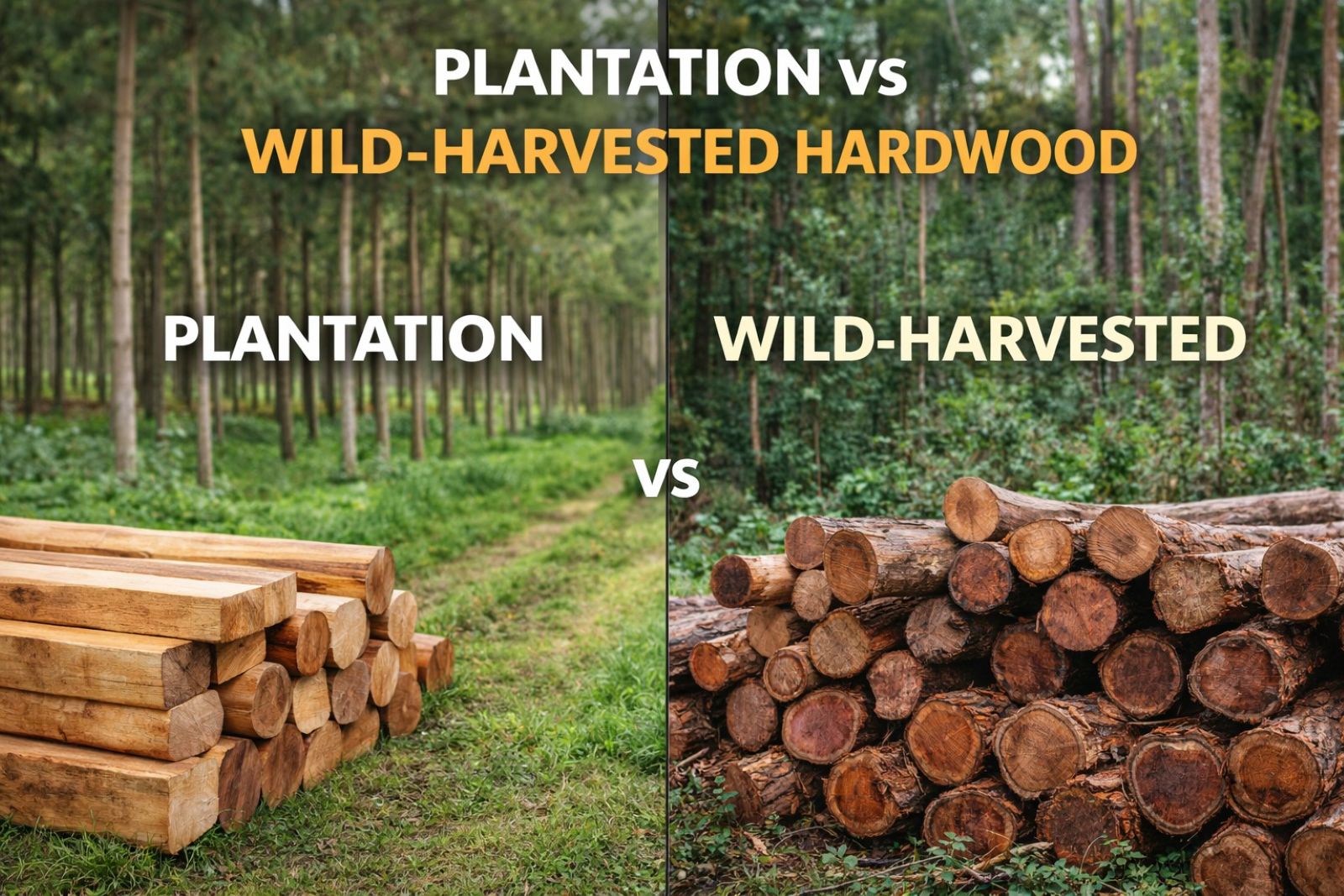
Plantation vs Wild-Harvested Hardwood
Exotic hardwoods enter the global market from two primary sourcing models: plantation-grown forests and wild-harvested natural forests.
Understanding the structural, environmental, and commercial differences between these sources is essential for collectors, buyers, and woodworkers evaluating material origin.
Neither model is universally superior. Each presents distinct characteristics, advantages, and limitations.
What Is Plantation-Grown Hardwood?
Plantation hardwood is cultivated in managed forest systems specifically established for timber production.
These operations typically involve:
- Controlled planting density
- Predictable harvest cycles
- Selective species cultivation
- Regulated management practices
Common plantation-grown species include:
- Teak
- Certain mahogany varieties
- Rubberwood
Plantations are often established outside a species’ native habitat.
Characteristics of Plantation-Grown Wood
Because plantation trees are typically grown in more uniform conditions:
- Growth rings may be more consistent
- Density may vary depending on growth rate
- Color uniformity may be higher
- Grain may be less irregular
Faster growth can sometimes result in:
- Slightly lower density
- Wider growth rings
- Less dramatic figure
However, quality varies significantly by region and management standards.
What Is Wild-Harvested Hardwood?
Wild-harvested hardwood comes from naturally occurring forests within a species’ native ecosystem.
Harvesting may be:
- Selective (controlled removal of individual trees)
- Concession-based
- Government-regulated
- Or, in some cases, illegal
Wild forests typically produce:
- Slower growth rates
- Tighter grain structure
- Higher density
- More irregular figure
These characteristics often create dramatic visual and structural properties.
Structural Differences
Wild-grown hardwoods often display:
- Interlocked grain
- Complex figure
- Greater density
- Higher extractive content
Plantation-grown material may show:
- More uniform appearance
- Slightly reduced density in fast-growth regions
- Fewer irregular growth anomalies
These differences are not universal but are common trends.
Sustainability Considerations
Plantation forestry offers:
- Predictable yield
- Reduced pressure on natural forests
- Controlled regeneration
Wild harvesting can be sustainable when:
- Legally managed
- Selectively harvested
- Monitored under forestry regulations
Illegal logging remains a risk in some regions, making supplier verification critical.
Market and Trade Impact
As certain wild species become restricted under CITES or national regulations, plantation sources may increase in importance.
However, plantations cannot replicate every species’ native ecological conditions.
This may affect:
- Density
- Grain structure
- Color
- Mechanical performance
Understanding origin helps set expectations.
Identification Challenges
It is often difficult to determine plantation vs wild origin through visual inspection alone.
Differences may be subtle.
Documentation and supplier transparency are more reliable than appearance for determining sourcing method.
Collector Considerations
For wood collectors:
- Wild-grown specimens may reflect native growth characteristics
- Plantation specimens document modern forestry evolution
- Both provide educational value
Proper labeling of origin enhances archival integrity.
Responsible Sourcing Practices
Before purchasing exotic hardwood:
- Confirm supplier legitimacy
- Request documentation where appropriate
- Verify compliance with CITES if applicable
- Understand regional forestry regulations
Responsible sourcing supports long-term species availability.
Not a Question of Quality Alone
Wild-harvested does not automatically mean superior.
Plantation-grown does not automatically mean inferior.
Quality depends on:
- Species
- Growth conditions
- Drying process
- Milling practices
- End use
Origin is one factor among many.
Institutional Note
Plantation and wild-harvested hardwood represent different forestry models, each with implications for sustainability, structural properties, and long-term supply. Accurate documentation and responsible sourcing are essential components of informed hardwood selection.
Understanding origin enhances both compliance and educational value.
Compare Wood Properties
See how different species rank in density and hardness using our Wood Density & Janka Hardness Chart. You can also explore Hardest Woods, Softest Woods, and Most Dense Woods for quick comparisons
Sourcing Materials:
Looking to find these species or similar materials? View recommended suppliers on our Where to Buy Exotic Woods page.
Building a Collection:
For those building a physical reference library, explore our Wood Collecting & Preservation guide.