
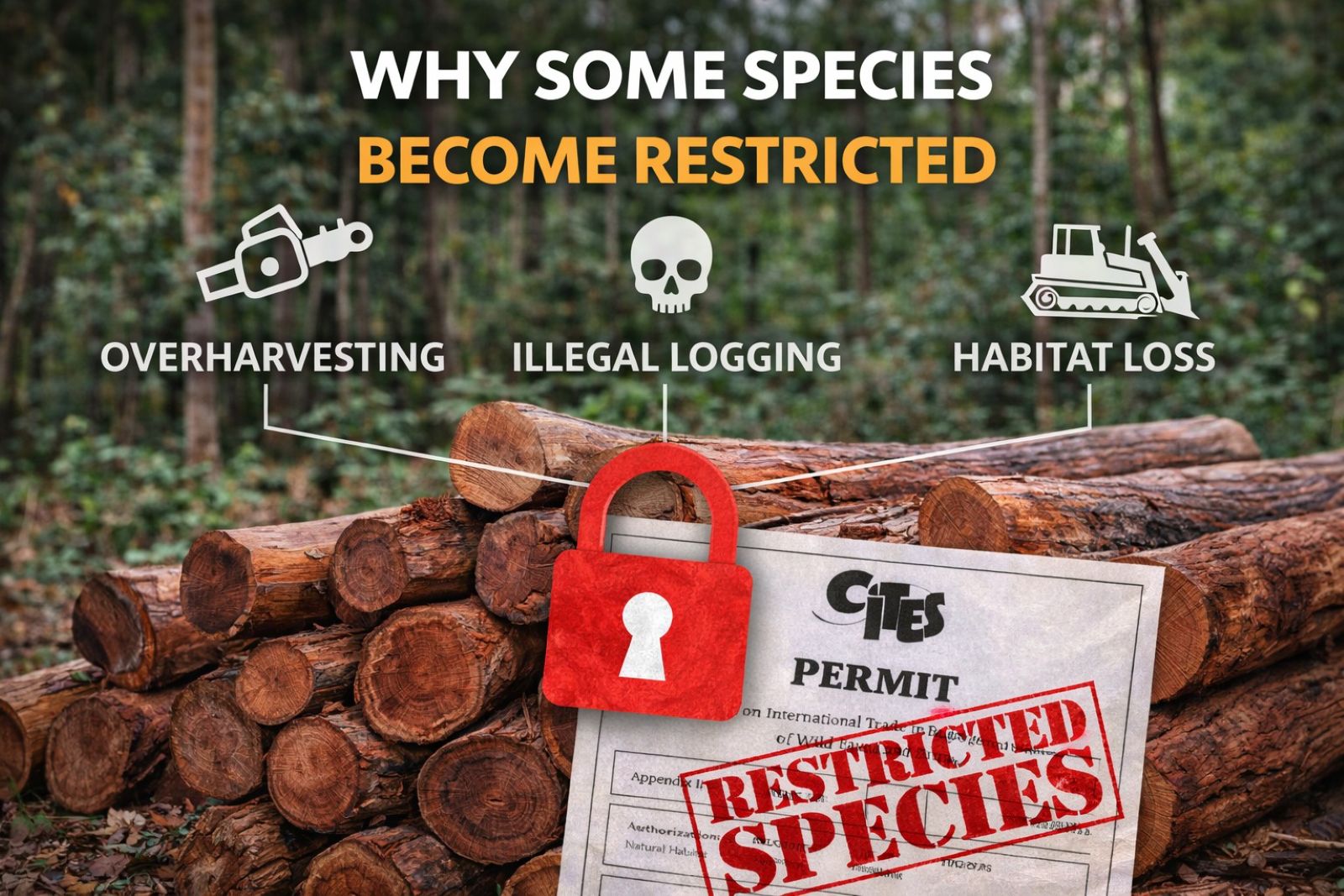
Why Some Species Become Restricted
Restrictions on certain hardwood species are typically the result of conservation, trade, and regulatory decisions intended to manage supply and prevent long-term depletion.
Understanding why species become restricted helps collectors, woodworkers, and buyers navigate availability changes, compliance requirements, and sourcing realities.
Restrictions are rarely sudden. They often follow measurable ecological and commercial pressures.
Primary Reasons Species Become Restricted
Several common factors lead to trade restrictions.
1. Overharvesting
When demand exceeds sustainable regeneration rates, population decline may occur.
High-value hardwoods used in:
- Luxury furniture
- Musical instruments
- Decorative veneers
Are particularly vulnerable to excessive harvest.
2. Illegal Logging
In some regions, weak enforcement can lead to unauthorized harvesting.
Illegal logging may result in:
- Habitat degradation
- Loss of biodiversity
- International trade pressure
- Regulatory response
Increased monitoring and documentation requirements often follow.
3. Rapid Market Demand
Sudden spikes in demand — particularly in global markets — can strain supply.
When a species becomes fashionable or commercially dominant, harvest pressure may accelerate beyond sustainable limits.
4. Habitat Loss
Deforestation for agriculture, development, or infrastructure reduces available forest area.
Even species not heavily harvested may become restricted if habitat decline affects population stability.
5. Limited Geographic Distribution
Species native to small or isolated regions are inherently more vulnerable.
If distribution is limited:
- Regeneration may be slower
- Environmental disruption has greater impact
- Trade management becomes precautionary
Restricted status may reflect geographic sensitivity rather than immediate extinction risk.
How Restrictions Are Implemented
Restrictions may occur through:
- CITES listings
- National export bans
- Quota systems
- Licensing requirements
- Certification mandates
These mechanisms regulate international trade rather than domestic ownership in most cases.
Appendix II vs Total Prohibition
Many restricted hardwoods are not banned outright.
Under CITES Appendix II:
- Trade is permitted
- Export permits are required
- Legal harvest must be documented
This allows continued commerce while monitoring sustainability.
Appendix I listings are more restrictive and significantly limit commercial trade.
Examples of Restricted Hardwood Groups
Certain Dalbergia species (rosewoods)
Some mahogany species
Regions African hardwoods
Listings may evolve as conservation data changes.
High-profile examples include Brazilian Rosewood (Dalbergia nigra), certain Bubinga species (Guibourtia spp.), Afrormosia (Pericopsis elata), and several ebony species such as Ceylon Ebony and Macassar Ebony. These species have experienced regulatory oversight due to combinations of international demand, slow growth rates, and concentrated harvesting pressure.
Impact on Availability
Restrictions may result in:
- Price increases
- Reduced export supply
- Greater documentation requirements
- Increased demand for substitute species
Markets often adapt by identifying alternative woods with similar properties.
Collector Considerations
For collectors:
- Pre-restriction stock may carry documentation value
- International resale may require permits
- Accurate labeling becomes more important
Historical specimens may gain archival interest as supply diminishes.
Responsible Response
Restrictions are intended to:
- Preserve long-term species viability
- Encourage responsible forestry
- Improve trade transparency
Compliance supports sustainable availability.
Understanding regulation reduces risk and promotes informed sourcing.
Not All Restrictions Reflect Imminent Extinction
A restricted status does not automatically mean a species is critically endangered.
Often, restrictions are precautionary measures intended to:
- Prevent overexploitation
- Stabilize trade
- Improve monitoring
Context matters.
Institutional Note
Species restrictions arise from ecological data, trade pressure, and conservation policy. They are regulatory tools designed to manage supply rather than eliminate use entirely. Responsible sourcing and accurate documentation remain central to lawful hardwood commerce.
Understanding why restrictions occur strengthens compliance and preserves long-term access to exotic hardwood diversity.
Compare Wood Properties
See how different species rank in density and hardness using our Wood Density & Janka Hardness Chart. You can also explore Hardest Woods, Softest Woods, and Most Dense Woods for quick comparisons
Sourcing Materials:
Looking to find these species or similar materials? View recommended suppliers on our Where to Buy Exotic Woods page.
Building a Collection:
For those building a physical reference library, explore our Wood Collecting & Preservation guide.