
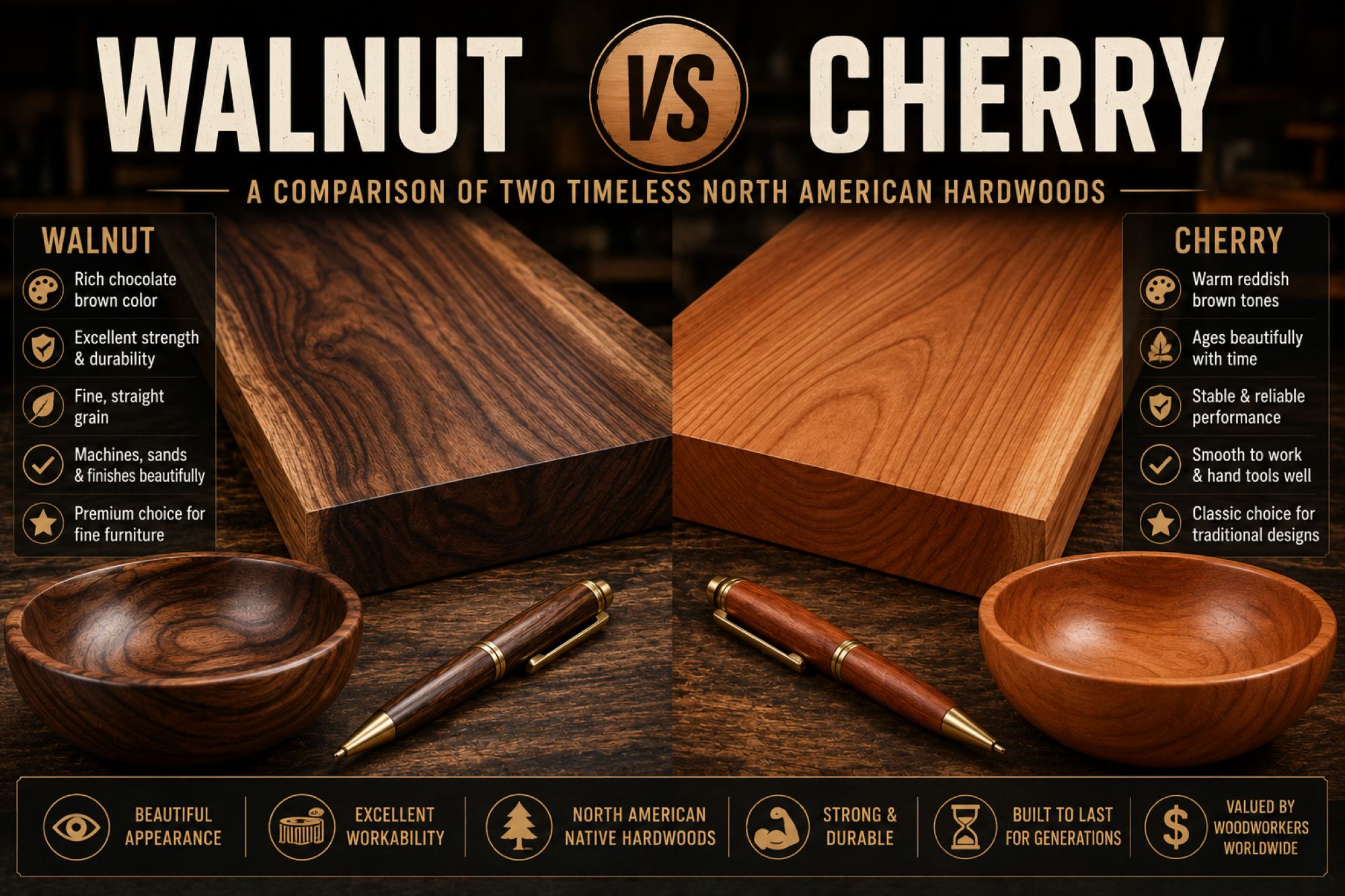
Walnut vs. Cherry
A side-by-side comparison of Walnut and Cherry, two of North America’s most celebrated hardwoods, examining their appearance, hardness, durability, workability, stability, and the woodworking applications where each species excels.
Overview
Walnut and Cherry have long been considered two of the finest furniture woods in the world. Both are native to North America, both machine beautifully, and both develop rich character with age. Their combination of beauty, stability, and workability has made them favorites among cabinetmakers, furniture builders, woodturners, and collectors for centuries.
Although they share many desirable qualities, Walnut and Cherry differ in color, hardness, grain, aging characteristics, and overall appearance. Choosing between them often comes down to the style of the project and the desired finished look.
This guide compares these two iconic hardwoods to help you determine which is the better choice for your next woodworking project.
Species Overview
| Characteristic | Black Walnut | Black Cherry |
|---|---|---|
| Scientific Name | Juglans nigra | Prunus serotina |
| Family | Juglandaceae | Rosaceae |
| Native Range | Eastern North America | Eastern North America |
| Wood Type | Hardwood | Hardwood |
Appearance
Walnut
Walnut is famous for its rich chocolate-brown heartwood, often accented with purple, gray, or darker streaks. The wood develops a luxurious, sophisticated appearance and has long been associated with fine furniture.
Characteristics
- Chocolate brown heartwood
- Occasional purple or gray tones
- Rich natural color
- Elegant appearance
- Medium natural luster
Cherry
Cherry begins as a light pinkish-brown wood that gradually darkens into a deep reddish-brown with exposure to light. Its warm color and smooth appearance make it one of the most recognizable furniture woods.
Characteristics
- Pink to reddish-brown
- Darkens beautifully with age
- Smooth appearance
- Warm color
- Fine natural luster
🏆 Appearance Winner: Tie
Grain & Texture
Walnut
- Usually straight grain
- Medium texture
- Occasionally curly or figured
- Smooth finish
Cherry
- Fine, closed grain
- Uniform texture
- Straight grain
- Satin-like finish
🏆 Grain & Texture Winner: Cherry
Hardness
Approximate Janka Hardness:
Walnut
- 1,010 lbf
Cherry
- 950 lbf
Walnut offers slightly better dent resistance.
🏆 Hardness Winner: Walnut
Density
Approximate Specific Gravity:
Walnut
- 0.55
Cherry
- 0.50
Walnut is slightly heavier.
🏆 Density Winner: Walnut
Dimensional Stability
Both woods are known for excellent dimensional stability and perform exceptionally well indoors.
🏆 Stability Winner: Tie
Durability
Walnut has slightly better natural decay resistance than Cherry, although both are intended primarily for interior applications.
🏆 Durability Winner: Walnut
Workability
Walnut
- Machines exceptionally well
- Sands easily
- Excellent turning wood
- Glues well
- Finishes beautifully
Cherry
- Excellent machining
- Sands easily
- Outstanding hand-tool performance
- Takes stain and finish well
- May burn slightly during machining if tools are dull
Both species are considered among the easiest premium hardwoods to work.
🏆 Workability Winner: Tie
Turning Performance
Both species are favorites among woodturners for bowls, platters, pens, and decorative objects.
🏆 Turning Winner: Tie
Carving
Cherry’s fine, uniform grain makes it especially well suited for detailed carving.
🏆 Carving Winner: Cherry
Furniture
Both woods have been used in high-end furniture for centuries.
Walnut is often chosen for formal, contemporary, and luxury furniture.
Cherry is favored for traditional, Shaker, Colonial, and heirloom furniture.
🏆 Furniture Winner: Tie
Cabinetry
Walnut creates dramatic, luxurious cabinetry.
Cherry offers a timeless, warm appearance that ages gracefully.
🏆 Cabinetry Winner: Tie
Flooring
Walnut flooring provides elegance and rich color.
Cherry flooring develops a warm patina but is somewhat softer.
🏆 Flooring Winner: Walnut
Knife Handles
Walnut is commonly used for custom knife handles due to its stability and appearance.
Cherry is used less frequently.
🏆 Knife Handle Winner: Walnut
Musical Instruments
Both woods are used in instrument making.
Walnut appears on guitars, ukuleles, and gunstocks.
Cherry is used for guitars, dulcimers, and specialty instruments.
🏆 Musical Instrument Winner: Tie
Availability
Cherry is generally more widely available throughout North America.
🏆 Availability Winner: Cherry
Value
Walnut typically commands a noticeably higher price than Cherry because of its darker heartwood and strong demand.
Cherry offers excellent performance and beauty at a lower average cost.
🏆 Value Winner: Cherry
Best Uses
Walnut
- Luxury furniture
- Cabinetry
- Gunstocks
- Knife handles
- Turnings
- Gunstocks
- Veneer
- Decorative boxes
- Musical instruments
Cherry
- Fine furniture
- Cabinetry
- Interior trim
- Carving
- Turnings
- Shaker furniture
- Colonial reproductions
- Musical instruments
Pros & Cons
Walnut
Pros
- Rich natural color
- Excellent stability
- Machines beautifully
- Highly desirable
- Outstanding durability
Cons
- Higher price
- Limited supply of wide boards
Cherry
Pros
- Beautiful aging process
- Excellent workability
- Fine grain
- More affordable
- Readily available
Cons
- Slightly softer
- Can darken unevenly during early sun exposure
Which Wood Should You Choose?
Choose Walnut if you want:
- Rich dark color
- Luxury furniture
- Premium cabinetry
- Better dent resistance
- Decorative knife handles
- High-end woodworking projects
Choose Cherry if you want:
- Warm reddish tones
- Traditional furniture
- Superior carving characteristics
- Better value
- A wood that develops a beautiful natural patina with age
Final Verdict
| Category | Winner |
|---|---|
| Appearance | Tie |
| Grain & Texture | Cherry |
| Hardness | Walnut |
| Density | Walnut |
| Stability | Tie |
| Durability | Walnut |
| Workability | Tie |
| Turning | Tie |
| Carving | Cherry |
| Furniture | Tie |
| Cabinetry | Tie |
| Flooring | Walnut |
| Knife Handles | Walnut |
| Musical Instruments | Tie |
| Availability | Cherry |
| Value | Cherry |
🏆 Overall Winner: Tie
Rather than one wood being universally better, Walnut and Cherry each excel in different areas. Walnut stands out for its luxurious dark color, slightly greater hardness, and premium appearance, making it a favorite for high-end furniture and cabinetry. Cherry, on the other hand, offers exceptional workability, a beautiful aging process, fine grain, and outstanding value. Both species have earned their reputations as two of North America’s finest hardwoods, and either is an excellent choice depending on the style, budget, and goals of the project.
Related Guides
- Best Woods for Furniture
- Best Woods for Cabinetry
- Best Woods for Wood Turning
- Wood Grain Patterns and Figure Explained
- Wood Density and Janka Hardness Chart
- Understanding Wood Movement and Seasonal Expansion
- Hardwood vs. Softwood Guide
Collector Notes
Walnut and Cherry have been prized by furniture makers for generations and remain two of the most sought-after domestic hardwoods in North America. Walnut’s deep chocolate heartwood conveys elegance and luxury, while Cherry is admired for the warm reddish-brown patina it develops over time. Together, these species represent the benchmark against which many other furniture woods are measured, making them essential additions to any serious wood collection or woodworking shop.