
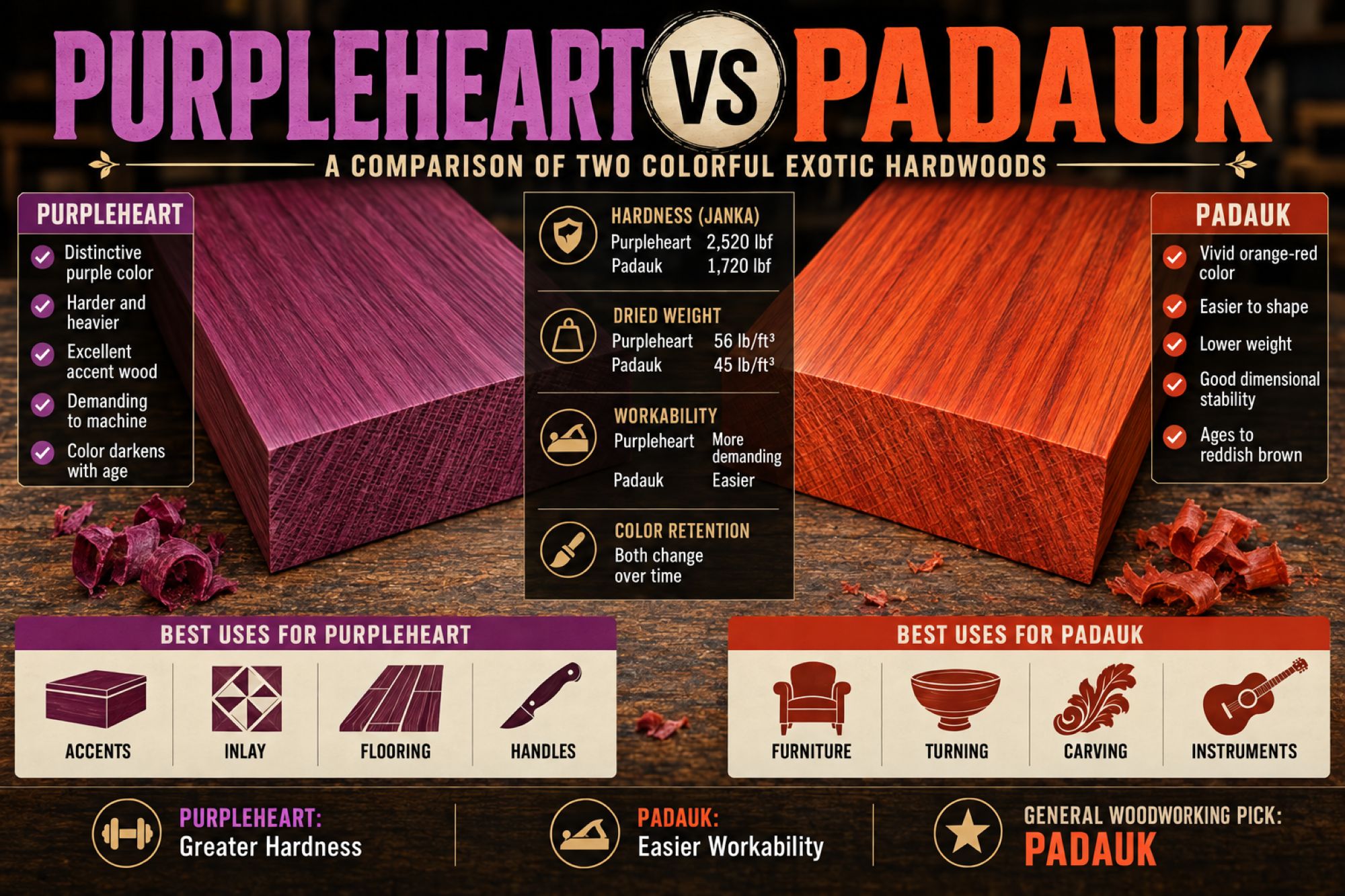
Purpleheart vs. Padauk
A side-by-side comparison of Purpleheart and African Padauk, two colorful exotic hardwoods valued for furniture, turning, flooring, decorative accents, knife handles, and specialty woodworking.
Overview
Purpleheart and Padauk offer some of the most recognizable natural colors in woodworking. Purpleheart develops distinctive purple tones, while freshly worked African Padauk displays vivid orange-red heartwood.
Both names can refer to multiple species. This comparison uses the website’s Purpleheart (Peltogyne paniculata) profile as its benchmark and African Padauk (Pterocarpus soyauxii) for Padauk.
Purpleheart generally offers greater hardness and weight. African Padauk offers easier working characteristics and a strong combination of durability, stability, and decorative appeal.
The category winners below are practical recommendations for typical woodworking projects. Individual boards, drying quality, and project requirements can change the preferred choice.
Species Overview
| Characteristic | Purpleheart | African Padauk |
|---|---|---|
| Scientific name | Peltogyne paniculata; other Peltogyne species also enter trade | Pterocarpus soyauxii |
| Family | Fabaceae | Fabaceae |
| Native region | Tropical Americas | West and Central Africa |
| Wood type | Tropical hardwood | Tropical hardwood |
| Signature appearance | Purple to purple-brown | Orange-red, aging toward reddish-brown |
| Approximate Janka hardness | 2,520 lbf | 1,720 lbf |
| Approximate dried weight | 56 lb/ft³ | 45 lb/ft³ |
These are representative reference values rather than guaranteed measurements for every board or species sold under these names.
Appearance
Purpleheart
Purpleheart is especially effective when a project calls for an unusual cool-toned accent. Its purple heartwood can provide strong contrast against pale or warm-colored woods.
Padauk
Padauk provides a warmer appearance. Fresh surfaces can be intensely orange-red, making it particularly striking in small decorative components.
🏆 Appearance Winner: Tie
Choose according to the intended color palette, while allowing for natural aging.
Grain & Texture
Purpleheart commonly has straight to interlocked grain and a medium texture. Padauk may also have interlocked grain, with pores and grain structure that can remain visually apparent after finishing.
Neither should be selected on color alone: inspect the actual grain direction and surface quality of the stock.
🏆 Grain & Texture Winner: Project-dependent
For a smooth decorative panel, compare prepared samples before choosing.
Hardness
The representative Janka values place Purpleheart above African Padauk.
That difference matters when resistance to indentation is a priority, but hardness does not establish every aspect of durability or strength.
🏆 Hardness Winner: Purpleheart
Density
Purpleheart is generally the heavier option.
For a small accent, this may have little practical consequence. For a large tabletop, cabinet door, or portable object, the accumulated weight deserves consideration.
🏆 Higher Density Winner: Purpleheart
🏆 Lower Weight Winner: Padauk
Durability
Both woods have established uses in demanding applications. African Padauk is documented for durable joinery, flooring, construction, and boat-related uses. Purpleheart is also valued as a durable tropical timber.
Natural decay resistance should be considered separately from surface hardness. Sapwood, exposure conditions, and construction details also affect service life.
🏆 Durability Winner: No universal winner
Choose according to the specific material and exposure conditions.
Dimensional Stability
African Padauk has moderately low reported shrinkage, making it a strong candidate when movement control is important. PROTA reports green-to-oven-dry shrinkage of approximately 2.2–3.8% radially and 4.1–6.2% tangentially. These are drying measurements, rather than predictions of seasonal movement in a finished project.
For either wood, use properly dried stock and allow for movement across the grain.
🏆 Stability Recommendation: Padauk
Workability
Purpleheart
Its greater hardness and weight make material removal more demanding. Sharp tooling and controlled machining help achieve clean results.
Padauk
Padauk is generally the more approachable choice for projects involving extensive cutting, shaping, or sanding. Interlocked areas still require care.
🏆 Workability Winner: Padauk
Finishing
Both woods benefit from a test finish on an offcut.
Consider:
- Whether the finish warms or ambers the surface
- Whether visible pores need filling
- Whether sanding residue affects adjacent pale wood
- How the finish looks after full curing
A freshly applied coating is only an initial preview of the wood’s eventual appearance.
🏆 Finishing Winner: Tie
The finish system and desired surface matter more than a blanket species ranking.
Natural Color
Purpleheart wins when the design specifically requires purple. Padauk wins when bright orange-red is the goal.
🏆 Purple Color Winner: Purpleheart
🏆 Orange-Red Color Winner: Padauk
Color Changes Over Time
Neither wood permanently retains its brightest freshly prepared appearance.
Purpleheart may develop from brownish freshly worked surfaces into purple, then darken toward purple-brown. Padauk’s bright orange-red commonly mellows toward deeper red and brown tones.
Reduced light exposure and an appropriate coating may slow visible changes, but no finish guarantees permanent original color.
🏆 Long-Term Bright Color Winner: Neither
Design for the aged appearance as well as the initial one.
Furniture
Purpleheart Furniture
Consider Purpleheart for:
- Contrasting edges
- Decorative legs
- Inlaid details
- Small tables
- Wear-prone accents
Padauk Furniture
Consider Padauk for:
- Cabinets and casework
- Tables
- Decorative panels
- Drawer fronts
- Larger accent components
🏆 General Furniture Recommendation: Padauk
Its lower weight and easier working characteristics make it the practical starting choice for many projects.
Cabinetry
For extensive cabinet work, evaluate door weight, machining time, and long-term color alongside the visual effect.
Padauk is the more practical recommendation for substantial quantities of solid wood. Purpleheart is particularly effective where a smaller amount provides the desired contrast.
🏆 Cabinetry Recommendation: Padauk
Flooring
Both woods have flooring applications, but a floor is a complete system involving moisture conditions, installation, finish, and maintenance.
Purpleheart’s greater representative hardness gives it the advantage when indentation resistance is the deciding factor.
🏆 Flooring Hardness Winner: Purpleheart
Turning
For a first project with either wood, begin with sound, dry stock and a simple form.
Padauk is the recommended starting choice for bowls, handles, and decorative turnings where efficient shaping matters. Purpleheart remains appealing when its purple color is central to the design.
🏆 Turning Recommendation: Padauk
Carving
For hand carving, Purpleheart’s greater hardness adds effort. Padauk is the more practical first choice when substantial material must be removed.
For fine details, grain direction and the condition of the individual blank remain critical.
🏆 Carving Recommendation: Padauk
Knife Handles
Choose between them according to the handle’s priorities:
| Priority | Suggested choice |
|---|---|
| Greater indentation resistance | Purpleheart |
| Easier shaping | Padauk |
| Purple accent | Purpleheart |
| Warm red-orange appearance | Padauk |
🏆 Knife Handle Winner: Tie
Handle design, grain orientation, attachment, and finish are as important as the species.
Musical Instruments
African Padauk has documented uses in xylophones and other percussion instruments, along with guitar components. Its resonant qualities give it a particularly relevant history in this category.
Instrument suitability is component-specific. A wood appropriate for a percussion bar is not automatically appropriate for a soundboard.
🏆 Musical Instrument Recommendation: Padauk
Decorative Inlay
Both woods offer strong natural contrast.
Choose Purpleheart when purple is essential to the pattern. Choose Padauk when the design calls for warmer red-orange details.
Test the complete sanding and finishing process before committing to a pale surrounding wood.
🏆 Inlay Winner: Tie
Decorative Boxes
For an entire box, Padauk is the practical recommendation. Purpleheart makes an effective contrasting lid, edge, handle, or inlaid feature.
Combining the woods can also work, provided the design accounts for their grain direction and movement.
🏆 Decorative Box Recommendation: Padauk
Availability
Both appear in the specialty hardwood trade, but usable dimensions and stock quality vary by supplier.
Compare:
- Actual board dimensions
- Moisture condition
- Defects and usable yield
- Confirmed species
- Sourcing documentation
🏆 Availability Winner: Supplier-dependent
Cost
Compare the cost of usable finished material rather than the board price alone.
A cheaper board may produce less usable stock, while harder material may require more machining time. Obtain comparable quotes for the same thickness, grade, and quantity.
🏆 Cost / Value Winner: Quote-dependent
Sustainability & Conservation
Buyers should request documented species identity and legal origin for both woods.
African populations of Pterocarpus are included in CITES Appendix II under annotation #17. Covered international transactions may therefore require documentation, depending on the material and product involved. Appendix II regulates trade rather than imposing a blanket ban.
🏆 Sustainability Winner: Source-dependent
A trade name alone does not establish responsible forestry.
Best Uses
Purpleheart
- Purple decorative accents
- Inlay
- Flooring selected for hardness
- Small furniture components
- Handles
- Turned details
- Contrasting trim
Padauk
- Furniture
- Cabinetry
- Decorative boxes
- Carving
- Turning
- Instrument components
- Warm-colored panels and accents
Pros & Cons
Purpleheart
Pros
- Distinctive purple coloration
- Greater representative hardness
- Strong contrast potential
- Useful for compact wear-resistant components
Cons
- Greater weight
- More demanding shaping
- Purple color changes with age
- Trade material can include different species
Padauk
Pros
- Striking orange-red appearance
- Easier general working characteristics
- Lower weight
- Useful balance of stability and durability
- Documented musical-instrument applications
Cons
- Bright color mellows with age
- Lower representative hardness
- Interlocked grain can complicate machining
- Sourcing and applicable trade documentation need attention
Which Wood Should You Choose?
Choose Purpleheart when your priorities are:
- A purple accent
- Greater indentation resistance
- Small, substantial components
- Strong contrast with lighter woods
Choose Padauk when your priorities are:
- Easier shaping
- Lower project weight
- Warm red-orange color
- Larger furniture or cabinet components
- Turning and carving
Final Verdict
| Category | Winner or recommendation |
|---|---|
| Appearance | Tie |
| Grain & Texture | Project-dependent |
| Hardness | Purpleheart |
| Higher Density | Purpleheart |
| Lower Weight | Padauk |
| Natural Durability | Material and exposure-dependent |
| Stability | Padauk |
| Workability | Padauk |
| Finishing | Tie |
| Purple Color | Purpleheart |
| Orange-Red Color | Padauk |
| Permanent Bright Color | Neither |
| General Furniture | Padauk |
| Cabinetry | Padauk |
| Flooring Indentation Resistance | Purpleheart |
| Turning | Padauk |
| Carving | Padauk |
| Knife Handles | Tie |
| Musical Instruments | Padauk |
| Inlay | Tie |
| Decorative Boxes | Padauk |
| Availability | Supplier-dependent |
| Cost / Value | Quote-dependent |
| Sustainability | Source-dependent |
🏆 Overall Recommendation: Padauk for General Woodworking
Padauk is the more practical starting choice for a broad range of projects because it combines easier working characteristics with lower weight and useful stability.
Purpleheart becomes the stronger choice when its distinctive purple appearance or greater hardness is the main reason for selecting the wood.
Related Guides
- Preserving Color in Purpleheart & Padauk
- Purpleheart Species Guide
- Pterocarpus Species Guide
- Wood Density & Janka Hardness Chart
- Wood Comparison Guides
Collector Notes
Purpleheart and Padauk make a useful comparison because their appeal includes both natural color and visible color change.
Keep labeled unfinished and finished samples, photograph them under consistent lighting, and record the preparation date. Comparing those samples later can reveal how exposure and finish affect appearance.
Record the scientific identity supplied with each sample, especially for Purpleheart, which enters trade from several Peltogyne species.