
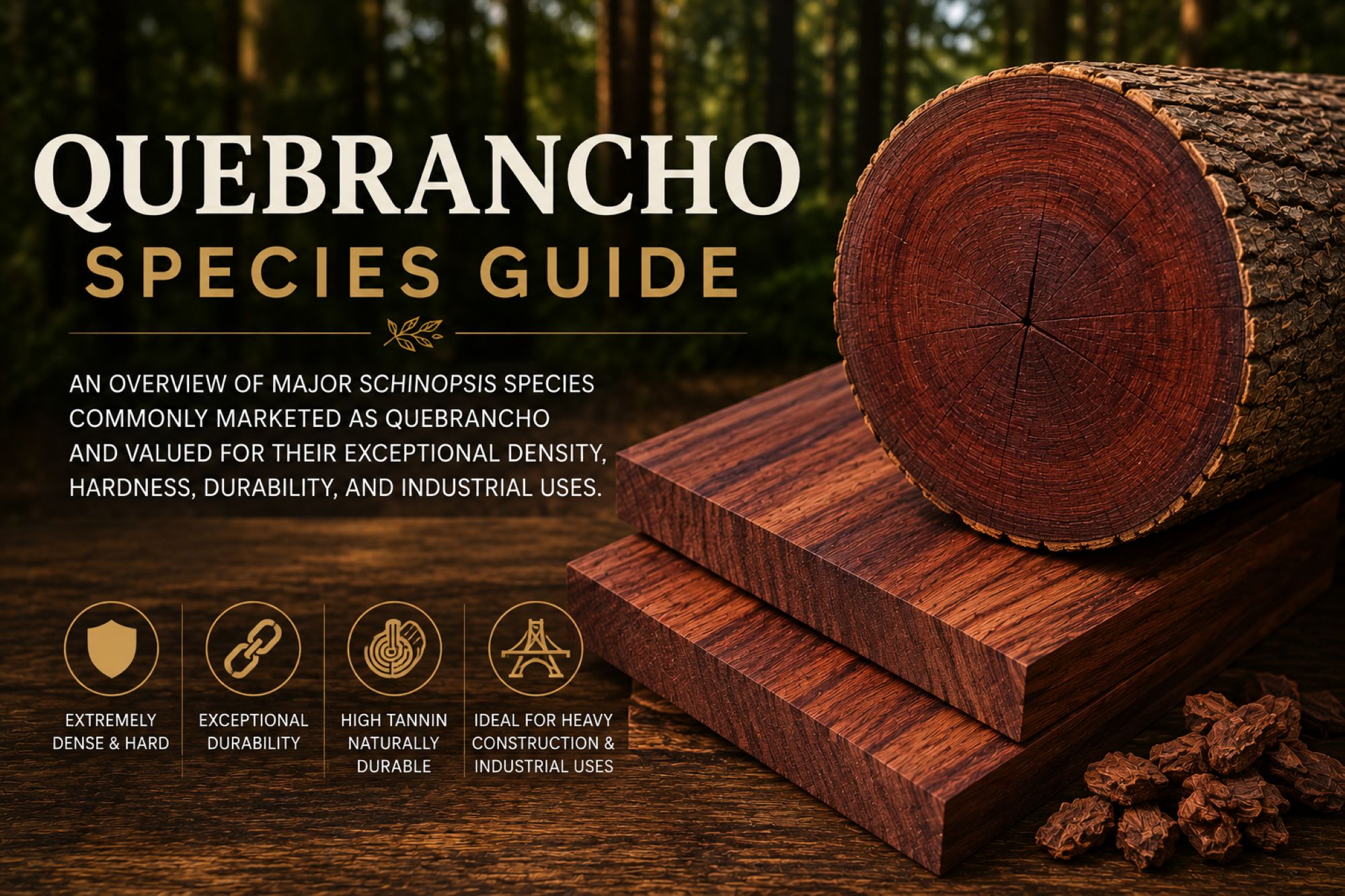
Quebracho Species Guide
An educational overview of the Schinopsis species commonly marketed as Quebracho and valued for their exceptional density, hardness, durability, and industrial applications.
Overview
Quebracho is a commercial name used for a group of exceptionally dense South American hardwoods belonging primarily to the genus Schinopsis. Native to Argentina, Paraguay, Bolivia, and surrounding regions, these trees produce some of the hardest and heaviest commercial timbers in the world.
The name “Quebracho” is derived from the Spanish phrase quiebra hacha, meaning “axe breaker,” a reference to the wood’s remarkable hardness and resistance to cutting. For centuries, Quebracho species have been valued for heavy construction, railroad ties, industrial applications, tannin extraction, and specialty woodworking.
Rather than referring to a single species, Quebracho encompasses several closely related species that share similar physical properties and commercial uses.
This guide serves as an overview of the broader Quebracho group and its most notable timber-producing species.
The Schinopsis Genus
The Schinopsis genus belongs to the Anacardiaceae family, which also includes cashew, mango, and sumac.
Quebracho species are known for:
- Extremely high density
- Exceptional hardness
- Outstanding durability
- High tannin content
- Excellent wear resistance
- Long service life
- Natural decay resistance
These characteristics have made Quebracho one of the most respected heavy-duty hardwood groups in the world.
Notable Quebracho Species
The Quebracho group contains several commercially important timber species found throughout South America.
Major Quebracho Species
Red Quebracho (Schinopsis balansae)
One of the most commercially important Quebracho species, Red Quebracho is renowned for its extreme hardness, durability, and high tannin content.
Santiago Quebracho (Schinopsis lorentzii)
A highly valued species native to Argentina, Paraguay, and Bolivia. It is frequently used in heavy-duty applications requiring exceptional strength and wear resistance.
Chaco Quebracho (Schinopsis heterophylla)
A dense and durable hardwood found within the Gran Chaco region and commonly grouped within the broader Quebracho trade.
Additional Schinopsis Species
The following species are notable members of the Schinopsis genus and may be added to the Exotic Woods of the World archive in the future:
- Schinopsis marginata
- Schinopsis boqueronensis
- Schinopsis haenkeana
- Schinopsis cornuta
- Schinopsis quebracho-colorado
As additional Quebracho-related species are added to the Exotic Woods of the World archive, they will be incorporated into this guide and linked to their individual species pages.
Common Characteristics of Quebracho Woods
Although properties vary between species, most Quebracho woods share several defining characteristics.
Common Quebracho Traits
- Extremely dense hardwood structure
- Exceptional hardness
- High crushing strength
- Outstanding durability
- Fine to medium texture
- Moderate natural luster
- Excellent wear resistance
- Very high tannin content
Few commercial hardwoods can match Quebracho’s combination of density and durability.
Common Uses
Quebracho has historically been used in some of the most demanding industrial and structural applications.
Common Applications
- Railroad ties
- Bridge construction
- Heavy timber construction
- Marine applications
- Industrial flooring
- Utility poles
- Fence posts
- Exterior structures
- Turned objects
- Specialty woodworking
Its exceptional durability makes it particularly valuable in applications exposed to heavy wear and harsh environmental conditions.
Identification Characteristics
Quebracho woods share several visual characteristics that help distinguish them from other hardwood groups.
Common Identification Traits
- Deep reddish-brown coloration
- Dense appearance
- Fine to medium texture
- Tight grain structure
- High weight
- Exceptional hardness
- Minimal movement in service
The wood’s extraordinary density is often its most recognizable characteristic.
Sustainability and Conservation
Quebracho forests have historically experienced significant harvesting pressure due to the wood’s commercial value and use in tannin production.
Sustainability considerations vary depending on:
- Species
- Harvest region
- Forest management practices
- Conservation regulations
- Reforestation efforts
Responsible sourcing remains important for maintaining healthy South American forest ecosystems and preserving long-term timber supplies.
Related Wood Family and Trade Group Pages
Explore additional wood family and trade-group guides:
Compare Wood Properties
Compare Quebracho woods alongside hundreds of hardwood species using the Exotic Woods of the World database.
Related resources:
- Wood Density and Janka Hardness Chart
- Hardest Woods in the World
- Most Dense Woods in the World
- Wood Grain Patterns and Figure Explained
Collector Notes
Quebracho represents one of the densest and most durable hardwood groups found anywhere in the world. Known as the “axe breaker” woods of South America, Schinopsis species have earned a reputation for exceptional strength, longevity, and resistance to wear. Understanding the broader Quebracho group helps collectors appreciate the remarkable diversity and importance of these legendary South American hardwoods.