
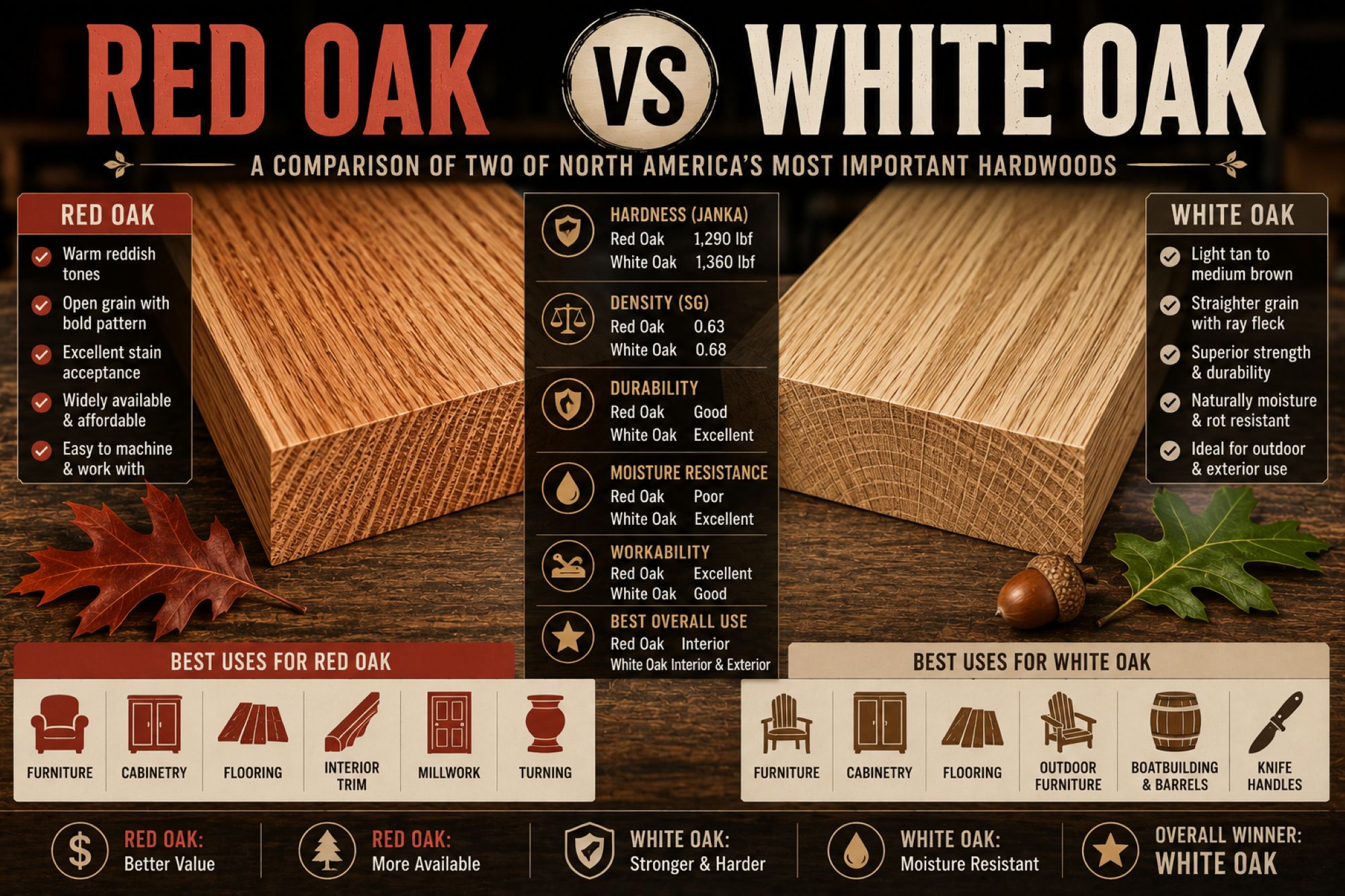
Red Oak vs. White Oak
A side-by-side comparison of Red Oak and White Oak, two of North America’s most important hardwoods, examining their appearance, hardness, durability, workability, stability, and the woodworking applications where each species excels.
Overview
Red Oak and White Oak are among the most widely used hardwoods in North America and have been staples of woodworking, flooring, cabinetry, furniture making, and construction for centuries. While they belong to the same genus (Quercus), they possess distinct characteristics that make each better suited for certain applications.
Red Oak is prized for its affordability, availability, and ease of machining, while White Oak is renowned for its superior durability, moisture resistance, and outdoor performance. Understanding these differences helps woodworkers select the right oak for every project.
This guide compares these two iconic hardwoods to help determine which species best fits your woodworking needs.
Species Overview
| Characteristic | Red Oak | White Oak |
|---|---|---|
| Scientific Name | Quercus rubra | Quercus alba |
| Family | Fagaceae | Fagaceae |
| Native Range | Eastern & Central North America | Eastern North America |
| Wood Type | Hardwood | Hardwood |
Appearance
Red Oak
Red Oak ranges from light tan to reddish-brown with a coarse, open grain and prominent growth rings. It has a warm, traditional appearance and readily accepts stain.
Characteristics
- Light reddish-brown color
- Open grain
- Bold growth rings
- Warm appearance
- Coarse texture
White Oak
White Oak ranges from light tan to medium brown with olive or gray undertones. Its grain is generally straighter and slightly more refined than Red Oak.
Characteristics
- Light tan to medium brown
- Olive-gray undertones
- Straight grain
- Elegant appearance
- Medium natural luster
🏆 Appearance Winner: White Oak
Grain & Texture
Red Oak
- Large open pores
- Coarse texture
- Prominent grain pattern
- Excellent stain acceptance
White Oak
- Medium to coarse texture
- More closed cellular structure
- Slightly finer appearance
- Attractive ray fleck in quarter-sawn lumber
🏆 Grain & Texture Winner: White Oak
Hardness
Approximate Janka Hardness:
Red Oak
- 1,290 lbf
White Oak
- 1,360 lbf
White Oak offers slightly greater resistance to dents and wear.
🏆 Hardness Winner: White Oak
Density
Approximate Specific Gravity:
Red Oak
- 0.63
White Oak
- 0.68
White Oak is heavier and denser.
🏆 Density Winner: White Oak
Dimensional Stability
Both species perform well indoors, but White Oak generally offers slightly better dimensional stability.
🏆 Stability Winner: White Oak
Durability
White Oak’s closed cellular structure (tyloses) makes it naturally resistant to moisture and decay.
Red Oak lacks tyloses, allowing water to move more freely through the wood.
🏆 Durability Winner: White Oak
Workability
Red Oak
- Machines easily
- Sands well
- Turns well
- Glues easily
- Accepts stain exceptionally well
White Oak
- Machines well
- Harder on cutting tools
- Excellent finishing qualities
- Requires sharp tools due to its density
🏆 Workability Winner: Red Oak
Turning Performance
Both species perform well on the lathe.
White Oak’s density produces exceptionally crisp details.
🏆 Turning Winner: Tie
Carving
Red Oak’s slightly lower density makes it somewhat easier to carve.
🏆 Carving Winner: Red Oak
Furniture
Both woods have been used in fine furniture for generations.
White Oak is especially popular for Mission, Craftsman, and Arts & Crafts furniture.
Red Oak remains a favorite for traditional furniture and general cabinetry.
🏆 Furniture Winner: White Oak
Cabinetry
Both woods make excellent cabinets.
White Oak has become especially popular for modern and high-end cabinetry.
🏆 Cabinetry Winner: White Oak
Flooring
Both species are widely used for hardwood flooring.
White Oak offers:
- Greater hardness
- Better wear resistance
- Better moisture resistance
- Longer service life
🏆 Flooring Winner: White Oak
Knife Handles
White Oak’s superior density and durability make it a better choice for custom knife handles.
🏆 Knife Handle Winner: White Oak
Outdoor Use
White Oak’s natural tyloses make it suitable for outdoor furniture, boatbuilding, whiskey barrels, and exterior projects.
Red Oak is generally not recommended for outdoor use because it absorbs moisture readily.
🏆 Outdoor Use Winner: White Oak
Musical Instruments
White Oak occasionally appears in specialty instruments, but neither species is widely used compared to maple, walnut, or mahogany.
🏆 Musical Instrument Winner: Tie
Availability
Red Oak is one of the most abundant commercial hardwoods in North America and is widely available.
🏆 Availability Winner: Red Oak
Value
Red Oak generally costs less than White Oak while providing excellent strength and performance for interior woodworking projects.
🏆 Value Winner: Red Oak
Best Uses
Red Oak
- Furniture
- Cabinetry
- Hardwood flooring
- Interior trim
- Millwork
- Shelving
- Turning
- Interior doors
- General woodworking
White Oak
- Premium furniture
- Hardwood flooring
- Cabinetry
- Outdoor furniture
- Boatbuilding
- Whiskey and wine barrels
- Architectural millwork
- Knife handles
- Fine woodworking
Pros & Cons
Red Oak
Pros
- More affordable
- Readily available
- Easy to machine
- Excellent stain acceptance
- Strong and durable
Cons
- Poor moisture resistance
- Not suitable for exterior use
- Slightly softer than White Oak
White Oak
Pros
- Superior durability
- Excellent moisture resistance
- Greater hardness
- Beautiful quarter-sawn figure
- Exceptional longevity
Cons
- Higher cost
- Heavier
- Slightly more difficult to machine
Which Wood Should You Choose?
Choose Red Oak if you want:
- Better value
- Lower cost
- Easy machining
- Interior furniture
- Interior cabinetry
- General woodworking
Choose White Oak if you want:
- Maximum durability
- Outdoor performance
- Premium furniture
- Hardwood flooring
- Superior moisture resistance
- Long-term heirloom projects
Final Verdict
| Category | Winner |
|---|---|
| Appearance | White Oak |
| Grain & Texture | White Oak |
| Hardness | White Oak |
| Density | White Oak |
| Stability | White Oak |
| Durability | White Oak |
| Workability | Red Oak |
| Turning | Tie |
| Carving | Red Oak |
| Furniture | White Oak |
| Cabinetry | White Oak |
| Flooring | White Oak |
| Knife Handles | White Oak |
| Outdoor Use | White Oak |
| Musical Instruments | Tie |
| Availability | Red Oak |
| Value | Red Oak |
🏆 Overall Winner: White Oak
White Oak earns the overall victory because of its superior durability, hardness, dimensional stability, moisture resistance, and versatility. Its closed cellular structure makes it one of the few domestic hardwoods well suited for both interior and exterior applications, including fine furniture, flooring, cabinetry, boatbuilding, and cooperage.
Red Oak remains an outstanding hardwood and offers exceptional value, making it an excellent choice for interior furniture, cabinetry, flooring, and general woodworking. For projects where moisture resistance is not a concern, Red Oak delivers excellent performance at a more affordable price.
Related Guides
- Oak Species Guide
- Best Woods for Furniture
- Best Woods for Flooring
- Best Woods for Cabinetry
- Wood Grain Patterns and Figure Explained
- Wood Density and Janka Hardness Chart
- Understanding Wood Movement and Seasonal Expansion
Collector Notes
Red Oak and White Oak represent two of the most recognizable and historically significant hardwoods in North America. Although closely related, their differences in pore structure, durability, and moisture resistance have led to distinct uses throughout history. White Oak has long been prized for shipbuilding, barrels, and heirloom-quality furniture, while Red Oak has become one of the most widely used hardwoods for interior woodworking and flooring. Together, they showcase the remarkable diversity found within the Quercus genus and remain essential species for both woodworkers and collectors.