
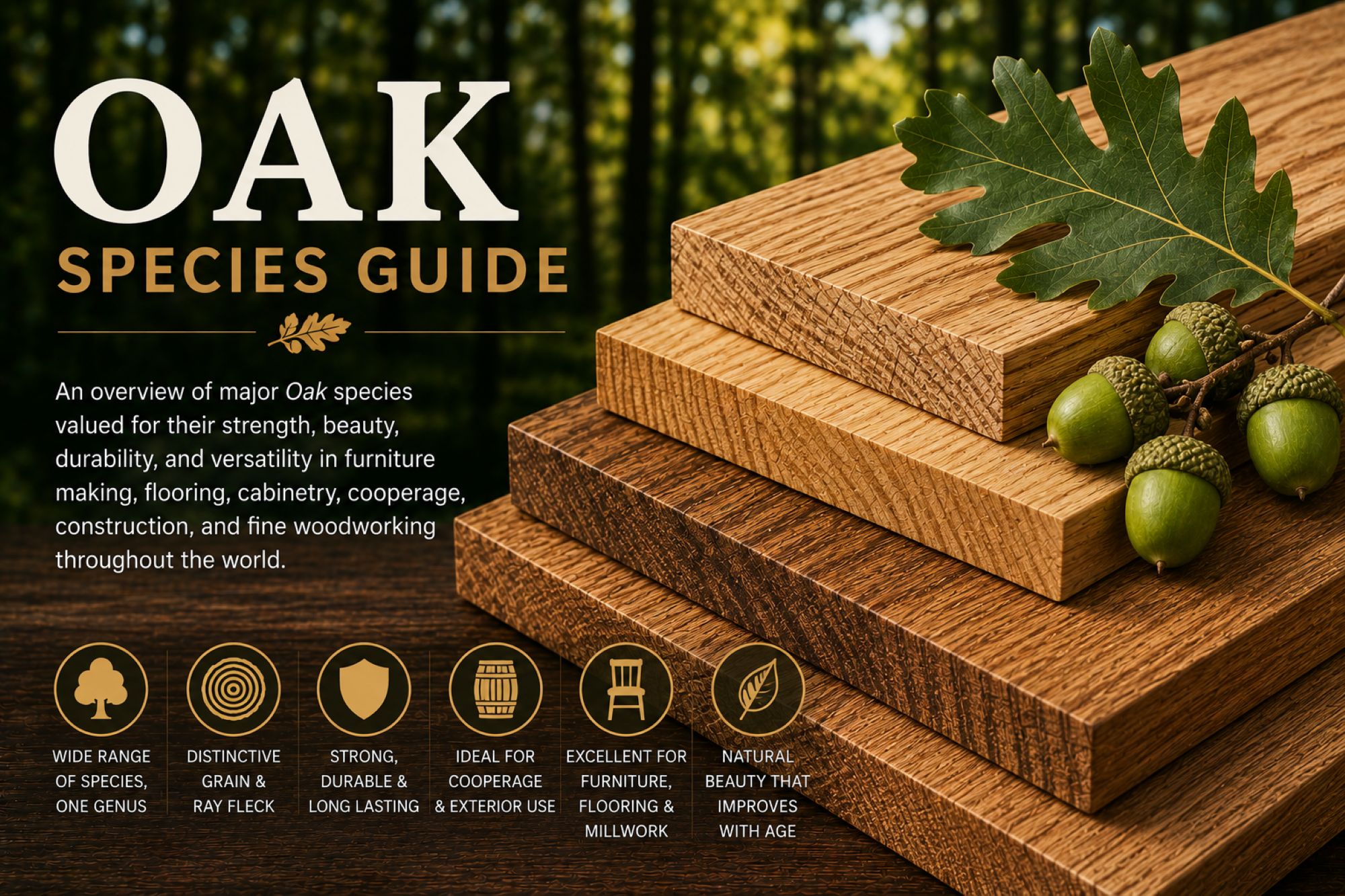
Oak Species Guide
Overview of major Oak species used in furniture making, flooring, cabinetry, cooperage, construction, and timber production throughout the world.
Overview
The Quercus genus, commonly known as Oak, contains some of the most important and widely recognized hardwood species in the world. Native to North America, Europe, Asia, and parts of North Africa, Oaks have played a central role in woodworking, construction, shipbuilding, and furniture making for centuries.
Oak wood is valued for its strength, durability, attractive grain patterns, and versatility. Different species produce a wide range of wood colors and characteristics, from the light brown tones of White Oak to the reddish hues of Red Oak and the dense, durable timber of many European and Asian species.
This guide serves as an overview of the broader Oak group and its most notable timber-producing species.
The Quercus Genus
The Quercus genus belongs to the Fagaceae family and contains more than 500 recognized species distributed throughout much of the Northern Hemisphere.
Oak species are known for:
- Exceptional strength
- Attractive grain patterns
- Excellent durability
- Long service life
- Versatile woodworking applications
- Strong commercial demand
- Historic importance
- Valuable timber production
Few hardwood groups have influenced woodworking and construction as significantly as Oak.
Notable Oak Species
The Oak genus contains hundreds of species, many of which are important timber trees.
Featured Oak Species
White Oak (Quercus alba)
One of the most important North American hardwoods, White Oak is prized for furniture, flooring, cabinetry, cooperage, and exterior applications due to its durability and moisture resistance.
Red Oak (Quercus rubra)
A highly popular hardwood known for its attractive grain, ease of machining, and widespread use in furniture, flooring, and millwork.
Bur Oak (Quercus macrocarpa)
A large North American species valued for its strength, durability, and attractive grain structure.
Pin Oak (Quercus palustris)
A common North American Oak used for lumber, landscaping, and general woodworking applications.
Turkey Oak (Quercus cerris)
A European species known for its adaptability and use in construction, fuelwood, and specialty woodworking.
Holm Oak (Quercus ilex)
An evergreen Mediterranean Oak recognized for its dense, durable timber and historical importance.
Additional Oak Species
The following species are notable members of the Quercus genus and may be added to the Exotic Woods of the World archive in the future:
- English Oak (Quercus robur)
- Sessile Oak (Quercus petraea)
- Cork Oak (Quercus suber)
- Live Oak (Quercus virginiana)
- Chestnut Oak (Quercus montana)
- Scarlet Oak (Quercus coccinea)
- Black Oak (Quercus velutina)
- Water Oak (Quercus nigra)
- Northern Pin Oak (Quercus ellipsoidalis)
- Southern Red Oak (Quercus falcata)
- Swamp White Oak (Quercus bicolor)
- Japanese Evergreen Oak (Quercus acuta)
As additional Oak species are added to Exotic Woods of the World, they will be incorporated into this guide and linked to their individual species pages.
White Oak Group vs. Red Oak Group
Many commercial Oak lumber products are categorized into two major groups.
White Oak Group
White Oak species are generally known for:
- Better moisture resistance
- Greater durability
- Closed cellular structure
- Exterior suitability
- Cooperage applications
Common examples include:
- White Oak (Quercus alba)
- English Oak (Quercus robur)
- Sessile Oak (Quercus petraea)
- Swamp White Oak (Quercus bicolor)
Red Oak Group
Red Oak species are generally known for:
- Faster growth rates
- Open pore structure
- Excellent workability
- Strong furniture demand
- Attractive grain patterns
Common examples include:
- Red Oak (Quercus rubra)
- Black Oak (Quercus velutina)
- Scarlet Oak (Quercus coccinea)
- Southern Red Oak (Quercus falcata)
Common Characteristics of Oak Woods
Although individual species vary, many Oaks share several defining characteristics.
Common Oak Traits
- Medium to high-density hardwood structure
- Prominent grain patterns
- Excellent strength
- Good wear resistance
- Attractive ray fleck figure
- Good dimensional stability
- Strong machining characteristics
- Long service life
Many species develop a beautiful patina as they age.
Common Uses
Oak remains one of the most versatile and widely used hardwood groups in the world.
Common Applications
- Furniture
- Cabinetry
- Flooring
- Cooperage
- Millwork
- Interior trim
- Doors
- Boatbuilding
- Structural timber
- Veneer
- Turned objects
- Historic restoration
Oak’s combination of strength, durability, and appearance makes it suitable for countless applications.
Oak Identification Characteristics
Many Oaks share recognizable visual characteristics.
Common Identification Traits
- Prominent grain patterns
- Large visible pores
- Distinct growth rings
- Attractive ray fleck figure
- Medium to coarse texture
- Light to medium brown coloration
- Strong structural appearance
Quarter-sawn Oak is especially known for its dramatic ray fleck figure.
Sustainability and Conservation
Most commercially harvested Oak species remain abundant and are managed through established forestry programs.
Sustainability considerations vary depending on:
- Species
- Harvest region
- Forest management practices
- Certification programs
- Conservation regulations
Many Oak forests benefit from long-term sustainable management throughout North America, Europe, and Asia.
Related Wood Family and Trade Group Pages
Explore additional wood family and trade-group guides:
- Maple Species Guide
- Hickory Species Guide
- Eucalyptus Species Overview
- Acacia Species Guide
- Wood Families & Trade Groups
Compare Wood Properties
Compare Oak woods alongside hundreds of hardwood species using the Exotic Woods of the World database.
Related resources:
- Wood Density and Janka Hardness Chart
- Hardest Woods in the World
- Most Dense Woods in the World
- Wood Grain Patterns and Figure Explained
Collector Notes
Oak represents one of the most important hardwood groups in human history. From the shipbuilding timbers of Europe to the flooring and furniture industries of North America, Oaks have shaped woodworking traditions for centuries. Understanding the broader Quercus genus helps collectors appreciate the extraordinary diversity found within one of the world’s most iconic hardwood families.