
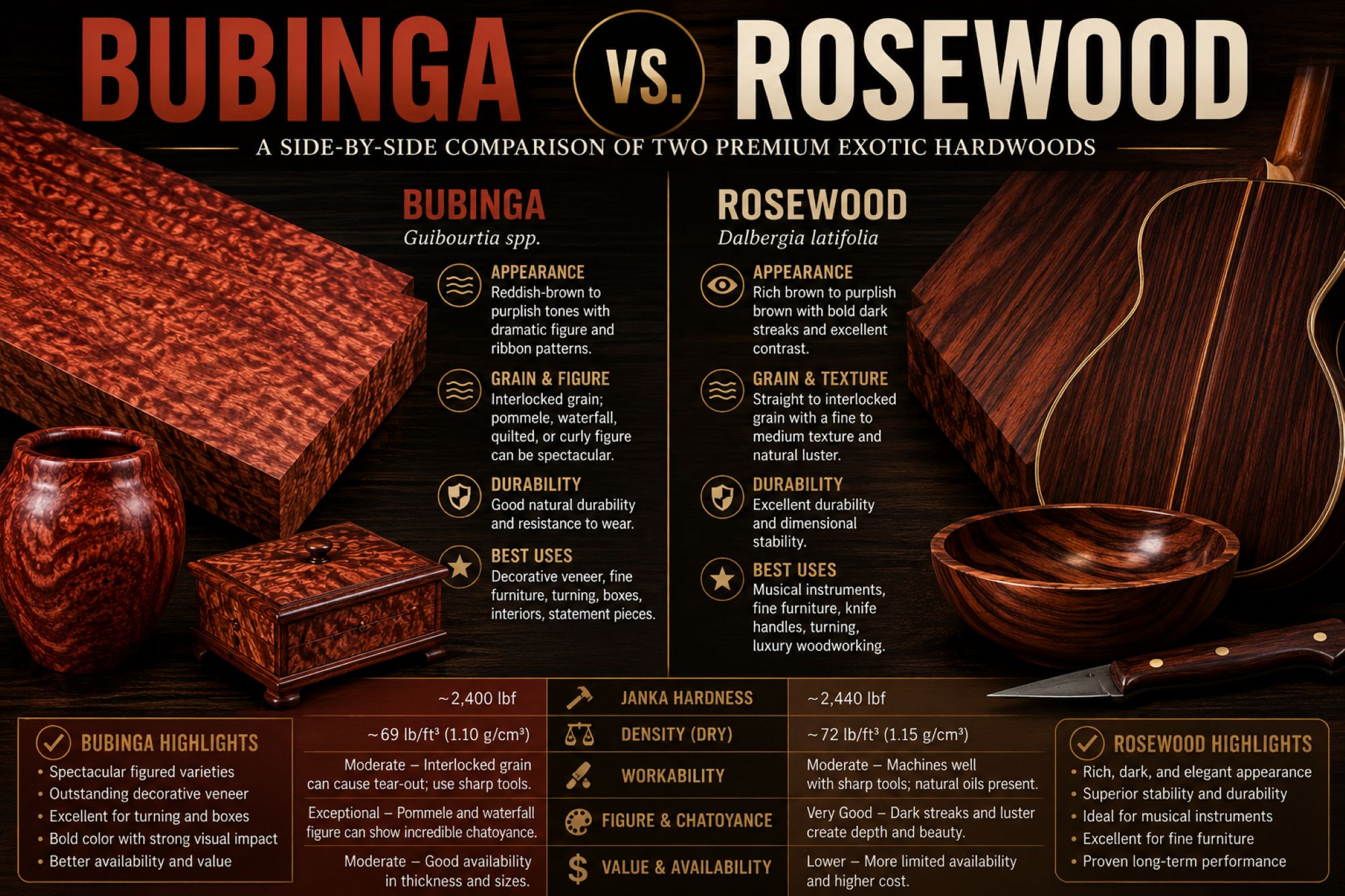
Bubinga vs. Rosewood
A side-by-side comparison of Bubinga and Rosewood, two premium exotic hardwood groups valued for rich coloration, dramatic grain, density, durability, musical instruments, fine furniture, turning, and luxury woodworking.
Overview
Bubinga and Rosewood are among the most visually impressive exotic hardwoods used in fine woodworking. Both can produce rich coloration, dark streaking, excellent natural luster, and dramatic figure, making them highly desirable for furniture, musical instruments, veneer, turning, decorative objects, and collector pieces.
However, the comparison requires an important distinction.
Bubinga generally refers to several closely related African species in the Guibourtia genus, particularly Guibourtia demeusei, G. pellegriniana, and G. tessmannii.
Rosewood is a broader trade name, but true rosewoods primarily belong to the Dalbergia genus. For this comparison, Indian Rosewood (Dalbergia latifolia) provides the most useful benchmark because it is one of the best-known commercial true rosewoods and is particularly important in furniture and musical instruments. Your existing material also characterizes Indian Rosewood by its rich brown color, dark streaking, high contrast, and premium applications.
Both are premium woods, but they excel in somewhat different areas.
Species Overview
| Characteristic | Bubinga | Indian Rosewood |
|---|---|---|
| Scientific Group | Guibourtia spp. | Dalbergia latifolia |
| Family | Fabaceae | Fabaceae |
| Native Range | Central & West-Central Africa | South Asia |
| Wood Type | Tropical Hardwood | Tropical Hardwood |
| General Character | Dense, reddish, often highly figured | Dark, streaked, resonant |
Appearance
Bubinga
Bubinga heartwood commonly ranges from pinkish-red and reddish-brown to darker purplish or burgundy tones.
Dark streaks may occur throughout the heartwood.
One of Bubinga’s greatest visual advantages is its ability to develop spectacular figure, including:
- Pommele
- Waterfall
- Quilted
- Curly
- Mottled
- Flamed
Highly figured Bubinga can be exceptionally dramatic.
Indian Rosewood
Indian Rosewood generally ranges from medium brown to deep reddish or purplish-brown.
Dark brown or nearly black streaks frequently run through the heartwood, creating substantial contrast. This rich brown-and-black streaked appearance is one of the defining visual characteristics highlighted in your existing Indian Rosewood material.
🏆 Appearance Winner: Tie
Choose Bubinga for spectacular figure and warmer reddish tones. Choose Rosewood for rich dark coloration and dramatic natural streaking.
Grain & Texture
Bubinga
Bubinga generally has:
- Straight to interlocked grain
- Fine to medium texture
- Good natural luster
- Potentially dramatic figure
Interlocked grain can produce both beautiful visual effects and machining challenges.
Indian Rosewood
Indian Rosewood typically has:
- Straight to interlocked grain
- Medium texture
- Strong dark streaking
- Good natural luster
- Rich visual depth
🏆 Grain & Texture Winner: Tie
Both can produce exceptional grain, but their visual character is distinctly different.
Hardness
Approximate Janka hardness values can vary according to the particular Bubinga species and individual material.
Bubinga
Approximately 2,400 lbf is commonly used as a general reference.
Indian Rosewood
Approximately 2,440 lbf.
Both are exceptionally hard woods.
🏆 Hardness Winner: Rosewood
Indian Rosewood receives a very slight advantage, although the difference is small enough that both should be considered extremely hard hardwoods.
Density
Bubinga and Indian Rosewood are both heavy, dense tropical hardwoods.
This density contributes to:
- Wear resistance
- Substantial feel
- Excellent polishing
- Strong finished components
It also increases tool wear and machining effort.
🏆 Density Winner: Tie
Durability
Both woods possess naturally durable heartwood.
Bubinga generally provides good resistance to decay and wear.
Indian Rosewood is also highly durable and has a long history in furniture and other applications where longevity is important.
🏆 Durability Winner: Rosewood
Rosewood receives a slight advantage based on its exceptional long-term reputation in demanding premium applications.
Dimensional Stability
Both species perform well when properly dried and acclimated.
However, their density means careful drying is important.
Bubinga can occasionally present drying challenges, particularly in thick or highly figured stock.
Indian Rosewood has an excellent history in applications where dimensional performance is critical, particularly musical instruments.
🏆 Stability Winner: Rosewood
Workability
Bubinga
Bubinga’s density and interlocked grain can make machining challenging.
Potential problems include:
- Tear-out
- Tool dulling
- Difficult hand-tool work
- Burning
- Resistance during cutting
Sharp carbide tooling can be particularly useful.
Indian Rosewood
Indian Rosewood is also hard and dense but generally machines reasonably well with sharp tools.
Its natural oils can occasionally affect gluing and finishing procedures.
🏆 Workability Winner: Rosewood
Neither is easy compared with common domestic hardwoods, but Indian Rosewood receives the advantage.
Finishing
Bubinga can finish exceptionally well.
Its fine texture, rich coloration, and natural luster respond beautifully to clear finishes.
Indian Rosewood can also achieve an outstanding polished surface. Its naturally rich coloration means staining is rarely necessary.
🏆 Finishing Winner: Tie
Both are premium finishing woods.
Figure
This is one of Bubinga’s strongest categories.
Exceptional Bubinga can display spectacular:
- Pommele
- Waterfall
- Quilted
- Curly
- Mottled
These figures can create substantial chatoyance and three-dimensional depth.
Rosewood can certainly produce beautiful figure, but its visual reputation is more strongly associated with color and dark streaking.
🏆 Figured Wood Winner: Bubinga
Chatoyance
Highly figured Bubinga can display exceptional movement under changing light.
Pommele and waterfall Bubinga are particularly dramatic.
Indian Rosewood can display excellent visual depth and natural luster, but it generally does not equal the strongest figured Bubinga.
🏆 Chatoyance Winner: Bubinga
Furniture
Both woods are exceptional furniture materials.
Bubinga Furniture
Bubinga works particularly well for:
- Luxury tables
- Desks
- Cabinetry
- Decorative panels
- Fine furniture
- Statement pieces
Large figured Bubinga surfaces can be visually spectacular.
Rosewood Furniture
Rosewood has centuries of association with luxury furniture and cabinetry.
It works particularly well for:
- Fine furniture
- Tables
- Cabinets
- Decorative furniture
- High-end interior woodworking
🏆 Furniture Winner: Rosewood
Rosewood receives a slight advantage because of its historic importance and exceptional reputation in fine furniture.
Veneer
Bubinga is an outstanding decorative veneer wood.
Highly figured logs can produce dramatic veneers that allow rare figure to be used across large furniture and architectural surfaces.
🏆 Veneer Winner: Bubinga
Musical Instruments
This is one of Rosewood’s strongest categories.
Indian Rosewood is particularly important for:
- Acoustic guitar backs
- Guitar sides
- Fingerboards
- Bridges
- Other instrument components
Your existing Indian Rosewood material specifically identifies musical instruments as a major premium application.
Bubinga has also been used in guitars, drums, and other instruments.
🏆 Musical Instruments Winner: Rosewood
Turning
Both woods can produce exceptional turned objects.
Bubinga offers:
- Dramatic figure
- Excellent polish
- High density
- Strong visual impact
Rosewood offers:
- Fine detail
- Excellent polish
- Rich coloration
- Dense, smooth surfaces
🏆 Turning Winner: Tie
Decorative Boxes
Both woods are excellent choices.
Rosewood’s dark streaking creates a classic luxury appearance, while figured Bubinga can create much more dramatic movement.
🏆 Decorative Boxes Winner: Bubinga
The advantage goes to Bubinga when visual figure is the priority.
Knife Handles
Both species offer excellent characteristics for premium knife handles.
Their high density and hardness provide:
- Wear resistance
- Durability
- Excellent polish
- Premium appearance
Rosewood’s long history in handles and small specialty objects gives it a slight advantage.
🏆 Knife Handle Winner: Rosewood
Flooring
Both woods are sufficiently hard for flooring, although neither would typically be selected as an economical general-purpose flooring species.
Their density provides excellent wear resistance.
🏆 Flooring Winner: Tie
Outdoor Use
Although both woods possess natural durability, their premium cost and conservation considerations generally make them more appropriate for high-value interior and specialty applications than routine exterior construction.
🏆 Outdoor Use Winner: Tie
There are usually better choices when outdoor exposure is the primary requirement.
Availability
Neither wood should be treated like an ordinary commodity hardwood.
Rosewoods in particular are affected by significant international conservation and trade considerations.
Bubinga is also subject to international trade controls.
Availability can therefore depend on:
- Species
- Country of origin
- Existing stock
- Documentation
- Supplier
- Applicable regulations
🏆 Availability Winner: Bubinga
Bubinga generally receives the practical advantage, although sourcing should still be carefully documented.
Sustainability & Trade Considerations
This category is particularly important when comparing these woods.
Both Bubinga and true Rosewoods have experienced significant international demand.
Many Dalbergia species have faced severe harvesting pressure, habitat loss, and illegal trade.
Bubinga species have also received international conservation attention.
Buyers should prioritize:
- Reputable suppliers
- Legal documentation
- Verified origin
- Responsibly harvested stock
- Reclaimed material where practical
International regulations should always be checked when importing or exporting these woods or finished products containing them.
🏆 Sustainability Winner: Neither
Responsible sourcing is essential for both.
Cost
Both woods belong to the premium exotic hardwood market.
Price varies considerably according to:
- Species
- Figure
- Grade
- Dimensions
- Availability
- Origin
- Documentation
Highly figured Bubinga can become extremely expensive.
High-quality true Rosewood can also command substantial premiums because of demand, limited availability, and trade restrictions.
🏆 Cost Winner: Bubinga
When comparable material is available, Bubinga will often provide better value than premium true Rosewood, although exceptional figured Bubinga can be extremely expensive.
Best Uses
Bubinga
Bubinga is particularly well suited for:
- Fine furniture
- Decorative veneer
- Tabletops
- Cabinetry
- Turning
- Decorative boxes
- Musical instruments
- Architectural panels
- Luxury interiors
- Statement woodworking
- Figured wood projects
Indian Rosewood
Indian Rosewood is particularly well suited for:
- Fine furniture
- Musical instruments
- Guitar backs and sides
- Turning
- Decorative objects
- Knife handles
- Cabinetry
- Veneer
- Luxury woodworking
- Specialty applications
Pros & Cons
Bubinga
Pros
- Exceptional figured varieties
- Excellent hardness
- High density
- Good durability
- Excellent natural luster
- Outstanding veneer
- Spectacular chatoyance
- Excellent polished appearance
Cons
- Heavy
- Difficult to machine
- Interlocked grain can tear out
- Premium pricing
- Conservation and trade considerations
- Figured stock can be very expensive
Rosewood
Pros
- Exceptional color
- Dramatic dark streaking
- Very high hardness
- Excellent durability
- Excellent stability
- Outstanding musical instrument wood
- Excellent natural luster
- Long history in luxury furniture
Cons
- Expensive
- Heavy
- Can dull tools
- Natural oils can complicate gluing
- Significant conservation concerns
- International trade restrictions can affect availability
Which Wood Should You Choose?
Choose Bubinga if you want:
- Dramatic figure
- Pommele or waterfall patterns
- Strong chatoyance
- Decorative veneer
- Statement furniture
- Large visually dramatic surfaces
- Better relative value among premium exotics
Choose Rosewood if you want:
- Rich dark coloration
- Black or dark brown streaking
- Musical instruments
- Maximum luxury appeal
- Excellent stability
- Exceptional hardness
- Fine furniture
- Premium small specialty projects
Final Verdict
| Category | Winner |
|---|---|
| Appearance | Tie |
| Grain & Texture | Tie |
| Hardness | Rosewood |
| Density | Tie |
| Durability | Rosewood |
| Stability | Rosewood |
| Workability | Rosewood |
| Finishing | Tie |
| Figured Wood | Bubinga |
| Chatoyance | Bubinga |
| Furniture | Rosewood |
| Veneer | Bubinga |
| Musical Instruments | Rosewood |
| Turning | Tie |
| Decorative Boxes | Bubinga |
| Knife Handles | Rosewood |
| Flooring | Tie |
| Outdoor Use | Tie |
| Availability | Bubinga |
| Cost / Value | Bubinga |
| Sustainability | Neither |
🏆 Overall Winner: Rosewood
Indian Rosewood earns the overall victory, particularly when performance, musical-instrument use, dimensional stability, durability, and fine-furniture tradition are considered together.
Its combination of extreme hardness, rich coloration, dark streaking, natural luster, and proven performance has made it one of the world’s classic premium hardwoods.
Bubinga, however, wins decisively when figure and visual movement are the priorities. Exceptional pommele, waterfall, curly, and quilted Bubinga can produce a level of chatoyance that even premium Rosewood may not match.
The practical decision is therefore straightforward: choose Bubinga for spectacular figure and decorative impact; choose Indian Rosewood for rich coloration, stability, musical instruments, and all-around premium performance.
Related Guides
- Wood Comparison Guides
- Best Woods for Furniture
- Best Woods for Knife Handles
- Understanding Chatoyance in Wood
- Wood Grain Patterns and Figure Explained
- Wood Density and Janka Hardness Chart
- Understanding Wood Movement and Seasonal Expansion
- Wood Toxicity and Allergies Guide
Collector Notes
Bubinga and Rosewood make an especially interesting collector comparison because both occupy the premium exotic-hardwood category while achieving their visual impact differently.
Bubinga’s greatest attraction often comes from figure. Pommele, waterfall, curly, and other figured examples can transform reddish-brown wood into highly three-dimensional surfaces that shift dramatically under changing light.
Indian Rosewood derives much of its identity from color and contrast. Rich brown, reddish, or purplish heartwood combined with dark streaking produces the classic Rosewood appearance that has become associated with luxury furniture and musical instruments.
For a wood collection, having both demonstrates the distinction between spectacular figure and spectacular coloration—two very different characteristics that can make exotic hardwood visually exceptional.