
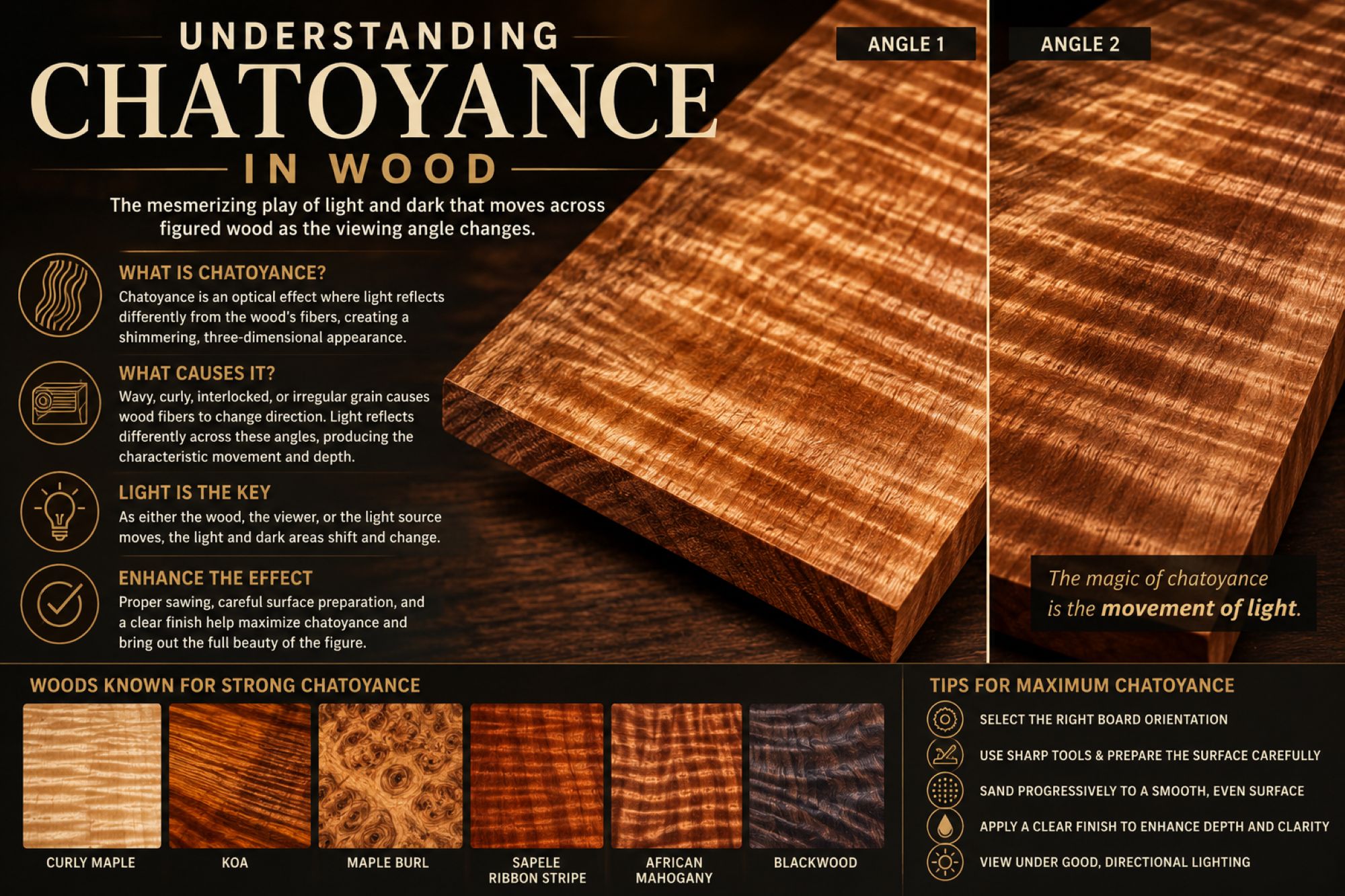
Understanding Chatoyance in Wood
A comprehensive guide to chatoyance in wood, including what causes the shimmering three-dimensional effect, which grain structures and figures produce it, how board orientation influences its appearance, and how woodworking and finishing techniques can enhance this remarkable optical characteristic.
Overview
Some of the world’s most beautiful woods appear to change as they are viewed from different angles. Light and dark areas seem to move across the surface, grain patterns shift with the viewer’s position, and the wood can develop an almost three-dimensional depth.
This optical effect is known as chatoyance.
Chatoyance is especially prized in figured woods used for fine furniture, musical instruments, turning, decorative boxes, veneers, knife handles, and other projects where the natural beauty of the wood is intended to become a focal point.
Although chatoyance is often associated with curly or figured grain, it is not a specific grain pattern itself. Instead, it is an optical effect created when light interacts differently with wood fibers that change orientation across the surface.
Understanding chatoyance helps woodworkers and collectors recognize why certain boards seem almost alive under changing light and why proper cutting, surface preparation, and finishing can dramatically enhance the effect.
What Is Chatoyance?
Chatoyance is an optical effect in which bands or areas of wood appear to shift between light and dark as the viewing angle or direction of illumination changes.
The effect can make a flat wooden surface appear:
- Three-dimensional
- Shimmering
- Wavy
- Reflective
- Deep
- Almost fluid
The term comes from the French word associated with a cat’s eye, referencing the moving band of reflected light seen in certain gemstones.
In woodworking, the term is used more broadly for the changing reflective appearance created by irregularly oriented wood fibers.
What Causes Chatoyance?
Wood is composed of millions of elongated cells and fibers.
In straight-grained wood, these structures generally run in a relatively consistent direction. Light interacting with the surface therefore behaves fairly uniformly.
In figured wood, fiber orientation can repeatedly change.
The fibers may:
- Curve
- Undulate
- Twist
- Interlock
- Reverse direction
- Wrap around growth irregularities
When light strikes these differently oriented fibers, some areas reflect more light toward the viewer while others reflect less.
As either the wood, viewer, or light source moves, those relationships change.
The result is the characteristic shifting light-and-dark effect known as chatoyance.
Chatoyance vs. Figure
Figure describes the visible decorative pattern produced by grain orientation, growth characteristics, color variation, or other anatomical features.
Chatoyance describes the optical movement produced when light interacts with those features.
A board can therefore have dramatic figure without particularly strong chatoyance.
Likewise, certain woods with relatively subtle figure can display impressive chatoyance under the right lighting.
The two characteristics are closely related but are not identical.
Chatoyance vs. Grain
Grain describes the orientation and arrangement of wood fibers.
Examples include:
- Straight grain
- Interlocked grain
- Spiral grain
- Wavy grain
- Irregular grain
Chatoyance occurs because variations in grain orientation cause light to reflect differently across the surface.
In simple terms:
Grain is a physical characteristic of the wood.
Chatoyance is an optical effect created by the interaction between that structure and light.
Curly Figure and Chatoyance
Curly wood is one of the best-known sources of strong chatoyance.
In curly figure, the fibers repeatedly undulate rather than traveling straight through the tree.
When the lumber is cut, these waves intersect the surface at changing angles.
This creates alternating reflective bands that can appear to move across the board.
Common examples include:
- Curly Maple
- Curly Koa
- Curly Cherry
- Curly Walnut
- Curly Mahogany
The stronger and more consistent the fiber undulation, the more dramatic the optical effect can become.
Fiddleback Figure
Fiddleback is a particularly tight and regular form of curly figure.
It produces narrow bands running across the grain and is especially prized for musical instruments.
Fiddleback figure is commonly associated with:
High-quality fiddleback wood can display exceptional chatoyance when viewed under directional lighting.
The figure appears to shift dramatically as an instrument or board is moved.
Quilted Figure
Quilted figure produces broader, rounded patterns that can resemble:
- Ripples
- Bubbles
- Clouds
- Padded fabric
Quilted Maple is one of the best-known examples.
Strongly quilted lumber can display exceptional depth because neighboring areas reflect light differently.
When properly finished, the figure may appear to sit beneath the surface rather than directly on it.
Ribbon Stripe Figure
Interlocked grain can produce another form of chatoyant appearance known as ribbon stripe.
When wood containing alternating directions of interlocked grain is quarter-sawn, the changing fiber orientation can create alternating light and dark bands.
Species known for ribbon stripe figure include:
The bands can appear to reverse from light to dark as the viewing angle changes.
Flame Figure
Flame figure describes broad, flowing patterns that resemble flames or waves.
Depending on the species and grain structure, flame figure can display considerable chatoyance.
The effect is particularly dramatic when the wood is used for:
- Musical instruments
- Decorative veneers
- Furniture panels
- Cabinet doors
Burl and Chatoyance
Burl wood contains extremely irregular grain caused by abnormal growth.
Fibers may twist and swirl in many directions, producing:
- Eyes
- Swirls
- Curls
- Waves
- Irregular figure
Because fiber orientation changes so dramatically, some burls can exhibit exceptional reflective depth.
However, burl figure does not automatically guarantee strong chatoyance. The effect depends on the structure of the individual piece.
Woods Known for Strong Chatoyance
Many species can develop chatoyance when appropriate figure is present.
Notable examples include:
Maple
Curly, fiddleback, quilted, and birdseye Maple can display exceptional visual depth.
Koa
Highly figured Koa is famous for strong golden chatoyance and dramatic curly figure.
Sapele
Quarter-sawn Sapele frequently displays ribbon stripe figure caused by interlocked grain.
African Mahogany
Interlocked grain can produce attractive ribbon figure and changing reflective bands.
Genuine Mahogany
Figured Mahogany can develop exceptional depth and natural luster.
Australian Blackwood
Figured Australian Blackwood can exhibit strong curly and fiddleback effects.
Acacia
Several Acacia species can develop highly reflective curly or wavy figure.
Walnut
Curly and figured Walnut may display beautiful chatoyance despite its darker coloration.
Other species capable of producing impressive chatoyant figure include:
Chatoyance depends heavily on the individual tree and board rather than simply the species name.
Does Every Board From a Chatoyant Species Show It?
No.
Figure and chatoyance can vary dramatically within a single species and even within a single tree.
One board may be relatively straight-grained while another from the same tree displays spectacular figure.
Factors influencing chatoyance include:
- Genetics
- Growth stresses
- Grain orientation
- Tree structure
- Location within the log
- Sawing orientation
- Surface preparation
- Lighting
- Finish
For this reason, highly figured lumber is often individually selected and sold at a premium.
Board Orientation and Chatoyance
How a log is sawn can dramatically influence visible figure.
Different orientations expose wood fibers differently.
Flatsawn Lumber
Flatsawn boards may emphasize:
- Cathedral grain
- Quilted figure
- Broad curly patterns
Quarter-Sawn Lumber
Quarter-sawn boards can emphasize:
- Ribbon stripe
- Fiddleback figure
- Interlocked grain
- Ray figure
Rift-Sawn Lumber
Rift-sawn lumber generally emphasizes straight, consistent grain and may display less dramatic figure in many species.
However, the ideal orientation depends on the specific type of figure present.
Lighting and Chatoyance
Chatoyance depends strongly on lighting.
Directional light generally reveals the effect more clearly than flat, diffuse lighting.
Strong chatoyance can often be seen by:
- Holding a finished board under a fixed light.
- Slowly tilting the board.
- Watching light and dark areas reverse or move across the surface.
The effect may appear weak in one room and spectacular under sunlight or directional workshop lighting.
This is one reason photographs do not always capture figured wood accurately.
Why Chatoyance Is Difficult to Photograph
A photograph captures the wood from one viewing angle under one lighting condition.
Chatoyance is dynamic.
Its full appearance becomes visible when:
- The observer moves
- The wood moves
- The light source changes
Video can often demonstrate chatoyance more effectively than a still photograph because the shifting reflections become visible as the board is tilted.
Surface Preparation
Proper surface preparation is critical for maximizing chatoyance.
Scratches, torn grain, and uneven sanding scatter light and can reduce visual depth.
A carefully prepared surface allows light to interact more cleanly with the underlying grain.
Important considerations include:
- Sharp cutting tools
- Careful planing
- Scraping when appropriate
- Progressive sanding
- Removing cross-grain scratches
- Avoiding excessive surface damage
Figured wood can be particularly prone to tear-out because fibers frequently change direction.
Planing Highly Figured Wood
Highly figured woods can be challenging to plane.
Because grain direction changes repeatedly, conventional planing may produce tear-out.
Woodworkers may use:
- Very sharp plane irons
- High-angle planes
- Card scrapers
- Cabinet scrapers
- Fine sanding
- Light cuts
Careful surface preparation helps preserve the figure while creating a surface capable of reflecting light evenly.
How Finish Enhances Chatoyance
Finishing can dramatically increase the apparent depth of figured wood.
A finish changes how light enters and reflects from the surface.
Finishes commonly used to emphasize figure include:
- Shellac
- Oil finishes
- Oil-varnish blends
- Lacquer
- Clear varnish
- French polish
A properly applied finish can make figure appear deeper, richer, and more three-dimensional.
Oil and Chatoyance
Oil finishes are particularly well known for enhancing figured grain.
Oil penetrates the wood and increases contrast between differently oriented fibers.
This can create a dramatic “wet wood” appearance.
Common choices include:
- Tung oil
- Polymerized oils
- Danish-style oil finishes
However, the ideal finish depends on the species and intended use.
Shellac and Chatoyance
Shellac is another traditional finish for highlighting figured wood.
It provides:
- Excellent clarity
- Strong visual depth
- Warm coloration
- Rapid film building
Highly figured furniture and musical instruments have historically benefited from clear finishes that allow light to interact with the wood beneath the surface.
Staining Figured Wood
Staining can either enhance or obscure chatoyance.
Carefully applied dyes may emphasize curly figure by increasing contrast.
However, heavy pigment stains can partially obscure the underlying grain.
For highly figured woods, woodworkers often prefer:
- Transparent dyes
- Clear oils
- Shellac
- Clear film finishes
The goal is usually to enhance the grain without covering it.
Chatoyance in Musical Instruments
Chatoyance is especially prized in instrument making.
Highly figured woods are frequently selected for:
- Guitar backs
- Guitar sides
- Guitar tops
- Violin backs
- Violin sides
- Ukuleles
- Decorative headstocks
Fiddleback Maple is perhaps the most famous example.
When an instrument moves under stage lighting, the figure can appear to shift dramatically across its surface.
Chatoyance in Furniture
Furniture makers often use figured wood strategically rather than throughout an entire project.
Chatoyant wood may be used for:
- Drawer fronts
- Cabinet doors
- Tabletops
- Decorative panels
- Veneers
- Chair backs
- Accent pieces
Carefully matching adjacent boards can create continuous patterns across multiple components.
Chatoyance in Woodturning
Woodturning can reveal grain from continuously changing angles.
This makes chatoyant wood especially dramatic in:
- Bowls
- Vases
- Hollow forms
- Pens
- Handles
- Decorative vessels
As a turned object rotates, reflective areas can appear to move continuously around the piece.
Chatoyance in Knife Handles
Figured woods are highly desirable for custom knife handles because a relatively small piece can display intense grain and optical depth.
Popular choices include:
- Curly Koa
- Curly Maple
- Desert Ironwood
- Australian Blackwood
- Walnut Burl
- Amboyna Burl
Stabilization may be used for some figured woods to improve durability and dimensional stability.
Chatoyance and Wood Value
Highly chatoyant lumber can command substantial premiums.
Value may increase based on:
- Strength of figure
- Consistency
- Rarity
- Board size
- Species
- Color
- Defect-free area
- Figure orientation
Instrument-grade figured lumber can be especially valuable because makers often require exceptional figure combined with specific dimensional and structural characteristics.
Chatoyance as a Wood Identification Trait
Chatoyance can provide useful information when examining wood, but it should not be used as a species identification method by itself.
Many unrelated species can produce similar optical effects.
Reliable wood identification should also consider:
- End-grain anatomy
- Pore structure
- Rays
- Color
- Density
- Texture
- Odor
- Geographic origin
Chatoyance is better considered a characteristic of figure and fiber orientation than a species-specific diagnostic feature.
Common Misconceptions
“Chatoyance is a type of grain.”
Not exactly.
Grain orientation creates the conditions that produce chatoyance, but chatoyance itself is an optical effect.
“Only exotic woods are chatoyant.”
False.
Domestic woods such as Maple, Cherry, Walnut, and Sycamore can produce spectacular chatoyance.
“All curly wood has the same chatoyance.”
False.
The strength of the effect depends on fiber orientation, figure intensity, cutting orientation, surface preparation, finish, and lighting.
“A glossy finish creates chatoyance.”
False.
Finish can enhance chatoyance, but the underlying optical effect originates from the wood’s structure.
“Chatoyance can always be judged from a photograph.”
False.
Because chatoyance changes with viewing angle and lighting, still photographs frequently underestimate the effect.
Frequently Asked Questions
What does chatoyance mean in wood?
Chatoyance describes the shifting light-and-dark appearance that occurs when light reflects differently from wood fibers oriented in different directions.
What wood has the strongest chatoyance?
Highly figured Maple, Koa, Sapele, Mahogany, Australian Blackwood, and several other species can display exceptional chatoyance. The individual piece of wood is usually more important than the species alone.
Is chatoyance the same as curl?
No. Curl is a type of figure caused by wavy grain. Chatoyance is the optical effect that may result when light interacts with that grain.
Can finishing increase chatoyance?
Yes. Clear finishes and penetrating oils can substantially enhance contrast and visual depth.
Does sanding remove chatoyance?
Sanding does not remove the underlying grain structure, but poor sanding or surface damage can reduce the clarity of the effect.
Why does figured wood look different when turned around?
Changing the viewing direction changes the angle between the observer, light source, and wood fibers. Areas that previously appeared dark may begin reflecting light and appear bright.
Related Guides
Continue exploring the Exotic Woods of the World educational library:
- Wood Grain Patterns and Figure Explained
- Sapwood vs. Heartwood Explained
- Wood Identification Guide
- Wood Density and Janka Hardness Chart
- Understanding Wood Movement and Seasonal Expansion
- Understanding Wood Shrinkage Values Explained
- Wood Toxicity and Allergies Guide
- Best Woods for Furniture
- Best Woods for Knife Handles

Collector Notes
Chatoyance is one of the characteristics that makes wood fundamentally different from most manufactured materials. A highly figured board does not simply display a pattern printed across its surface. Its appearance results from the three-dimensional orientation of fibers within the wood itself.
As light moves across those fibers, the visible pattern can change continuously, producing depth and movement that no single photograph can fully capture.
For collectors, chatoyance can make an otherwise ordinary-sized wood sample exceptional. Curly Maple, figured Koa, ribbon-striped Sapele, and other highly figured woods demonstrate how growth within a living tree can create optical effects that remain visible decades or even centuries after the tree has been harvested.
Understanding chatoyance therefore provides another way to appreciate wood not simply by species, color, or hardness, but by how its internal structure interacts with light.