
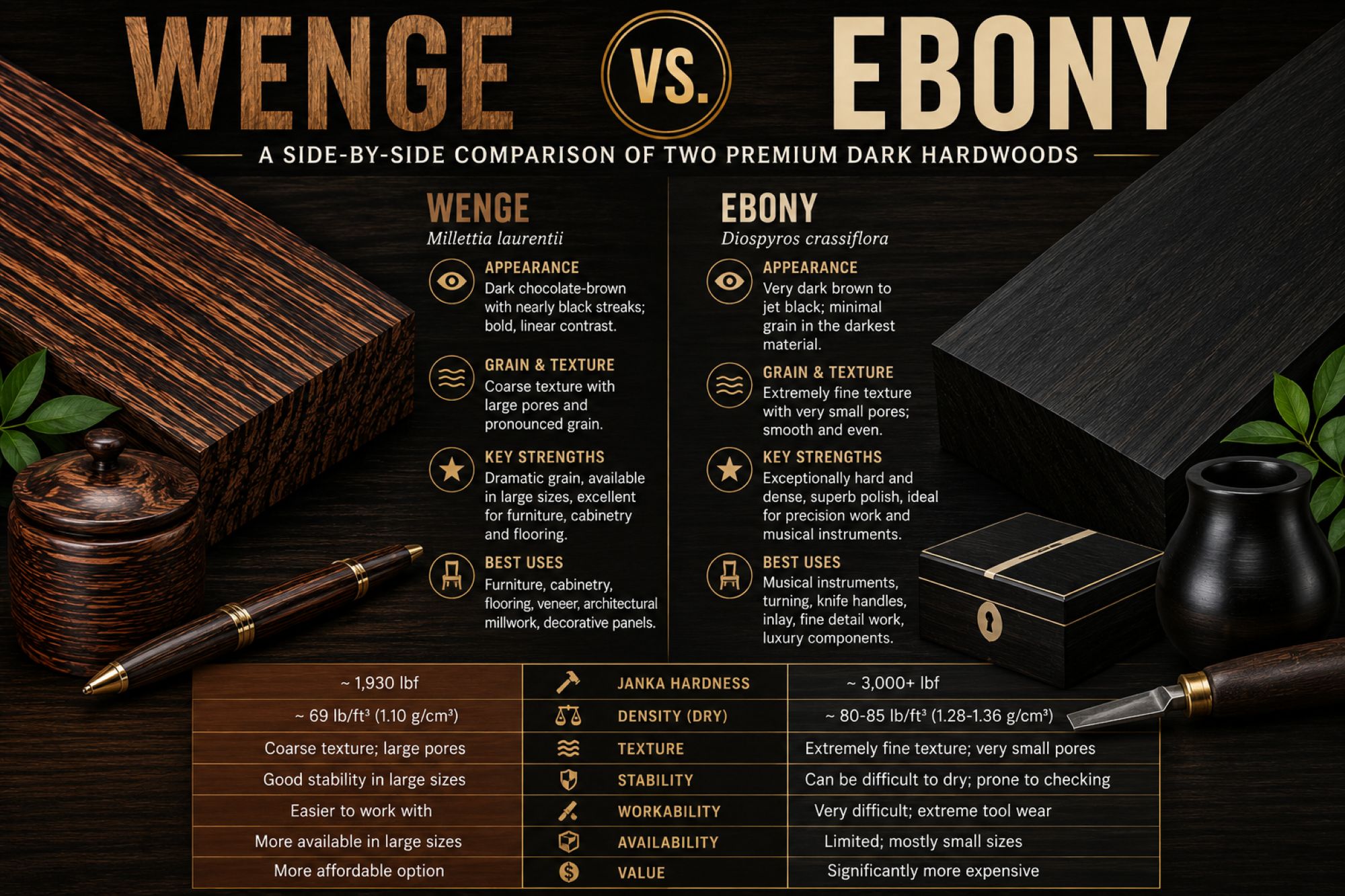
Wenge vs. Ebony
A side-by-side comparison of Wenge and Ebony, two dark exotic hardwoods valued for dramatic coloration, hardness, density, durability, fine furniture, turning, musical instruments, knife handles, and luxury woodworking.
Overview
Wenge and Ebony are two of the most recognizable dark exotic hardwoods, but they are considerably different in appearance, structure, working characteristics, availability, and ideal applications.
Wenge (Millettia laurentii) is an African hardwood known for its dark chocolate-brown heartwood, nearly black streaks, coarse texture, and strongly contrasting grain. Its linear appearance makes it particularly popular for contemporary furniture, cabinetry, flooring, veneer, and architectural interiors.
Ebony refers to several species within the Diospyros genus. For this comparison, Gaboon Ebony (Diospyros crassiflora) serves as the primary benchmark because it represents the classic dense, extremely dark Ebony traditionally associated with musical instruments, turning, decorative objects, and luxury woodworking.
Ebony is generally harder, denser, finer textured, and darker than Wenge. Wenge is easier to obtain in larger dimensions and offers a much more pronounced grain pattern at a lower cost.
Species Overview
| Characteristic | Wenge | Gaboon Ebony |
|---|---|---|
| Scientific Name | Millettia laurentii | Diospyros crassiflora |
| Family | Fabaceae | Ebenaceae |
| Native Range | Central Africa | West & Central Africa |
| Wood Type | Tropical Hardwood | Tropical Hardwood |
| General Character | Dark, coarse, strongly striped | Extremely dark, dense, fine textured |
Appearance
Wenge
Wenge heartwood generally ranges from medium brown to very dark chocolate brown.
Nearly black streaks run throughout the wood, producing a distinctive linear pattern.
Freshly cut Wenge can initially appear lighter before darkening with exposure.
Common characteristics include:
- Dark chocolate-brown heartwood
- Nearly black streaks
- Strong linear grain
- High contrast
- Contemporary appearance
- Distinctive coarse texture
Ebony
Gaboon Ebony is famous for its exceptionally dark heartwood.
Premium material may appear almost completely black, although brown, gray, or slightly lighter streaks can occur.
Common characteristics include:
- Dark brown to nearly jet-black heartwood
- Very fine texture
- Minimal visible grain in the darkest material
- Smooth, polished appearance
- Strong luxury association
🏆 Appearance Winner: Tie
Ebony wins for the deepest black coloration, while Wenge provides much more visible grain and contrast.
Grain & Texture
Wenge
Wenge typically has:
- Straight grain
- Very coarse texture
- Large pores
- Strong dark streaking
- Low to moderate natural luster
The coarse structure remains visually apparent even after finishing.
Ebony
Gaboon Ebony generally has:
- Straight to slightly irregular grain
- Extremely fine, even texture
- Very small pores
- Smooth appearance
- Excellent natural luster when polished
🏆 Grain & Texture Winner: Ebony
Ebony produces a substantially finer and smoother surface.
Hardness
Approximate Janka hardness:
Wenge
- 1,930 lbf
Gaboon Ebony
- Approximately 3,000+ lbf
Exact values for Ebony can vary between species and individual samples, but Gaboon Ebony is considerably harder than Wenge.
🏆 Hardness Winner: Ebony
Density
Wenge is a heavy hardwood, but Ebony belongs to an even more extreme density class.
Many Ebony species are dense enough to sink in water.
The extraordinary density contributes to Ebony’s:
- Substantial weight
- Wear resistance
- Smooth polish
- Fine detailing ability
🏆 Density Winner: Ebony
Durability
Both woods offer good natural durability.
Wenge heartwood is generally resistant to decay and performs well in demanding interior applications.
Gaboon Ebony also possesses excellent resistance to wear and good natural durability.
🏆 Durability Winner: Ebony
Ebony receives a slight advantage because of its exceptional density and wear resistance.
Dimensional Stability
Wenge performs reasonably well once properly dried, although movement must still be considered in furniture and flooring.
Ebony can be stable after careful drying but is notoriously difficult to dry without defects.
Problems may include:
- Checking
- Splitting
- Cracking
- End checking
Once properly seasoned, high-quality Ebony can perform exceptionally well in small precision components.
🏆 Stability Winner: Wenge
Wenge is generally more practical for larger woodworking projects.
Workability
Wenge
Wenge’s hardness and coarse grain create several challenges.
Potential issues include:
- Splintering
- Tear-out
- Tool dulling
- Large pores
- Difficult sanding
Wenge splinters deserve particular attention because they can be sharp and painful.
Ebony
Ebony is exceptionally hard and dense.
Potential difficulties include:
- Heavy tool wear
- Difficult hand machining
- Cracking
- Burning during machining
- Considerable resistance when cutting
However, its fine texture allows extremely precise finished surfaces.
🏆 Workability Winner: Wenge
Neither is easy to work, but Wenge is considerably less extreme.
Finishing
Wenge accepts clear finishes well, but its very large pores may require filling if a perfectly smooth surface is desired.
Ebony can be polished to an exceptionally smooth surface and may require relatively little enhancement to achieve a luxurious appearance.
🏆 Finishing Winner: Ebony
Natural Black Color
This category has a decisive winner.
Although Wenge can become extremely dark, its brown background and visible black streaking generally remain apparent.
High-quality Gaboon Ebony can approach a nearly uniform natural black.
🏆 Natural Black Color Winner: Ebony
Visible Grain
Wenge’s dramatic grain is one of its defining characteristics.
The alternating dark brown and nearly black lines remain clearly visible across the surface.
Premium black Ebony may show very little visible grain.
🏆 Visible Grain Winner: Wenge
Furniture
Wenge Furniture
Wenge is particularly effective for:
- Tables
- Desks
- Cabinets
- Contemporary furniture
- Shelving
- Accent pieces
- Architectural furniture
Its availability in larger boards makes it practical for substantial projects.
Ebony Furniture
Solid Ebony is rarely used for entire large furniture pieces because of:
- Weight
- Cost
- Limited dimensions
- Availability
Instead, Ebony is frequently used for:
- Inlay
- Edging
- Decorative details
- Handles
- Accents
🏆 Furniture Winner: Wenge
Cabinetry
Wenge’s bold linear grain makes it an excellent cabinetry material.
It works particularly well for:
- Cabinet doors
- Drawer fronts
- Contemporary kitchens
- Architectural panels
- Luxury interiors
Ebony is usually too expensive and limited for extensive solid cabinetry.
🏆 Cabinetry Winner: Wenge
Flooring
Wenge’s hardness and wear resistance make it suitable for premium flooring.
Its dark coloration and strong grain create a dramatic interior appearance.
Ebony is sufficiently hard for flooring but would generally be impractical because of cost, availability, weight, and conservation considerations.
🏆 Flooring Winner: Wenge
Turning
Ebony is one of the classic premium turning woods.
Its extreme density and fine texture allow:
- Crisp details
- Thin sections
- Smooth surfaces
- Exceptional polish
Wenge can also be turned successfully, but its coarse grain and tendency to splinter make it less refined.
🏆 Turning Winner: Ebony
Carving
Neither wood is particularly easy to carve.
Wenge’s coarse structure can splinter, while Ebony’s extreme hardness makes material removal difficult.
Ebony nevertheless allows extremely fine details when worked with sharp tools.
🏆 Fine Detail Carving Winner: Ebony
Knife Handles
Both woods can produce excellent knife handles.
Wenge
Offers:
- Dark appearance
- Visible grain
- Good hardness
- Strong visual character
Ebony
Offers:
- Exceptional hardness
- Fine texture
- Excellent polish
- Excellent wear resistance
- Classic black appearance
🏆 Knife Handle Winner: Ebony
Musical Instruments
Ebony has an extraordinary history in musical-instrument making.
Common applications include:
- Guitar fingerboards
- Violin fingerboards
- Bridges
- Piano keys
- Woodwind instruments
- Instrument fittings
Its hardness, fine texture, wear resistance, and smooth feel are particularly valuable.
Wenge is also used for instrument components but cannot match Ebony’s historical importance.
🏆 Musical Instruments Winner: Ebony
Decorative Inlay
Ebony is one of the world’s classic inlay woods.
Its nearly black coloration creates exceptional contrast against lighter species such as:
- Maple
- Holly
- Boxwood
- Satinwood
🏆 Inlay Winner: Ebony
Decorative Boxes
Both are excellent choices.
Wenge provides bold visible grain, while Ebony creates a more formal, nearly black luxury appearance.
🏆 Decorative Boxes Winner: Tie
Availability
Wenge remains a premium exotic hardwood but can generally be obtained in considerably larger dimensions than Gaboon Ebony.
High-quality black Ebony is increasingly limited and often available primarily as:
- Turning blanks
- Fingerboard blanks
- Small boards
- Instrument components
- Specialty stock
🏆 Availability Winner: Wenge
Cost
Both woods are expensive compared with common domestic hardwoods.
However, premium Gaboon Ebony can be dramatically more expensive, particularly in large, defect-free pieces with uniform black coloration.
🏆 Cost Winner: Wenge
Wenge provides significantly more material for the money.
Sustainability & Conservation
Responsible sourcing is important for both species.
Wenge has experienced harvesting pressure and habitat concerns within portions of its natural range.
Several Ebony species have also faced serious pressure from:
- Overharvesting
- Habitat loss
- Illegal logging
- International demand
Because Ebony grows slowly and premium black heartwood is highly valuable, responsible sourcing is particularly important.
Buyers should prioritize legally harvested and well-documented material.
🏆 Sustainability Winner: Neither
Both require careful sourcing.
Best Uses
Wenge
Wenge is particularly well suited for:
- Furniture
- Cabinetry
- Flooring
- Veneer
- Architectural interiors
- Tables
- Decorative panels
- Turning
- Accent pieces
- Contemporary woodworking
Ebony
Ebony is particularly well suited for:
- Musical instruments
- Fingerboards
- Turning
- Knife handles
- Inlay
- Decorative boxes
- Small luxury objects
- Furniture accents
- Carving
- Instrument fittings
- Jewelry
- Specialty woodworking
Pros & Cons
Wenge
Pros
- Dramatic dark grain
- Excellent hardness
- Good durability
- Available in larger dimensions
- Excellent furniture wood
- Suitable for flooring
- Strong contemporary appearance
- Less expensive than premium Ebony
Cons
- Coarse texture
- Large pores
- Splinters easily
- Can dull tools
- Heavy
- Difficult machining
- Responsible sourcing is important
Ebony
Pros
- Exceptionally dark natural color
- Extremely hard
- Extremely dense
- Very fine texture
- Exceptional polish
- Outstanding wear resistance
- Excellent turning wood
- Premier musical-instrument material
- Excellent for fine detail and inlay
Cons
- Extremely expensive
- Limited availability
- Often available only in small dimensions
- Difficult to machine
- Can crack during drying
- Very heavy
- Significant conservation concerns
Which Wood Should You Choose?
Choose Wenge if you want:
- Dark wood with visible grain
- Furniture
- Cabinetry
- Flooring
- Large boards
- Contemporary interiors
- Better value
- Bold brown-and-black contrast
Choose Ebony if you want:
- The darkest natural wood
- Musical instruments
- Fingerboards
- Knife handles
- Turning
- Fine inlay
- Extremely smooth texture
- Maximum hardness
- Small luxury components
Final Verdict
| Category | Winner |
|---|---|
| Appearance | Tie |
| Grain & Texture | Ebony |
| Hardness | Ebony |
| Density | Ebony |
| Durability | Ebony |
| Stability | Wenge |
| Workability | Wenge |
| Finishing | Ebony |
| Natural Black Color | Ebony |
| Visible Grain | Wenge |
| Furniture | Wenge |
| Cabinetry | Wenge |
| Flooring | Wenge |
| Turning | Ebony |
| Fine Detail Carving | Ebony |
| Knife Handles | Ebony |
| Musical Instruments | Ebony |
| Inlay | Ebony |
| Decorative Boxes | Tie |
| Availability | Wenge |
| Cost / Value | Wenge |
| Sustainability | Neither |
🏆 Overall Winner: Ebony
Ebony earns the overall victory because of its extraordinary hardness, density, fine texture, wear resistance, polish, and unmatched importance in musical instruments and precision specialty woodworking.
However, this is one comparison where the overall winner should not automatically be considered the better choice for most projects.
For furniture, cabinetry, flooring, architectural interiors, or any project requiring substantial quantities of dark lumber, Wenge is usually the more practical choice. It provides dramatic dark coloration and distinctive grain while being available in larger dimensions and at a substantially lower cost than premium Ebony.
Ebony becomes the superior choice when relatively small amounts of wood are needed and exceptional hardness, fine texture, deep black coloration, or precision are priorities.
Choose Wenge for large dark-wood projects and bold grain. Choose Ebony for small premium components, musical instruments, turning, inlay, and the deepest natural black appearance.
Related Guides
- Wood Comparison Guides
- Best Woods for Furniture
- Best Woods for Flooring
- Best Woods for Knife Handles
- Wood Grain Patterns and Figure Explained
- Understanding Chatoyance in Wood
- Wood Density and Janka Hardness Chart
- Understanding Wood Movement and Seasonal Expansion
- Wood Toxicity and Allergies Guide
Collector Notes
Wenge and Ebony make an excellent collector comparison because they demonstrate that “dark wood” is not a single visual category.
Wenge retains an obvious woody character. Its coarse pores, chocolate-brown background, and nearly black linear streaks create a surface where grain remains one of the dominant visual features.
Ebony represents almost the opposite extreme. Premium Gaboon Ebony can become so uniformly dark and finely textured that the traditional grain pattern nearly disappears, leaving an exceptionally smooth black surface after polishing.
Displaying the two samples together demonstrates the difference between a wood prized for dark grain and one prized for dark color—making Wenge and Ebony particularly complementary species in an exotic wood collection.