
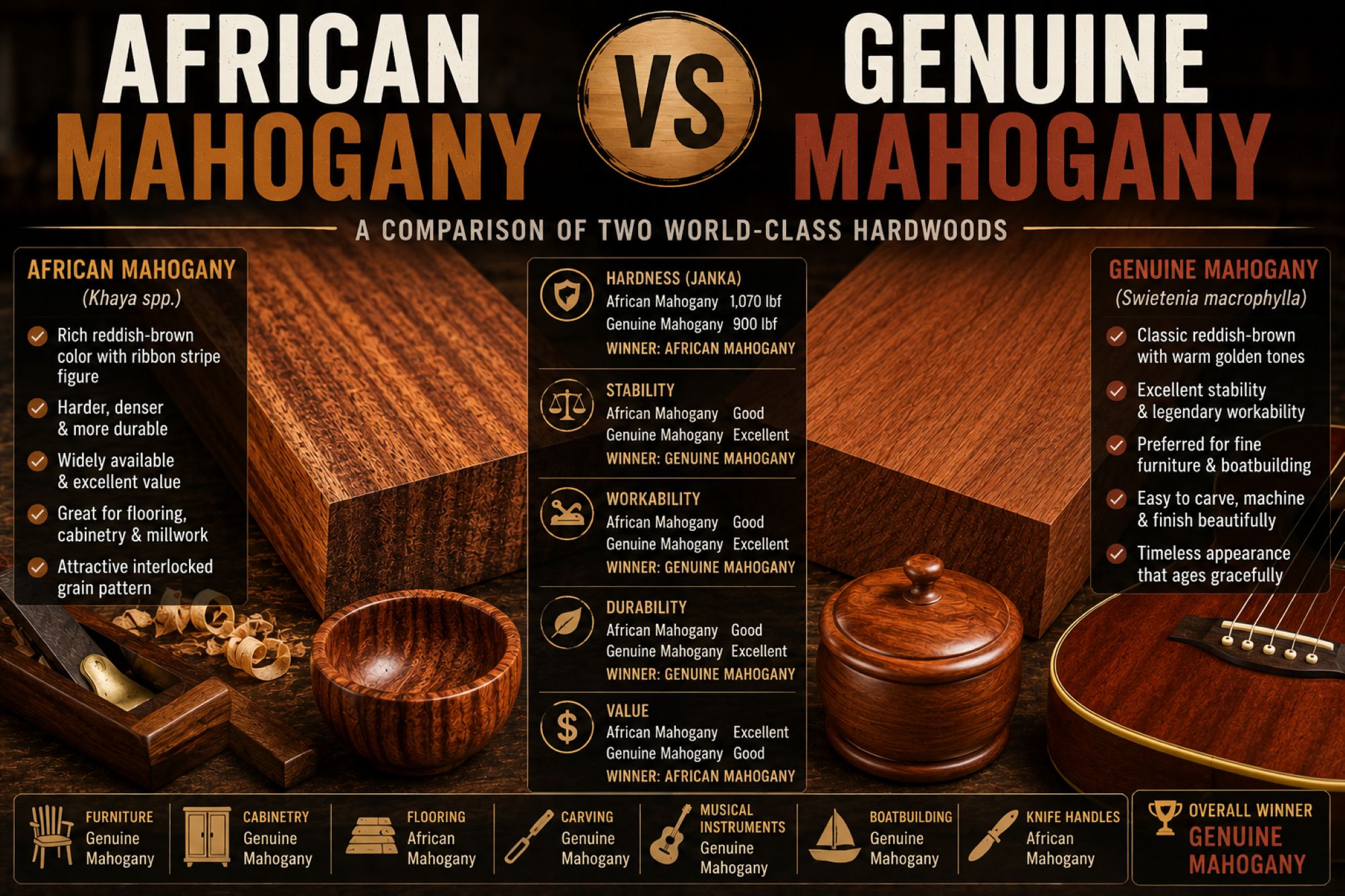
African Mahogany vs. Genuine Mahogany
A side-by-side comparison of African Mahogany and Genuine Mahogany, examining their appearance, hardness, durability, workability, stability, and the woodworking applications where each species excels.
Overview
African Mahogany and Genuine Mahogany are two of the world’s most respected hardwoods, prized for centuries for their beauty, workability, and versatility. While they share the common name “mahogany,” they come from different botanical genera and possess distinct characteristics that influence their performance in woodworking.
African Mahogany, harvested from several species within the Khaya genus, has become one of the most widely used alternatives to Genuine Mahogany due to its availability and affordability. Genuine Mahogany (Swietenia macrophylla) has long been considered the benchmark for fine furniture, cabinetry, boatbuilding, and musical instruments.
This guide compares these two exceptional hardwoods to help determine which is the better choice for your next woodworking project.
Species Overview
| Characteristic | African Mahogany | Genuine Mahogany |
|---|---|---|
| Scientific Name | Khaya spp. | Swietenia macrophylla |
| Family | Meliaceae | Meliaceae |
| Native Range | Tropical Africa | Central & South America |
| Wood Type | Hardwood | Hardwood |
Appearance
African Mahogany
African Mahogany ranges from pale pinkish-brown to medium reddish-brown and often darkens with age. Some boards display attractive ribbon stripe figure due to interlocked grain.
Characteristics
- Pink to reddish-brown
- Ribbon stripe figure
- Medium natural luster
- Moderate color variation
- Attractive interlocked grain
Genuine Mahogany
Genuine Mahogany is known for its rich reddish-brown heartwood that develops a deep, elegant patina over time. The grain is typically more uniform than African Mahogany.
Characteristics
- Rich reddish-brown
- Warm golden undertones
- Uniform appearance
- Fine natural luster
- Elegant aging
🏆 Appearance Winner: Genuine Mahogany
Grain & Texture
African Mahogany
- Medium texture
- Frequently interlocked grain
- Ribbon stripe figure
- Moderate natural luster
Genuine Mahogany
- Fine to medium texture
- Generally straight grain
- Uniform appearance
- Smooth surface
🏆 Grain & Texture Winner: Genuine Mahogany
Hardness
Approximate Janka Hardness:
African Mahogany
- 1,070 lbf
Genuine Mahogany
- 900 lbf
African Mahogany provides greater dent resistance.
🏆 Hardness Winner: African Mahogany
Density
Approximate Specific Gravity:
African Mahogany
- 0.54
Genuine Mahogany
- 0.50
African Mahogany is generally denser.
🏆 Density Winner: African Mahogany
Dimensional Stability
Both woods are exceptionally stable and have long histories in fine woodworking.
Genuine Mahogany has earned a legendary reputation for remaining stable under changing environmental conditions.
🏆 Stability Winner: Genuine Mahogany
Durability
Both species offer good natural durability.
Genuine Mahogany has a slightly longer historical record in marine and exterior applications.
🏆 Durability Winner: Genuine Mahogany
Workability
African Mahogany
- Machines well
- Sands easily
- Can exhibit tear-out due to interlocked grain
- Accepts finishes well
- Glues easily
Genuine Mahogany
- Exceptional machining
- Outstanding hand-tool performance
- Excellent carving qualities
- Easy finishing
- Minimal tear-out
Genuine Mahogany has long been considered one of the easiest premium hardwoods to work.
🏆 Workability Winner: Genuine Mahogany
Turning Performance
Both species turn exceptionally well.
African Mahogany’s greater hardness produces crisp details, while Genuine Mahogany cuts effortlessly.
🏆 Turning Winner: Tie
Carving
Genuine Mahogany’s straight grain and uniform texture make it one of the finest carving woods available.
🏆 Carving Winner: Genuine Mahogany
Furniture
Both woods are outstanding furniture woods.
African Mahogany is widely used in modern furniture manufacturing.
Genuine Mahogany has been the standard for luxury furniture for centuries.
🏆 Furniture Winner: Genuine Mahogany
Cabinetry
Both species make excellent cabinetry.
African Mahogany provides outstanding value for large cabinet projects.
Genuine Mahogany offers a more refined appearance.
🏆 Cabinetry Winner: Genuine Mahogany
Flooring
African Mahogany’s greater hardness makes it better suited for hardwood flooring.
🏆 Flooring Winner: African Mahogany
Knife Handles
African Mahogany’s higher density provides better durability for knife handles.
🏆 Knife Handle Winner: African Mahogany
Musical Instruments
Both woods have been widely used for guitars and other stringed instruments.
Genuine Mahogany remains the traditional choice for premium acoustic guitars.
🏆 Musical Instrument Winner: Genuine Mahogany
Boatbuilding
Both woods have excellent marine histories.
Genuine Mahogany has been one of the world’s premier boatbuilding woods for over a century.
🏆 Boatbuilding Winner: Genuine Mahogany
Outdoor Use
Both species perform well when properly finished.
Genuine Mahogany’s long history in exterior joinery and marine applications gives it a slight advantage.
🏆 Outdoor Use Winner: Genuine Mahogany
Availability
African Mahogany is considerably more available in today’s lumber market.
🏆 Availability Winner: African Mahogany
Value
African Mahogany offers many of the desirable characteristics of Genuine Mahogany at a significantly lower average price.
🏆 Value Winner: African Mahogany
Best Uses
African Mahogany
- Furniture
- Cabinetry
- Hardwood flooring
- Interior trim
- Doors
- Millwork
- Turnings
- Knife handles
- Decorative panels
Genuine Mahogany
- Luxury furniture
- Premium cabinetry
- Boatbuilding
- Musical instruments
- Architectural millwork
- Carving
- Veneers
- Fine joinery
- Heirloom furniture
Pros & Cons
African Mahogany
Pros
- Greater hardness
- Excellent value
- Widely available
- Attractive ribbon stripe figure
- Machines well
Cons
- Interlocked grain may cause tear-out
- Color variation between boards
Genuine Mahogany
Pros
- Legendary workability
- Exceptional stability
- Beautiful aging
- Excellent carving qualities
- Premium appearance
Cons
- Higher cost
- More limited availability
- Increasing conservation concerns in some regions
Which Wood Should You Choose?
Choose African Mahogany if you want:
- Better value
- Greater hardness
- Wider availability
- Flooring
- Large cabinetry projects
- Decorative ribbon stripe figure
Choose Genuine Mahogany if you want:
- Premium furniture
- Traditional heirloom projects
- Superior workability
- Fine carving
- Boatbuilding
- Musical instruments
- The classic mahogany appearance
Final Verdict
| Category | Winner |
|---|---|
| Appearance | Genuine Mahogany |
| Grain & Texture | Genuine Mahogany |
| Hardness | African Mahogany |
| Density | African Mahogany |
| Stability | Genuine Mahogany |
| Durability | Genuine Mahogany |
| Workability | Genuine Mahogany |
| Turning | Tie |
| Carving | Genuine Mahogany |
| Furniture | Genuine Mahogany |
| Cabinetry | Genuine Mahogany |
| Flooring | African Mahogany |
| Knife Handles | African Mahogany |
| Musical Instruments | Genuine Mahogany |
| Boatbuilding | Genuine Mahogany |
| Outdoor Use | Genuine Mahogany |
| Availability | African Mahogany |
| Value | African Mahogany |
🏆 Overall Winner: Genuine Mahogany
Genuine Mahogany earns the overall victory because of its legendary workability, exceptional dimensional stability, elegant appearance, and centuries-long reputation as one of the world’s finest furniture and woodworking timbers. Its superior machining characteristics and timeless beauty continue to make it the benchmark against which other mahogany species are measured.
African Mahogany remains an outstanding alternative, offering greater hardness, excellent durability, wider availability, and significantly better value. For many modern woodworking projects, it provides exceptional performance at a more accessible price while retaining much of the classic beauty associated with mahogany.
Related Guides
- Mahogany Species Guide
- Best Woods for Furniture
- Best Woods for Cabinetry
- Best Woods for Musical Instruments
- Wood Grain Patterns and Figure Explained
- Wood Density and Janka Hardness Chart
- Understanding Wood Movement and Seasonal Expansion
Collector Notes
Although African Mahogany and Genuine Mahogany belong to the same botanical family (Meliaceae), they represent two distinct groups of hardwoods with unique characteristics. Genuine Mahogany has long been regarded as the gold standard for fine woodworking, prized for its unmatched workability and rich, aging beauty. African Mahogany, with its striking ribbon-stripe figure and greater hardness, has become one of the most successful and widely accepted alternatives. Both species remain highly valued by woodworkers and collectors, each offering exceptional beauty, versatility, and craftsmanship potential.