
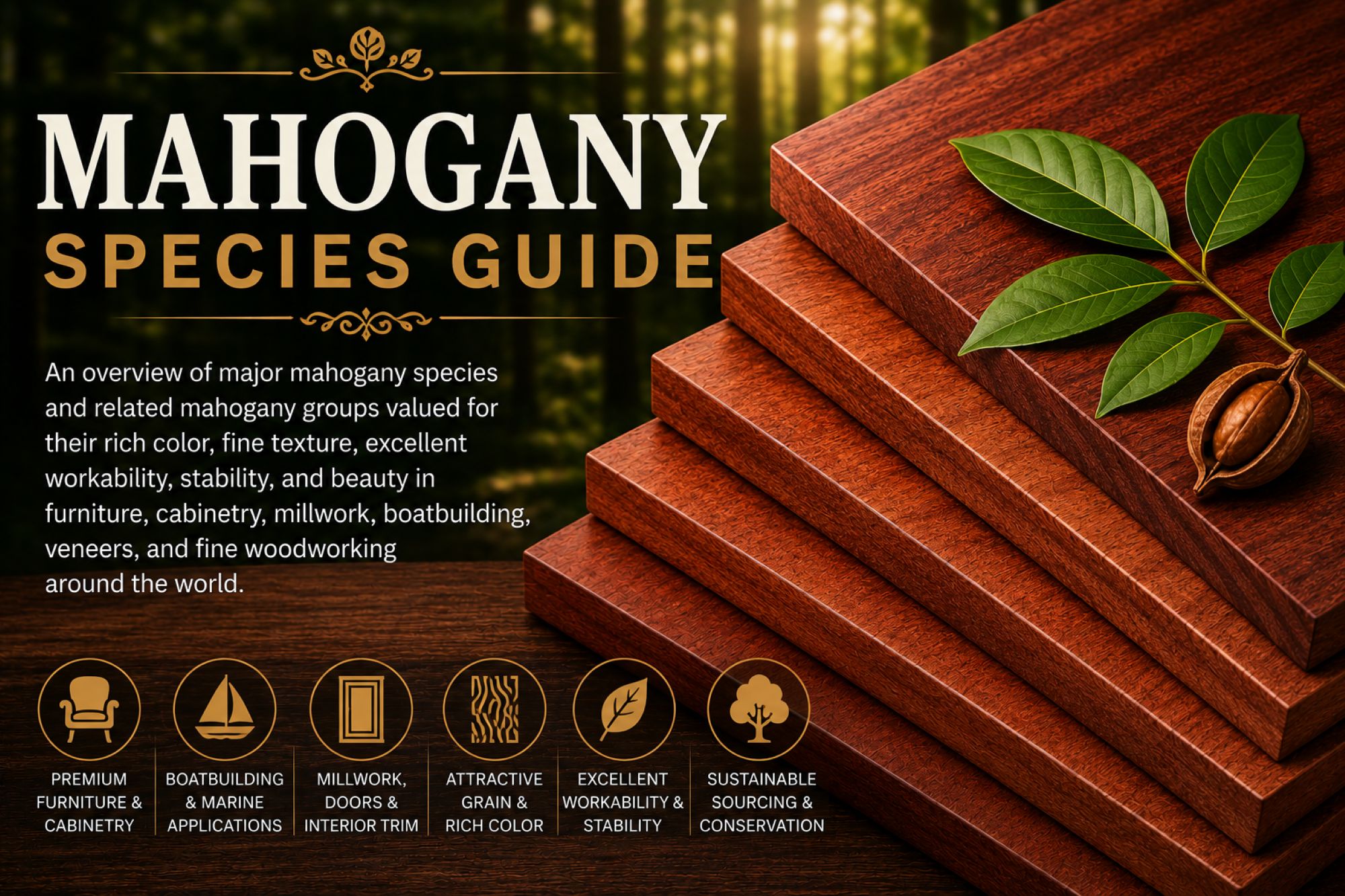
Mahogany Species Guide
Overview of major mahogany species including Swietenia woods and related mahogany groups valued for furniture, cabinetry, boatbuilding, millwork, veneer production, and fine woodworking throughout the world.
Overview
Mahogany is one of the most recognized and respected wood groups in the world. For centuries, mahogany woods have been prized for their beauty, stability, workability, and rich coloration, making them a preferred material for fine furniture, cabinetry, musical instruments, luxury interiors, and boatbuilding.
While the term “Mahogany” is often used broadly in the timber trade, true mahogany belongs to the genus Swietenia. However, several related wood groups—including African Mahogany, Sapele, and other tropical hardwoods—are commonly marketed as mahogany due to their similar appearance and woodworking characteristics.
This guide serves as an overview of both the true mahogany species and the major related mahogany groups found throughout the world.
True Mahogany (Swietenia)
The genus Swietenia represents the true mahoganies and belongs to the Meliaceae family.
True mahoganies are known for:
- Rich reddish-brown coloration
- Excellent dimensional stability
- Superior workability
- Fine furniture applications
- Decorative figure
- Premium veneer production
- Historic importance
- Exceptional finishing qualities
These woods are considered among the finest furniture timbers ever harvested.
Notable True Mahogany Species
Bigleaf Mahogany (Swietenia macrophylla)
The most commercially important true mahogany species, widely used in furniture, cabinetry, millwork, veneers, and luxury woodworking applications.
Cuban Mahogany (Swietenia mahagoni)
Historically regarded as one of the finest furniture woods in the world and closely associated with antique furniture production.
Pacific Mahogany (Swietenia humilis)
A smaller Central American species valued regionally for woodworking and specialty timber applications.
Related Mahogany Groups
Several important hardwoods are commonly marketed as mahogany despite belonging to different genera.
African Mahogany (Khaya)
The African Mahogany group belongs to the genus Khaya and includes several important African timber species.
Related page:
Khaya Species Guide
Major species include:
- African Mahogany (Khaya ivorensis)
- East African Mahogany (Khaya anthotheca)
- Large-Leaved Mahogany (Khaya grandifoliola)
- Senegal Mahogany (Khaya senegalensis)
- Madagascar Mahogany (Khaya madagascariensis)
Sapele
One of the most important mahogany substitutes in the world.
Species:
Widely used in:
- Furniture
- Doors
- Millwork
- Musical instruments
- Veneer
Utile
Another important African hardwood frequently grouped with mahogany woods.
Species:
Known for its attractive grain and stability.
Spanish Cedar
Although not a true cedar, Spanish Cedar belongs to the same family as mahogany.
Species:
Common uses include:
- Humidors
- Cabinetry
- Millwork
- Boatbuilding
Common Characteristics of Mahogany Woods
Although individual species vary, many mahogany woods share several recognizable traits.
Common Mahogany Traits
- Medium-density hardwood structure
- Excellent workability
- Good dimensional stability
- Attractive reddish-brown coloration
- Fine to medium texture
- Good natural luster
- Straight to interlocked grain
- Outstanding finishing qualities
These characteristics have made mahogany one of the most sought-after wood groups in history.
Common Uses
Mahogany woods have been used in some of the world’s finest woodworking projects.
Common Applications
- Fine furniture
- Cabinetry
- Architectural millwork
- Boatbuilding
- Veneer
- Musical instruments
- Doors
- Interior trim
- Luxury interiors
- Turned objects
- Carving
- Specialty woodworking
Few hardwood groups can match mahogany’s combination of beauty and versatility.
Identification Characteristics
Many mahogany woods share several visual characteristics.
Common Identification Traits
- Reddish-brown heartwood
- Fine to medium texture
- Moderate natural luster
- Straight or interlocked grain
- Excellent finishing qualities
- Attractive ribbon figure in some species
- Uniform appearance
The rich color and elegant grain patterns make mahogany easy to recognize.
Sustainability and Conservation
Several mahogany species face conservation concerns due to historical overharvesting and strong international demand.
Sustainability considerations may vary depending on:
- Species
- Country of origin
- Forestry regulations
- Certification programs
- Conservation status
Responsible sourcing remains critical for the long-term preservation of these valuable hardwood resources.
Related Wood Family and Trade Group Pages
Explore additional wood family and trade-group guides:
- Khaya Species Guide
- Walnut Species Guide
- Oak Species Guide
- Pterocarpus Species Guide
- Wood Families & Trade Groups
Compare Wood Properties
Compare mahogany woods alongside hundreds of hardwood species using the Exotic Woods of the World database.
Related resources:
- Wood Density and Janka Hardness Chart
- Hardest Woods in the World
- Most Dense Woods in the World
- Wood Grain Patterns and Figure Explained
Collector Notes
Mahogany represents one of the most prestigious wood groups in history. From the legendary Cuban Mahogany of antique furniture to modern African Mahogany and Sapele, these woods have shaped woodworking traditions for centuries. Understanding the broader mahogany group helps collectors distinguish between true mahogany species and the many related woods that share their beauty, performance, and enduring appeal.