

Mildbraed’s Pterocarpus
Scientific name: Pterocarpus mildbraedii
Overview
Mildbraed’s Pterocarpus (Pterocarpus mildbraedii) is a large African forest tree in the legume family. It occurs mainly in West and west-central tropical Africa, with a separated East African population in the Usambara and Udzungwa mountain regions of Tanzania. Unlike the better-known commercial padauks, it is rarely harvested as an international timber. Local communities value the tree for carved mortars, edible leaves, shade in cocoa farms, and other practical uses.
Quick Facts
- Common Name: Mildbraed’s Pterocarpus
- Alternate Common Name(s): White Padauk, Padouk Blanc, Mkula, Oha
- Scientific Name: Pterocarpus mildbraedii
- Region: African Woods
- Tree Size: Typically 50–118 ft (15–36 m) tall
- Average Dried Weight: Reliable published data is limited
- Janka Hardness: Reliable published data is limited
- Grain: Usually straight to mildly interlocked
- Texture: Fine to moderately fine
Identification Characteristics
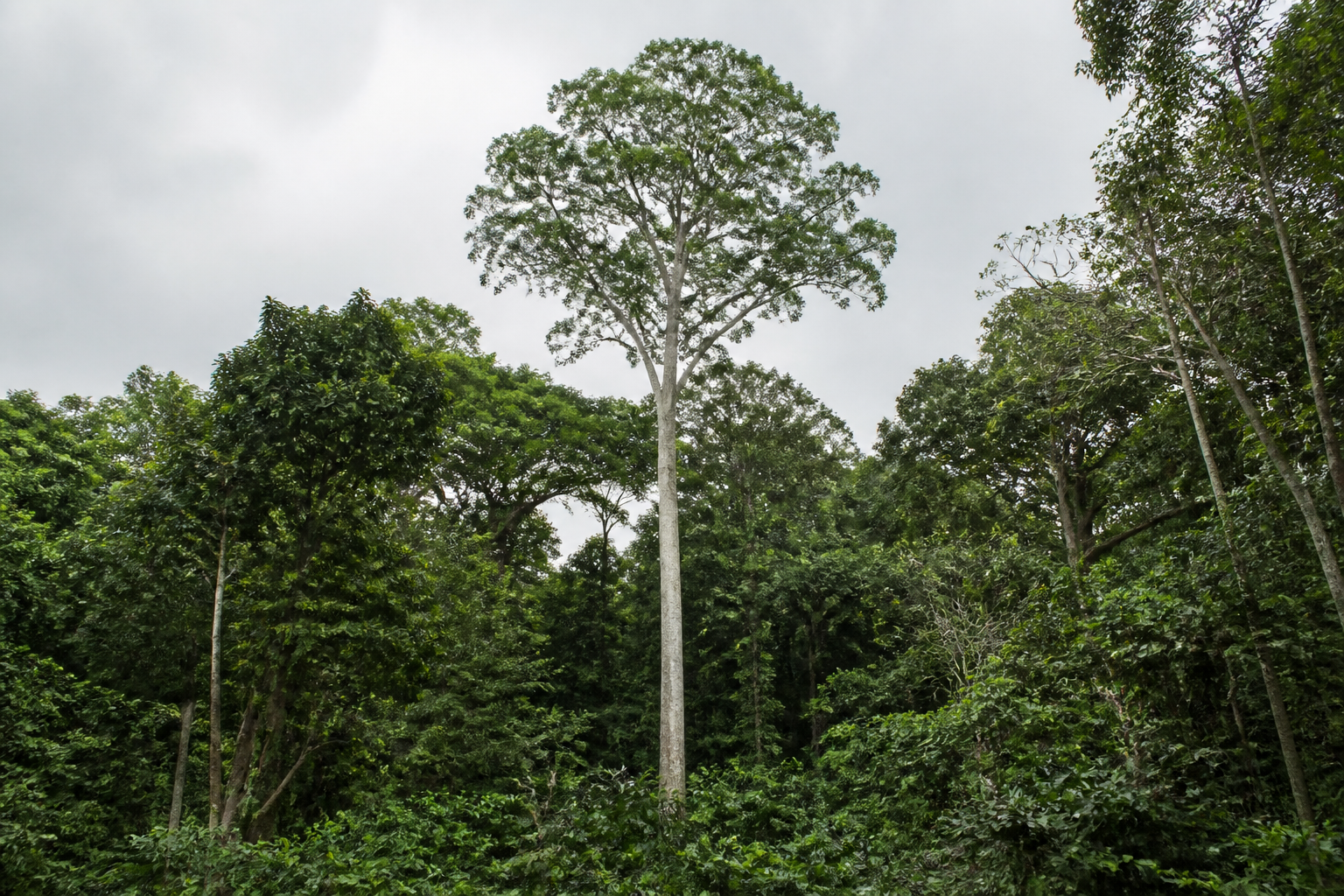
In East African descriptions, the species can become a tall tree with a long, straight bole and a relatively small rounded crown. The bark is smooth, gray to pale brown, and a cut in the bark exudes red gum—a useful clue shared with other members of Pterocarpus. The leaves are alternate and pinnately compound, with ovate to elliptic leaflets.
Golden-yellow flowers are followed by conspicuous, large, flat, winged fruits. These fruits are broadly rounded to obovate and thin rather than thickened and woody. Timber identification is difficult because verified reference samples and commercial property records are scarce.
Key identification traits include:
- Large forest tree with a long clean trunk and high rounded crown
- Smooth gray or pale-brown bark that yields red gum when cut
- Compound leaves with several broad, pointed leaflets
- Clusters of golden-yellow pea-family flowers
- Large, flat, broadly winged pods with a single seed chamber
- Pale, comparatively understated timber rather than the vivid red-orange color of commercial African padauk

Working Properties
Detailed, independently tested working-property data for this species is limited. Published references describe timber use as uncommon and primarily local, so shop behavior should not be assumed from the better-known red padauks. Woodworkers fortunate enough to obtain verified material should begin with test cuts and record the specimen’s density, moisture content, grain, and response to tools.
- Use sharp cutters and moderate feed rates until grain behavior is understood.
- Test planing direction on each face to minimize lifting or tear-out.
- Pre-drill near ends and edges before installing fasteners.
- Test adhesives and finishes on an offcut, especially if gum or extractives are present.
- Dry thick sections slowly and monitor them for checking and distortion.
- Preserve labeled offcuts as reference material because authenticated samples are uncommon.
Safety Note
Treat the dust as potentially irritating even though species-specific occupational reports are limited. Use effective dust collection, eye protection, and a properly fitted respirator during sawing, routing, turning, and sanding. Avoid skin contact with dust and wash after handling. The edible use of properly prepared leaves does not imply that wood dust or bark extracts are safe to inhale or ingest.
Common Uses


Mildbraed’s Pterocarpus is rarely exploited for timber. Documented uses emphasize carved mortars and other local utility objects. The living tree may be retained or planted as shade in cocoa-growing systems, while its young leaves are cooked as a vegetable in parts of Nigeria. These non-timber roles can be more important locally than lumber production.
- Traditional carved mortars and pestles
- Small household implements and local utility carving
- Shade tree in cocoa agroforestry
- Cooked leafy vegetable in regional cuisine
- Traditional plant uses, which require appropriate local knowledge
Sustainability & Notes
The species occupies lowland rainforest, dry evergreen forest, and riverine forest, reaching about 1,250 m elevation overall. Forest clearing and urban expansion can affect local populations even where the species is not a major timber target. Its ability to grow rapidly and coppice well may support carefully designed agroforestry or restoration work, but planting should use locally appropriate genetic material.
Current references have reported differing conservation assessments over time. Buyers should therefore consult current national rules and authoritative conservation databases, and should never interpret a broad status category as proof that an individual shipment is legal or responsibly harvested.
Comparative Notes & Related Species
African Padauk – A much better-known commercial Pterocarpus, notable for vivid orange-red heartwood that darkens with exposure.
Mukula – A southern and central African species whose red timber has faced intense commercial pressure.
African Barwood – A more dry-forest-associated species with different foliage and ecological preferences.
Osun – Another West African Pterocarpus that can be confused in poorly documented trade.
Related Guides
- How to Identify Exotic Hardwood by Grain Pattern
- Wood Identification
- How to Store Exotic Wood Samples
Compare Wood Properties
See how this species ranks in density and hardness using our Wood Density & Janka Hardness Chart. You can also explore Hardest Woods, Softest Woods, and Most Dense Woods for quick comparisons.
Collector Notes
A documented specimen can be valuable because the timber is uncommon in international collections. Retain supplier records, locality information, photographs, and botanical authentication with the sample. Avoid purchasing material identified only as “padauk” or “mkula,” since those names may refer to several species.
Share Your Photos of This Species
Do you have lumber, wood samples, tree photographs, woodworking projects, furniture, carvings, turnings, musical instruments, or other items made from this species?
Exotic Woods of the World welcomes photographs from woodworkers, collectors, sawyers, researchers, and wood enthusiasts around the world. Selected submissions may be featured on this page and throughout our website to help document and showcase real-world examples of this species.
When submitting photos, please include the common name, scientific name (if known), a brief description, and any information you would like us to share with the image.
Wood Sample Collection
This species is part of an ongoing effort to document and preserve wood samples from around the world.
Learn more about contributing to the collection:
Resources
Authoritative botanical and forestry references used in compiling information about this species include:
• USDA Forest Service – Wood Handbook: Wood as an Engineering Material
https://www.fpl.fs.usda.gov/products/publications/
• The Wood Database – Global reference for wood identification, physical properties, and woodworking characteristics
https://www.wood-database.com/
• Royal Botanic Gardens, Kew – Plants of the World Online – Botanical taxonomy and species distribution database
https://powo.science.kew.org/
• International Union for Conservation of Nature (IUCN Red List) – Global conservation status assessments
https://www.iucnredlist.org/
• Convention on International Trade in Endangered Species (CITES) – International trade regulations for protected plant species
https://cites.org/
Additional forestry publications, academic research papers, and regional timber studies may also be referenced where available.
Love This Species?
Enjoy learning about this wood species?
Help support the continued growth of Exotic Woods of the World by participating in our Adopt a Species program. Your support helps fund species research, educational content, photography, videos, and future conservation awareness initiatives.
Support Forest Conservation
This species is part of the growing Exotic Woods of the World reference archive, dedicated to documenting and preserving knowledge of the world’s wood species.
Through the Adopt a Species program, visitors can help support ongoing species research, educational content, photography, video production, and future conservation awareness initiatives.
Contributions help fund the continued expansion of this archive while promoting sustainable forestry education and the long-term appreciation of the world’s forests.
Interested in supporting this species? Visit our Adopt a Species and Conservation Partners pages to learn more.
Availability & Where to Buy
Exotic hardwood availability can vary significantly depending on region, sustainability regulations, and supplier inventory.
As this archive grows, recommended suppliers and specialty wood retailers will be listed here to help woodworkers locate responsibly sourced material.
Lumber Suppliers:
Availability varies — see the Where to Buy Exotic Woods page for current sources.
Related Tools & Products:
Availability varies — see the Where to Buy Exotic Woods page for current sources.
Share This Wood Species
Stay Connected
Follow the latest species additions, educational resources, videos, conservation initiatives, and major project milestones through our Site Updates archive.
The Site Updates archive provides a permanent record of new content, library growth, and future developments across Exotic Woods of the World.