
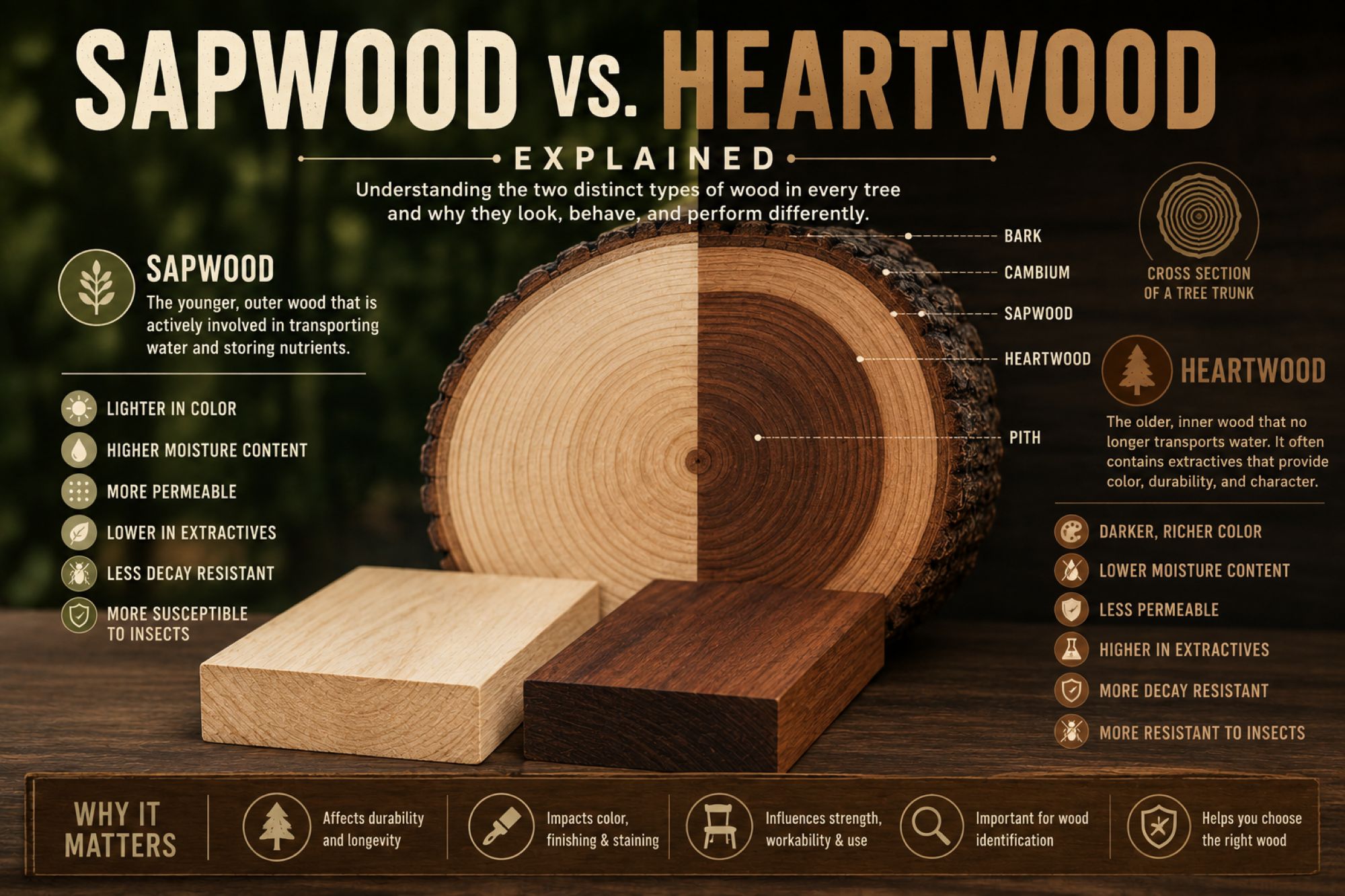
Sapwood vs. Heartwood Explained
A comprehensive guide to the differences between sapwood and heartwood, including their location within the tree, color, biological function, durability, moisture content, appearance, and importance in woodworking and wood identification.
Overview
Cut across the trunk of almost any mature tree and two visually distinct areas may be visible: a lighter outer region and a darker inner core. These regions are commonly known as sapwood and heartwood.
Although both are part of the tree’s secondary xylem, they perform very different roles during the life of the tree and can have significantly different characteristics once the tree is converted into lumber.
Sapwood is the younger, active wood located toward the outside of the trunk. It participates in transporting water and dissolved minerals upward through the tree and also stores nutrients.
Heartwood develops from older inner sapwood that is no longer actively involved in water transport. As this transformation occurs, the tree may deposit extractives and other compounds within the cells, often changing the wood’s color, odor, permeability, and natural durability.
Understanding the difference between sapwood and heartwood is important for wood identification, lumber selection, furniture making, exterior woodworking, finishing, and collecting.
What Is Sapwood?
Sapwood is the younger wood located toward the outside of the trunk, immediately inside the cambium.
It contains functioning xylem tissue involved in transporting water and dissolved minerals from the roots toward the crown.
Sapwood also serves as a storage area for carbohydrates and other nutrients.
Common Sapwood Characteristics
Sapwood is often:
- Lighter in color
- Higher in moisture when freshly cut
- More permeable
- Lower in extractives
- Less naturally decay resistant
- More susceptible to some insects
- Located around the outer portion of the trunk
The amount of sapwood varies considerably between species and individual trees.
What Is Heartwood?
Heartwood is the older, nonconducting wood located toward the center of the trunk.
As sapwood ages, some of the inner cells cease functioning in water transport. The tree may then deposit chemicals known as extractives within this older wood.
These compounds can produce many of the characteristics associated with heartwood.
Common Heartwood Characteristics
Heartwood is often:
- Darker in color
- Less permeable
- Richer in extractives
- More naturally decay resistant in some species
- More resistant to certain insects
- Located toward the center of the trunk
- Responsible for much of a species’ characteristic wood color
Heartwood remains structurally important even though it no longer actively transports water.
Where Are Sapwood and Heartwood Located?
Looking at the cross-section of a mature tree trunk:
Outside → Inside
Bark
Cambium
Sapwood
Heartwood
Pith
Sapwood forms a band surrounding the heartwood.
The relative width of these regions varies dramatically between species.
Some trees develop:
- Very narrow sapwood
- Wide bands of sapwood
- Large heartwood cores
- Little visible distinction between heartwood and sapwood
Age, growth rate, environment, and tree health can also influence their proportions.
How Sapwood Becomes Heartwood
Heartwood formation occurs gradually as a tree grows.
New wood is produced near the outside of the trunk. As additional growth rings accumulate, older inner sapwood becomes less involved in water transport.
During heartwood formation:
- Living cells in the older xylem die
- Water transport decreases or stops
- Stored materials may be redistributed
- Extractives may accumulate
- Permeability may decrease
- Color may change
- Natural durability may increase
The exact process varies among species.
Color Differences
Color is often the easiest way to distinguish sapwood from heartwood.
Sapwood
Common colors include:
- White
- Cream
- Pale yellow
- Light tan
Heartwood
Heartwood may develop colors such as:
- Golden brown
- Reddish brown
- Chocolate brown
- Purple
- Orange
- Black
- Olive
- Deep red
These colors are frequently produced by naturally occurring extractives.
Species With Strong Heartwood and Sapwood Contrast
Some woods display dramatic differences between the two regions.
Examples include:
Black Walnut
Heartwood is typically rich chocolate brown, while sapwood is pale cream to yellowish.
Eastern Red Cedar
Heartwood may be reddish or purplish brown while sapwood is nearly white.
Black Cherry
Heartwood develops warm reddish-brown coloration while sapwood remains considerably lighter.
Cocobolo
Heartwood can display orange, red, brown, and dark streaking while sapwood is much paler.
Purpleheart
Fresh heartwood eventually develops its famous purple coloration while the sapwood remains pale.
These contrasts can become an important part of a finished project’s appearance.
Species With Limited Color Contrast
Not every species develops dramatically darker heartwood.
Some woods may have relatively subtle differences between sapwood and heartwood.
In these species, identification may require examination of:
- End grain
- Pore structure
- Growth rings
- Rays
- Texture
- Geographic origin
Color alone should never be considered a definitive identification method.
Does Heartwood Make the Tree Stronger?
Heartwood continues to provide structural support to the tree even though it is no longer actively conducting water.
However, the distinction between heartwood and sapwood does not automatically mean heartwood is mechanically stronger.
For many species, the basic strength properties of clear sapwood and heartwood can be relatively similar.
The major differences are more commonly associated with:
- Extractives
- Permeability
- Moisture
- Color
- Natural durability
This distinction is important because darker heartwood is sometimes incorrectly assumed to always be stronger.
Natural Durability
One of the most important differences between sapwood and heartwood is natural durability.
Heartwood in certain species contains extractives that resist:
- Fungal decay
- Insects
- Moisture-related deterioration
Examples of woods known for naturally durable heartwood include:
Sapwood from these same trees may have considerably less natural durability.
The durability reputation of many species therefore applies primarily to the heartwood rather than the sapwood.
Sapwood and Insect Attack
Sapwood frequently contains stored nutrients that can make it more attractive to wood-boring insects.
Depending on the species and environment, insects may preferentially attack sapwood while leaving durable heartwood relatively unaffected.
This is especially important when evaluating:
- Reclaimed lumber
- Stored lumber
- Logs
- Antique furniture
- Wood collections
Small holes, galleries, powder, or frass near pale outer wood may indicate previous insect activity.
Moisture Content
Fresh sapwood generally contains considerably more moisture than heartwood because it participates in water transport.
After lumber is properly dried, however, both sapwood and heartwood eventually move toward an equilibrium moisture content determined largely by surrounding temperature and relative humidity.
This means the dramatic moisture difference present in a living tree does not remain indefinitely after drying.
Permeability
Sapwood is generally more permeable than heartwood.
This can make sapwood easier to:
- Pressure treat
- Impregnate with preservatives
- Penetrate with certain chemicals
Heartwood can be significantly more resistant to penetration because of extractives, blocked pathways, or other anatomical changes.
This difference is especially important in commercial lumber treatment.
Heartwood Extractives
Extractives are naturally occurring compounds deposited within wood.
Depending on the species, they can include:
- Oils
- Resins
- Tannins
- Gums
- Waxes
- Phenolic compounds
- Pigments
These compounds may influence:
- Color
- Odor
- Decay resistance
- Insect resistance
- Gluing
- Finishing
- Natural luster
Some of the most distinctive exotic hardwood colors are largely the result of heartwood extractives.
Sapwood and Woodworking
Sapwood is not automatically defective or unusable.
It can be intentionally incorporated into woodworking projects to create visual contrast.
Examples include:
- Walnut furniture with pale sapwood accents
- Live-edge slabs
- Turned bowls
- Decorative boxes
- Sculptural pieces
- Natural-edge furniture
However, sapwood may require additional consideration where natural decay resistance is important.
Heartwood and Woodworking
Heartwood is often preferred when woodworkers want:
- Characteristic species coloration
- Natural durability
- Uniform appearance
- Premium-grade lumber
- Exterior performance
In many exotic hardwoods, the heartwood is the portion responsible for the species’ commercial value.
Examples include the dramatic colors and patterns associated with:
Sapwood in Live-Edge Lumber
Live-edge slabs frequently retain some or all of their sapwood.
This can produce dramatic natural contrast between:
- Pale sapwood
- Dark heartwood
- Bark edge
Walnut is particularly well known for this appearance.
Whether sapwood is retained or removed depends largely on:
- Project design
- Desired appearance
- Condition of the wood
- Insect damage
- Intended environment
Sapwood and Exterior Projects
When selecting naturally durable lumber for exterior applications, it is important to determine whether the durability rating applies to the entire board.
In many species, only the heartwood provides strong natural decay resistance.
Large amounts of sapwood can therefore reduce the expected durability of an exterior project.
This consideration is particularly important for:
- Decking
- Outdoor furniture
- Fencing
- Exterior trim
- Garden structures
- Boatbuilding
Sapwood and Heartwood in Wood Identification
The relationship between sapwood and heartwood can provide an important identification clue.
Wood identifiers may examine:
- Sapwood color
- Heartwood color
- Width of sapwood
- Sharpness of the color transition
- Extractive deposits
- Fluorescence
- Odor
These characteristics should be combined with anatomical features rather than used independently.
Common Misconceptions
“Heartwood is the living part of the tree.”
False.
Sapwood contains the active conducting xylem and living storage cells. Heartwood no longer actively conducts water.
“Sapwood is bad wood.”
False.
Sapwood can be structurally useful and visually attractive. Its suitability depends on the application.
“Heartwood is always stronger.”
False.
Heartwood may be more naturally durable, but it is not necessarily mechanically stronger.
“Dark wood is always heartwood.”
Not necessarily.
Wood coloration can also be influenced by staining, mineral deposits, fungal activity, oxidation, finishing, and other factors.
“Naturally durable wood is durable everywhere in the board.”
Not necessarily.
In many species, published natural durability primarily describes the heartwood.
Frequently Asked Questions
Is heartwood dead?
Heartwood no longer contains the functioning living cells associated with active sapwood and does not conduct water. However, it remains an important structural part of the tree.
Can sapwood be used for furniture?
Yes. Sapwood is commonly used in furniture and can create attractive color contrast, particularly in species such as Walnut.
Should sapwood be removed for outdoor projects?
That depends on the species and application. Where natural decay resistance is important, minimizing sapwood is often desirable because sapwood generally has much lower natural durability.
Why is heartwood darker?
Many species deposit pigments, oils, tannins, resins, and other extractives as sapwood transitions into heartwood. These compounds frequently darken the wood.
Does every tree have visible heartwood?
No. Some species have little visible color difference between sapwood and heartwood.
Is heartwood always more expensive?
Not always, but in species prized for distinctive heartwood coloration or natural durability, lumber containing mostly heartwood may command a premium.
Related Guides
Continue exploring the Exotic Woods of the World educational library:
- Wood Grain Patterns and Figure Explained
- Wood Identification Guide
- Understanding Wood Movement and Seasonal Expansion
- Understanding Wood Shrinkage Values Explained
- Wood Moisture Content Guide
- Wood Density and Janka Hardness Chart
- Wood Toxicity and Allergies Guide
- Wood Drying and Kiln-Drying Guide
Collector Notes
The distinction between sapwood and heartwood is one of the most fundamental concepts in understanding wood. What appears to be a simple color change across a board actually reflects major changes that occurred within the tree as it grew.
Sapwood represents the younger, active portion of the tree’s wood, while heartwood represents older wood that has transitioned away from water transport and, in many species, accumulated the extractives responsible for distinctive color, aroma, and natural durability.
For wood collectors, this distinction is particularly important. A single sample containing both sapwood and heartwood can reveal far more about a species than a uniformly colored heartwood sample alone, showing how dramatically the appearance and properties of wood can change within a single tree.