
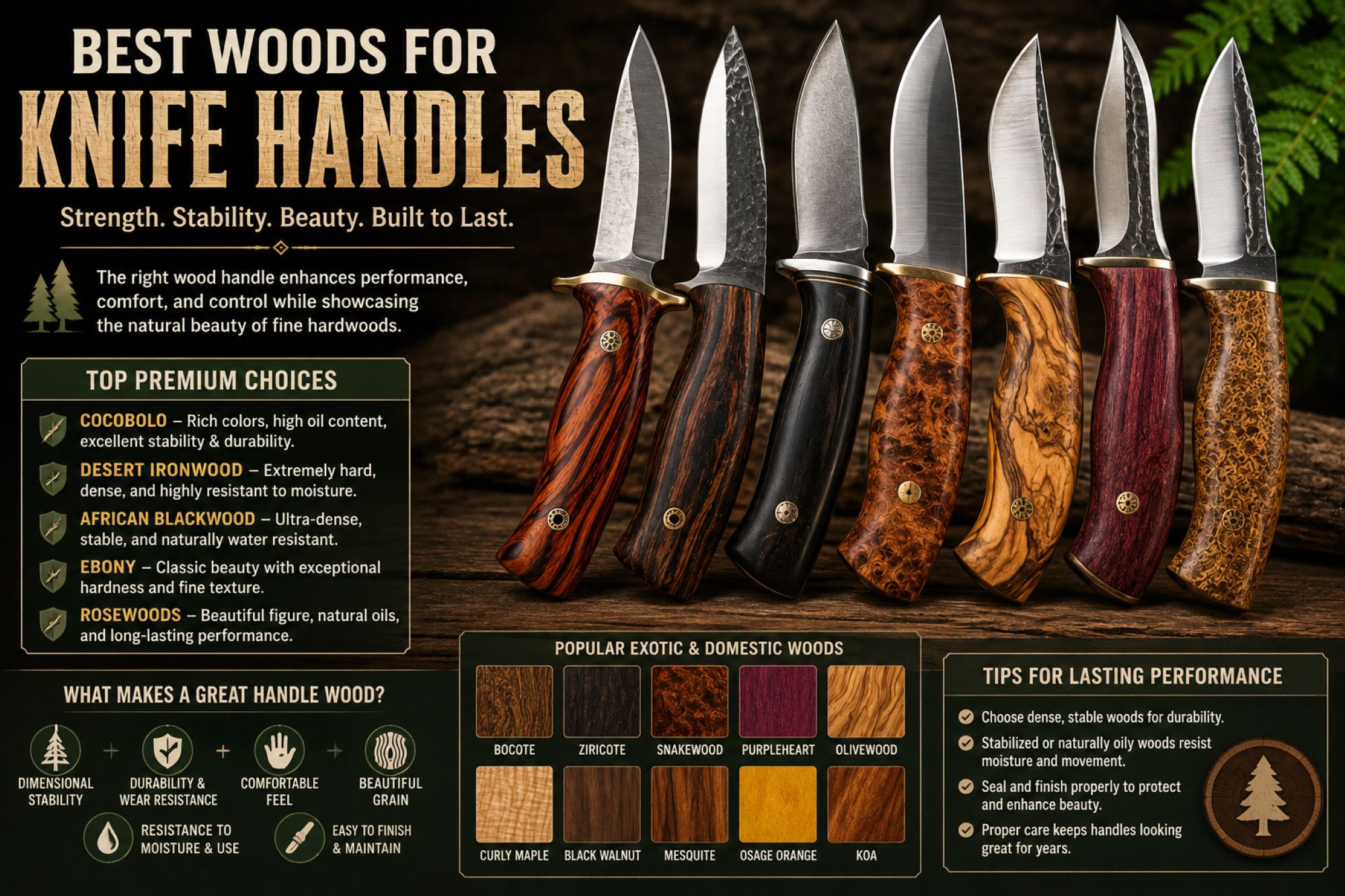
Best Woods for Knife Handles
A comprehensive guide to selecting the best woods for knife handles, including durability, stability, grain, workability, appearance, and the characteristics that make certain species ideal for custom knives and everyday use.
Overview
A knife handle does far more than provide a comfortable grip—it plays a critical role in the knife’s durability, balance, appearance, and long-term performance. Whether crafting a hunting knife, chef’s knife, bushcraft knife, or collector’s piece, selecting the right wood can greatly influence both functionality and aesthetics.
The best knife handle woods combine strength, dimensional stability, wear resistance, and an attractive grain. They should withstand repeated handling, changes in humidity, and occasional exposure to water without excessive movement or deterioration.
This guide explores the characteristics that make certain woods excellent choices for knife handles and highlights many of the world’s finest species used by custom knifemakers.
What Makes a Good Knife Handle Wood?
Several characteristics should be considered when choosing wood for a knife handle.
Important Characteristics
- High dimensional stability
- Good hardness
- Fine to medium texture
- Attractive grain
- Excellent finishing qualities
- Comfortable feel in the hand
- Resistance to wear
- Good shock resistance
- Moisture resistance
- Durability
Dense woods generally produce longer-lasting handles, although weight and balance should also be considered.
Best Overall Woods for Knife Handles
Cocobolo
One of the finest woods available for knife handles, Cocobolo offers exceptional durability, natural oils, outstanding stability, and spectacular orange, red, and black figure.
Strengths
- Extremely durable
- Excellent moisture resistance
- Highly stable
- Beautiful natural figure
- Polishes exceptionally well
Desert Ironwood
Considered by many custom knifemakers to be the premium handle wood.
Strengths
- Extremely dense
- Outstanding stability
- Rich figure
- Excellent durability
- Natural oils provide weather resistance
African Blackwood
One of the densest woods in the world.
Strengths
- Extremely hard
- Exceptional stability
- Fine texture
- Nearly waterproof
- Luxury appearance
Ebony
Ebony remains a classic choice for premium knives.
Strengths
- Elegant black appearance
- Extremely dense
- Smooth finish
- Excellent wear resistance
Rosewoods
Several Rosewood species continue to be favorites among knife makers.
Examples include:
Benefits include:
- Excellent stability
- Beautiful figure
- Fine texture
- Natural oils
Other Excellent Knife Handle Woods
- Bocote
- Ziricote
- Snakewood
- Purpleheart
- Leopardwood
- Olivewood
- Thuya Burl
- Claro Walnut
- Black Walnut
- Curly Maple
- Birdseye Maple
- Koa
- Mesquite
- Osage Orange
- Wenge
- Padauk
- Lacewood
- Bubinga
- Bloodwood
- Satinwood
- Lignum Vitae
- Verawood
- Amboyna Burl
- Redwood Burl
- Buckeye Burl (stabilized)
- Maple Burl (stabilized)
Best Domestic Woods
North American woods also make excellent knife handles.
Popular choices include:
- Black Walnut
- Curly Maple
- Birdseye Maple
- Osage Orange
- Mesquite
- Persimmon
- American Holly
- Cherry
These woods are widely available and easy to work while still producing attractive custom handles.
Best Exotic Woods
Many exotic hardwoods have become favorites for high-end custom knives.
Top choices include:
- Cocobolo
- Desert Ironwood
- African Blackwood
- Gabon Ebony
- Kingwood
- Bocote
- Ziricote
- Snakewood
- Thuya Burl
- Amboyna Burl
- Bubinga
- Bloodwood
- Verawood
- Olivewood
- Purpleheart
These woods often feature dramatic grain patterns and exceptional density.
Stabilized Wood
Many knife makers use stabilized wood.
During stabilization:
- Air is removed from the wood.
- Resin is forced deep into the cellular structure.
- The resin cures inside the wood.
Benefits include:
- Improved dimensional stability
- Reduced moisture movement
- Greater durability
- Better polishing
- Longer service life
Highly figured woods that might otherwise be too soft often become excellent knife handle materials after stabilization.
Burl Woods
Burls produce some of the most visually striking knife handles.
Popular burl choices include:
- Maple Burl
- Redwood Burl
- Amboyna Burl
- Thuya Burl
- Buckeye Burl
- Walnut Burl
Because many burls have irregular grain, stabilization is commonly recommended.
Factors to Consider
When selecting a wood, consider:
Intended Use
- Hunting knives
- Kitchen knives
- Pocket knives
- Bushcraft knives
- Collector knives
Moisture Exposure
Outdoor knives benefit from:
- Oily woods
- Stable woods
- Stabilized woods
Weight
Very dense woods produce heavier handles.
Balance should match the intended knife.
Appearance
Consider:
- Figure
- Grain
- Color
- Contrast
- Chatoyance
- Natural luster
Maintenance
Some woods require occasional oiling, while naturally oily species require very little maintenance.
Woods Less Suitable for Knife Handles
Some species are generally poor choices because they are:
- Too soft
- Unstable
- Weak
- Open-grained
- Easily damaged
Examples include:
These woods may dent, absorb moisture, or wear quickly under regular use.
Handle Finishes
Common finishes include:
- Tung Oil
- Danish Oil
- Tru-Oil
- Linseed Oil
- Wax
- CA Finish
- Polyurethane
- Resin stabilization
Many dense exotic woods require little more than polishing because of their natural oils.
Frequently Asked Questions
What is the best wood for knife handles?
Desert Ironwood, Cocobolo, African Blackwood, and Ebony are widely regarded as some of the finest choices due to their durability, stability, and appearance.
Should knife handles be stabilized?
Stabilization is highly recommended for softer woods, burls, and highly figured species. Dense oily woods often perform well without stabilization.
Are exotic woods better than domestic woods?
Not always. While many exotic species offer exceptional density and figure, domestic woods such as Curly Maple, Black Walnut, Mesquite, and Osage Orange also make excellent knife handles.
Which woods are naturally water resistant?
Species such as Cocobolo, Desert Ironwood, Teak, African Blackwood, and Lignum Vitae contain natural oils that improve moisture resistance.
Related Guides
Explore additional Exotic Woods of the World resources:
- Best Woods for Cutting Boards
- Best Woods for Wood Carving
- Best Woods for Wood Turning
- Best Woods for Furniture
- Wood Grain Patterns and Figure Explained
- Wood Density and Janka Hardness Chart
- Understanding Wood Movement and Seasonal Expansion
- Wood Toxicity and Allergies Guide
Collector Notes
Knife handles showcase some of the finest qualities found in wood. Dense hardwoods with striking figure, rich color, and exceptional stability have long been prized by custom knifemakers and collectors alike. While performance remains the primary consideration, the beauty of a well-chosen wood can transform a functional tool into a work of art. From the dramatic patterns of Snakewood and Ziricote to the deep black elegance of Ebony and the legendary durability of Desert Ironwood, knife handle woods represent some of the most desirable and collectible timbers in the woodworking world.