
Zebrawood vs. Goncalo Alves
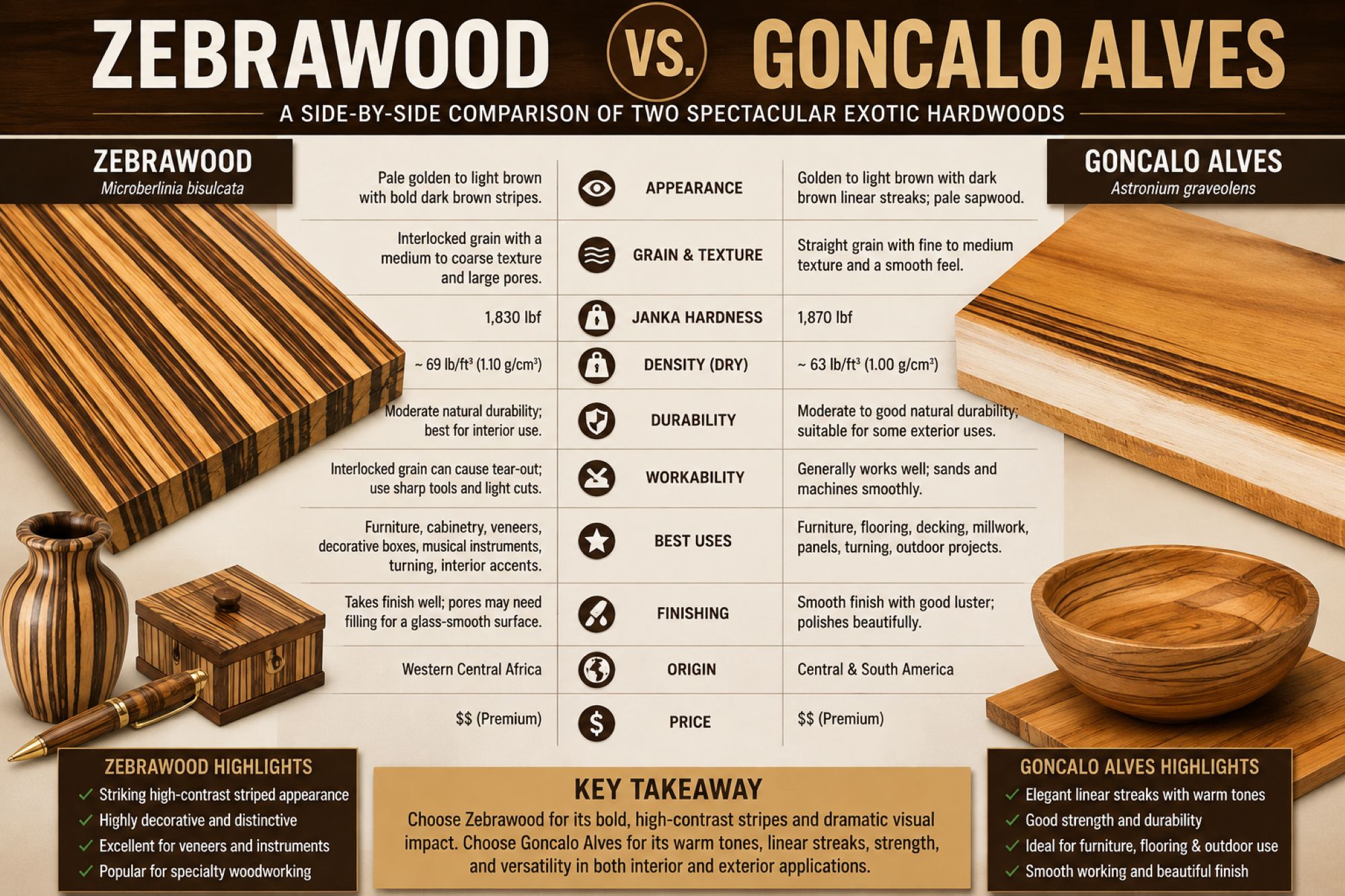
A side-by-side comparison of Zebrawood and Goncalo Alves, two visually dramatic exotic hardwoods, examining their appearance, grain, hardness, density, durability, stability, workability, furniture applications, turning performance, and overall value.
Overview
Zebrawood and Goncalo Alves are two distinctive tropical hardwoods prized for bold coloration and dramatic natural grain. Both are commonly selected when the wood itself is intended to become a major visual feature of a project, but their appearance and physical properties are considerably different.
Zebrawood (Microberlinia bisulcata) is best known for its unmistakable alternating dark and light stripes. Native to western Central Africa, it has become a popular decorative wood for furniture, cabinetry, veneers, musical instruments, and specialty woodworking.
Goncalo Alves (Astronium graveolens), often marketed as Tigerwood, originates in tropical regions of Central and South America. It typically combines golden, orange, reddish-brown, and dark brown coloration with irregular streaks that can produce a dramatic tiger-like appearance.
Zebrawood generally provides the more immediately recognizable striped appearance, while Goncalo Alves offers substantially greater hardness, density, natural durability, and resistance to wear.
This guide compares the two woods to determine where each performs best.
Species Overview
| Characteristic | Zebrawood | Goncalo Alves |
|---|---|---|
| Scientific Name | Microberlinia bisulcata | Astronium graveolens |
| Common Trade Name | Zebrawood | Goncalo Alves / Tigerwood |
| Family | Fabaceae | Anacardiaceae |
| Native Range | Western Central Africa | Central & South America |
| Wood Type | Tropical Hardwood | Tropical Hardwood |
Appearance
Zebrawood
Zebrawood is one of the easiest exotic hardwoods to recognize.
Its heartwood typically has a pale golden-yellow to light brown background crossed by narrow dark brown or nearly black streaks.
When properly cut, these contrasting lines produce the striped appearance responsible for the Zebrawood name.
Characteristics
- Pale golden-brown background
- Dark brown stripes
- Extremely high color contrast
- Bold linear figure
- Highly recognizable appearance
- Strong decorative character
Goncalo Alves
Goncalo Alves generally has a richer and warmer overall coloration.
Its heartwood can range from golden brown and orange-brown to deep reddish-brown, frequently crossed by irregular dark brown or black streaks.
The resulting appearance may resemble tiger stripes.
Characteristics
- Golden to reddish-brown coloration
- Dark irregular streaks
- Rich color variation
- Tiger-like figure
- Strong natural luster
- Dramatic exotic appearance
🏆 Appearance Winner: Tie
Zebrawood wins for bold, unmistakable contrast, while Goncalo Alves offers richer coloration and a more organic striped appearance.
Grain & Texture
Zebrawood
Zebrawood typically has:
- Interlocked grain
- Medium to coarse texture
- Large pores
- Strong striped figure
- Moderate natural luster
The interlocked grain contributes to its appearance but can make machining difficult.
Goncalo Alves
Goncalo Alves typically has:
- Straight to interlocked grain
- Fine to medium texture
- Good natural luster
- Irregular dark streaking
- Smooth finished appearance
🏆 Grain & Texture Winner: Goncalo Alves
Its generally finer texture gives Goncalo Alves a smoother and more refined finished surface.
Hardness
Approximate Janka hardness:
Zebrawood
- 1,830 lbf
Goncalo Alves
- 2,170 lbf
Both woods are considerably harder than many common domestic hardwoods, but Goncalo Alves provides greater resistance to dents and wear.
🏆 Hardness Winner: Goncalo Alves
Density
Both species are relatively heavy hardwoods.
Goncalo Alves is generally denser and heavier than Zebrawood.
Its additional density contributes to excellent wear resistance but also makes machining more demanding.
🏆 Density Winner: Goncalo Alves
Dimensional Stability
Zebrawood can experience moderate dimensional movement and its interlocked grain requires careful drying and preparation.
Goncalo Alves generally performs well once properly dried, although its density means proper acclimation remains important.
🏆 Stability Winner: Goncalo Alves
Durability
This is one of the clearest differences between the two species.
Zebrawood offers moderate natural durability.
Goncalo Alves heartwood is generally considered substantially more resistant to decay and wear.
Its durability has contributed to its use in:
- Flooring
- Exterior applications
- Heavy-use furniture
- Decking
- Specialty projects
🏆 Durability Winner: Goncalo Alves
Workability
Zebrawood
Zebrawood can be challenging because of its interlocked grain.
Potential issues include:
- Tear-out during planing
- Splintering
- Difficult surface preparation
- Large pores requiring filling for glass-smooth finishes
Sharp tools and light cuts are recommended.
Goncalo Alves
Goncalo Alves is extremely hard and dense.
Potential challenges include:
- Greater tool wear
- Resistance to hand tools
- Difficult machining
- Pre-drilling requirements
- Occasional grain tear-out
Despite these challenges, it can produce an exceptionally smooth finished surface.
🏆 Workability Winner: Zebrawood
Neither is particularly easy to work, but Zebrawood’s lower density gives it a slight advantage.
Finishing
Zebrawood accepts clear finishes well, although its relatively large pores may require filling when an extremely smooth surface is desired.
Clear finishes strongly emphasize its dark and light contrast.
Goncalo Alves can polish exceptionally well and its natural coloration often requires little more than a clear finish.
🏆 Finishing Winner: Goncalo Alves
Chatoyance and Visual Depth
Both species can display attractive optical depth.
Zebrawood’s visual impact comes primarily from its strong contrasting stripes.
Goncalo Alves can combine dark streaking with natural luster and reflective depth that changes under different lighting.
🏆 Chatoyance Winner: Goncalo Alves
Furniture
Both woods can create spectacular furniture.
Zebrawood Furniture
Zebrawood is particularly effective for:
- Cabinet fronts
- Tabletops
- Accent panels
- Contemporary furniture
- Decorative veneers
Because its figure is so visually dominant, it is frequently used selectively rather than throughout an entire piece.
Goncalo Alves Furniture
Goncalo Alves works particularly well for:
- Tables
- Benches
- Chairs
- Luxury furniture
- Decorative components
- Heavy-use furniture
Its greater hardness and durability provide an advantage for surfaces subjected to wear.
🏆 Furniture Winner: Goncalo Alves
Cabinetry
Zebrawood is an outstanding decorative cabinetry wood, especially when used as veneer.
Its strong linear pattern works particularly well across:
- Cabinet doors
- Drawer fronts
- Architectural panels
Goncalo Alves can also produce beautiful cabinetry but its greater weight and hardness can make large projects more difficult.
🏆 Cabinetry Winner: Zebrawood
Flooring
Goncalo Alves is substantially better suited to flooring.
Its combination of:
- High hardness
- Excellent wear resistance
- Density
- Durability
- Dramatic coloration
has made Tigerwood flooring commercially popular.
Zebrawood can be used for flooring but is less commonly selected for this purpose.
🏆 Flooring Winner: Goncalo Alves
Turning
Both species can produce impressive turned objects.
Zebrawood’s stripes create dramatic patterns as grain orientation changes around a turned piece.
Goncalo Alves’ density allows extremely crisp details and smooth polished surfaces.
🏆 Turning Winner: Goncalo Alves
Carving
Neither wood would normally be considered an easy carving species.
Zebrawood’s interlocked grain can cause tear-out, while Goncalo Alves’ exceptional hardness requires considerable effort.
Zebrawood’s lower hardness gives it a slight advantage.
🏆 Carving Winner: Zebrawood
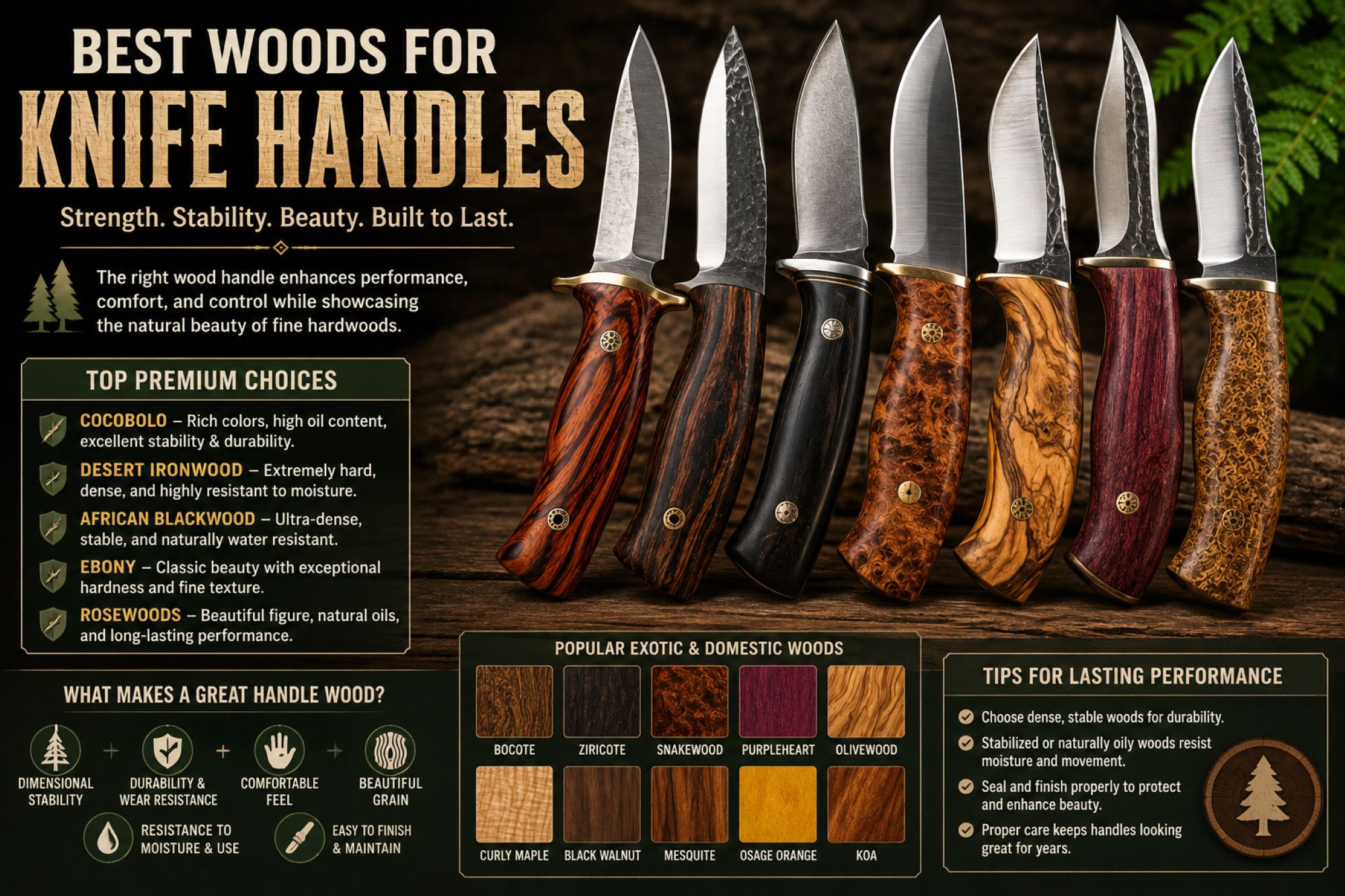
Knife Handles
Both woods can create striking knife handles.
Zebrawood offers dramatic appearance but Goncalo Alves provides greater:
- Hardness
- Density
- Wear resistance
- Natural durability
These characteristics make it particularly suitable for handles subjected to frequent use.
🏆 Knife Handle Winner: Goncalo Alves
Decorative Boxes
Zebrawood’s dramatic stripes make it especially effective for small decorative projects where relatively little material can create substantial visual impact.
🏆 Decorative Box Winner: Zebrawood
Musical Instruments
Zebrawood has been used for:
- Guitar backs
- Guitar sides
- Guitar tops
- Decorative instrument components
- Veneers
Its distinctive striped appearance makes it especially popular where visual character is important.
Goncalo Alves also appears in specialty instrument components but is less strongly associated with instrument making.
🏆 Musical Instrument Winner: Zebrawood
Outdoor Use
Goncalo Alves has the clear advantage for exterior applications because of its superior natural durability and resistance to wear.
It has been used for:
- Decking
- Exterior furniture
- Outdoor architectural components
Zebrawood is generally better reserved for protected or interior applications.
🏆 Outdoor Use Winner: Goncalo Alves
Availability
Zebrawood is relatively well established in the international exotic lumber market and is commonly available from specialty hardwood suppliers.
Goncalo Alves is also commercially available but may be encountered less consistently depending on region and lumber dimensions.
🏆 Availability Winner: Zebrawood
Value
Both woods are premium exotic hardwoods.
Pricing varies according to:
- Grade
- Figure
- Thickness
- Board width
- Geographic market
- Availability
Zebrawood’s recognizable appearance can command premium pricing, while Goncalo Alves offers exceptional hardness and durability for its cost.
🏆 Value Winner: Goncalo Alves
Best Uses
Zebrawood
Zebrawood is particularly well suited for:
- Decorative furniture
- Cabinetry
- Veneer
- Cabinet doors
- Drawer fronts
- Decorative boxes
- Musical instruments
- Turning
- Interior millwork
- Accent pieces
- Luxury interiors
Goncalo Alves
Goncalo Alves is particularly well suited for:
- Fine furniture
- Flooring
- Knife handles
- Turning
- Outdoor furniture
- Decking
- Heavy-use surfaces
- Decorative objects
- Luxury woodworking
- Specialty applications
Pros & Cons
Zebrawood
Pros
- Extremely distinctive appearance
- Dramatic striped figure
- Excellent decorative wood
- Good hardness
- Widely recognized exotic species
- Excellent veneer material
- Attractive for musical instruments
Cons
- Interlocked grain can tear out
- Coarse texture
- Large pores
- Moderate rather than exceptional natural durability
- Bold figure can overwhelm some designs
Goncalo Alves
Pros
- Exceptional hardness
- Excellent durability
- Beautiful tiger-like figure
- Rich coloration
- Excellent wear resistance
- Smooth polished surface
- Suitable for flooring and some exterior uses
Cons
- Heavy
- Difficult to machine
- Hard on cutting tools
- Pre-drilling may be necessary
- Can be difficult to work with hand tools
Which Wood Should You Choose?
Choose Zebrawood if you want:
- Maximum visual contrast
- Distinctive striped grain
- Decorative cabinetry
- Veneer
- Musical instruments
- Decorative boxes
- A recognizable exotic appearance
Choose Goncalo Alves if you want:
- Greater hardness
- Better durability
- Flooring
- Knife handles
- Heavy-use furniture
- Outdoor applications
- Greater wear resistance
- Rich tiger-like coloration
Final Verdict
| Category | Winner |
|---|---|
| Appearance | Tie |
| Grain & Texture | Goncalo Alves |
| Hardness | Goncalo Alves |
| Density | Goncalo Alves |
| Stability | Goncalo Alves |
| Durability | Goncalo Alves |
| Workability | Zebrawood |
| Finishing | Goncalo Alves |
| Chatoyance | Goncalo Alves |
| Furniture | Goncalo Alves |
| Cabinetry | Zebrawood |
| Flooring | Goncalo Alves |
| Turning | Goncalo Alves |
| Carving | Zebrawood |
| Knife Handles | Goncalo Alves |
| Decorative Boxes | Zebrawood |
| Musical Instruments | Zebrawood |
| Outdoor Use | Goncalo Alves |
| Availability | Zebrawood |
| Value | Goncalo Alves |
🏆 Overall Winner: Goncalo Alves
Goncalo Alves earns the overall victory because of its exceptional combination of hardness, density, durability, wear resistance, rich coloration, and versatility. It can perform successfully in demanding applications such as flooring, furniture, knife handles, turning, and selected exterior projects while still providing the dramatic appearance expected from a premium exotic hardwood.
Zebrawood remains the better choice when visual impact is the primary objective. Few woods can match its unmistakable dark-on-light striping, making it particularly valuable for cabinetry, veneer, musical instruments, decorative boxes, and statement furniture.
The choice ultimately depends on the project: choose Zebrawood for bold contrast and decorative impact; choose Goncalo Alves for hardness, durability, and all-around performance.
Related Guides
Continue exploring the Exotic Woods of the World guide library:
- Wood Comparison Guides
- Best Woods for Furniture
- Best Woods for Flooring
- Best Woods for Knife Handles
- Best Woods for Outdoor Use
- Understanding Chatoyance in Wood
- Wood Grain Patterns and Figure Explained
- Wood Density and Janka Hardness Chart
- Understanding Wood Movement and Seasonal Expansion
Collector Notes
Zebrawood and Goncalo Alves demonstrate two very different ways tropical hardwoods can develop dramatic striped appearances.
Zebrawood produces its characteristic visual identity through strong contrast between a pale background and relatively regular dark streaks. Goncalo Alves typically combines richer golden, reddish, and brown coloration with darker irregular streaking that gives the wood its Tigerwood trade name.
For collectors, placing samples of these two species beside one another provides an excellent demonstration of why similar descriptive terms such as “striped” can represent completely different grain patterns, colors, textures, and physical properties.
Both deserve a place in an exotic wood collection, but Goncalo Alves represents the stronger performance wood while Zebrawood remains one of the world’s most immediately recognizable decorative hardwoods.