
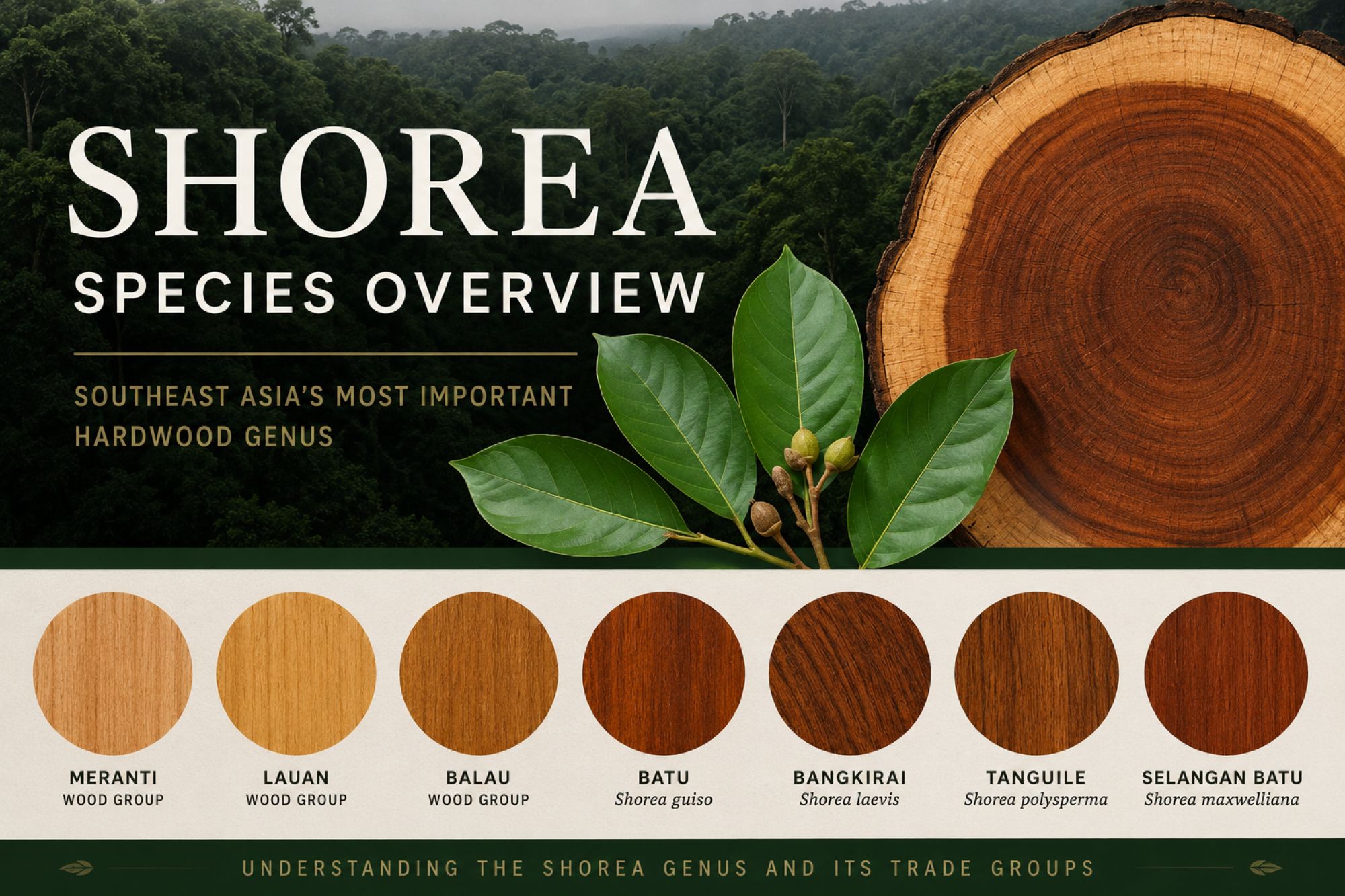
Shorea Species Overview
An educational overview of Shorea hardwood species and the broader Southeast Asian trade groups commonly associated with Meranti, Lauan, Balau, and related tropical hardwoods.
Overview
The Shorea genus is one of the largest and most commercially important hardwood groups in Southeast Asia. Belonging to the Dipterocarpaceae family, Shorea species are widely distributed throughout countries including the Philippines, Malaysia, Indonesia, Thailand, and surrounding tropical regions.
Rather than being sold strictly by exact scientific species, many Shorea woods are grouped into broad commercial trade categories based on color, density, appearance, and regional lumber practices. This has created one of the most complex and confusing trade-name systems in the tropical hardwood industry.
Terms such as Meranti, Lauan, and Balau often refer to broad groups containing multiple related species rather than a single exact wood.
This page serves as an overview of the larger Shorea ecosystem and its associated trade groups.
The Shorea Trade Group System
Many woods within the Shorea genus are classified commercially instead of botanically. Lumber suppliers, plywood manufacturers, flooring companies, and exporters often group multiple species together under a single trade name.
These classifications are commonly based on:
- color
- density
- durability
- regional harvesting
- commercial usage
- export standards
As a result, a single trade name may contain multiple different species with slightly different working characteristics and appearance.
Major Shorea Trade Groups
Meranti Wood Group
The Meranti group includes a wide range of Southeast Asian hardwoods commonly divided into classifications such as Red Meranti, White Meranti, and Dark Red Meranti.
The name Meranti may include multiple related species and regional classifications.
Lauan Wood Group
Lauan is a commercial grouping commonly associated with lightweight Southeast Asian hardwoods frequently used in plywood, paneling, doors, and general construction applications.
The name Lauan may include multiple related species and regional classifications.
Balau Wood Group
The Balau group includes dense Southeast Asian hardwoods commonly associated with exterior construction, decking, marine applications, and structural hardwood usage.
The name Balau may include multiple related species and regional classifications.
Exact Shorea Species Pages
Several exact Shorea species are also represented individually within the Exotic Woods of the World archive.
Bangkirai (Shorea laevis)
A dense and durable Southeast Asian hardwood often associated with exterior construction and decking applications.
Batu (Shorea guiso)
A heavy tropical hardwood commonly associated with flooring, industrial use, and marine applications.
Selangan Batu (Shorea maxwelliana)
A dense and durable Shorea species widely used for heavy-duty outdoor and structural applications.
Tanguile (Shorea polysperma)
A lighter-density Shorea species commonly used in millwork, paneling, and interior applications.
Common Characteristics of Shorea Woods
While Shorea trade groups vary considerably, many share several recognizable characteristics.
Common Shorea Traits
- Medium to high density tropical hardwood structure
- Interlocked or moderately straight grain
- Moderate to coarse texture
- Colors ranging from pale tan to deep reddish brown
- Good dimensional stability
- Widespread commercial plywood usage
- Strong presence in Southeast Asian lumber exports
Durability and workability can vary significantly depending on the exact species and trade grouping involved.
Shorea and Tropical Hardwood Trade
The Shorea genus plays a major role in the global tropical hardwood market and has historically been one of the most commercially exported hardwood groups in Southeast Asia.
Because many Shorea woods are sold under broad trade names rather than exact species, identification can sometimes be difficult for:
- collectors
- woodworkers
- importers
- flooring companies
- lumber buyers
This makes understanding Shorea taxonomy especially important when comparing wood properties, sourcing material, or evaluating sustainability claims.
Sustainability and Conservation
Many Shorea species face increasing pressure from logging, land conversion, and commercial demand throughout Southeast Asia.
Sustainability and legality can vary significantly depending on:
- harvesting region
- supplier practices
- local forestry regulations
- plantation vs natural forest sourcing
Responsible sourcing is increasingly important within the Shorea trade due to the large number of species involved and the complexity of regional export systems.
Related Wood Family and Trade Group Pages
- Sustainability and Exotic Hardwood Trade
- Ebony Species of the World
- Rosewoods of the World
- African Mahogany Species Guide
- Pterocarpus Species Guide
- Wood Identification Guide
Compare Wood Properties
Compare Shorea woods alongside hundreds of hardwood species using the Exotic Woods of the World database.
Related resources:
- Wood Grain Patterns and Figure Explained
- Wood Density and Janka Hardness Chart
- Hardest Woods in the World
- Most Dense Woods in the World
Collector Notes
Shorea woods represent one of the most commercially significant and taxonomically complex hardwood systems in the world. Because many woods are sold through broad trade classifications rather than exact species names, collectors and woodworkers often encounter substantial variation between boards sold under the same commercial name.
Understanding the larger Shorea family structure can greatly improve identification accuracy, sourcing knowledge, and long-term documentation of Southeast Asian hardwoods.