
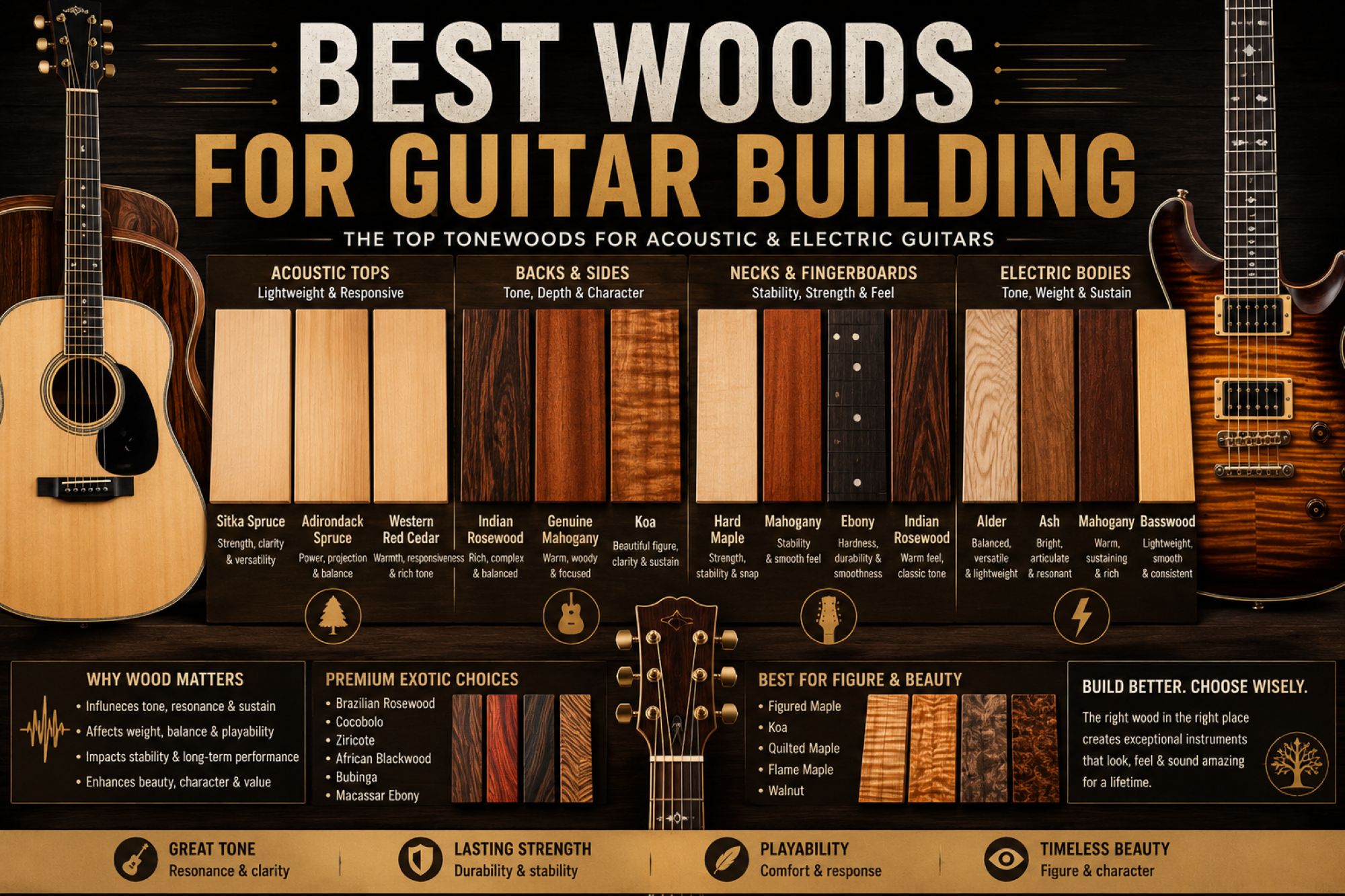
Best Woods for Guitar Building
Explore the best woods for guitar building, including traditional and exotic tonewoods used for acoustic guitar tops, backs and sides, electric guitar bodies, necks, fingerboards, bridges, and decorative components.
Overview
Few woodworking applications place as many different demands on wood as guitar building. A guitar must combine structural strength, dimensional stability, manageable weight, precise machining characteristics, visual appeal, and, particularly in acoustic instruments, carefully selected vibrational properties.
For this reason, there is no single best wood for a guitar.
The ideal species depends heavily on where the wood will be used. A lightweight, stiff softwood such as Spruce may be ideal for an acoustic soundboard, while a dense hardwood such as Ebony may be preferred for a fingerboard. Mahogany may provide an excellent neck, while Rosewood can be particularly desirable for acoustic backs and sides.
Electric guitars introduce another set of priorities because pickups and electronics play a major role in the instrument’s amplified sound. Structural performance, weight, stability, feel, appearance, and construction method become especially important when selecting electric-guitar woods.
This guide examines some of the world’s most important guitar-building woods and explains where each performs best.
What Makes a Good Guitar Wood?
Luthiers evaluate wood differently depending on the component being built.
Important characteristics may include:
- Stiffness
- Strength-to-weight ratio
- Density
- Dimensional stability
- Grain orientation
- Resonance
- Damping characteristics
- Workability
- Hardness
- Wear resistance
- Weight
- Appearance
- Availability
- Sustainability
No species excels in every category.
The goal is to match the properties of the wood with the requirements of the component.
Acoustic vs. Electric Guitar Woods
The role of wood differs substantially between acoustic and electric guitars.
Acoustic Guitars
The wooden body itself is responsible for producing and projecting much of the instrument’s audible sound.
Wood selection is therefore particularly important for:
- Soundboards
- Backs
- Sides
- Bracing
- Necks
- Fingerboards
- Bridges
Electric Guitars
Electric guitar pickups convert string vibration into an electrical signal.
Wood still influences important physical characteristics such as:
- Weight
- Balance
- Stiffness
- Stability
- Feel
- Sustain characteristics
- Construction
- Appearance
However, electronics, pickups, hardware, strings, setup, scale length, and amplifier configuration also play major roles in the final amplified sound.
Best Woods for Acoustic Guitar Tops
The soundboard is one of the most structurally and acoustically important components of an acoustic guitar.
The ideal top wood generally combines relatively low weight with high stiffness.
Sitka Spruce (Picea sitchensis)
Sitka Spruce is one of the world’s most widely used acoustic guitar soundboard woods.
It offers an excellent combination of:
- Low weight
- High stiffness
- Strength
- Availability
- Consistency
- Workability
It is used across an enormous range of acoustic guitar designs.
🏆 Best Overall Acoustic Guitar Top: Sitka Spruce
Its versatility, proven performance, and availability make Sitka Spruce an excellent general-purpose soundboard wood.
Engelmann Spruce (Picea engelmannii)
Engelmann Spruce is another important North American tonewood.
It is generally lightweight and is prized by builders seeking responsive soundboards.
Common applications include:
- Acoustic guitar tops
- Classical guitars
- Specialty stringed instruments
Adirondack Spruce (Picea rubens)
Also known as Red Spruce, Adirondack Spruce has an important history in American acoustic guitar construction.
It is valued for its high stiffness-to-weight ratio and is particularly associated with premium steel-string guitars.
European Spruce (Picea abies)
European or Norway Spruce has centuries of history in musical-instrument construction.
It is used for:
- Classical guitars
- Acoustic guitars
- Violins
- Other stringed instruments
High-quality straight-grained material is particularly desirable.
Western Red Cedar (Thuja plicata)
Western Red Cedar provides an important alternative to Spruce.
It is especially associated with:
- Classical guitars
- Fingerstyle guitars
- Acoustic instruments designed for a responsive top
Its reddish-brown coloration also provides a visually distinctive alternative to pale Spruce.
🏆 Best Alternative to Spruce: Western Red Cedar
Best Woods for Acoustic Guitar Backs and Sides
Back-and-side woods generally require greater density and hardness than soundboard woods.
Some of the most famous guitar tonewoods occur in this category.
Indian Rosewood (Dalbergia latifolia)
Indian Rosewood is one of the classic premium woods for acoustic guitar backs and sides.
Characteristics include:
- High density
- Good dimensional stability
- Dark streaked appearance
- Excellent natural luster
- Long history in instrument making
It became especially important as restrictions and scarcity reduced the availability of Brazilian Rosewood.
🏆 Best Overall Back & Side Wood: Indian Rosewood
Genuine Mahogany (Swietenia macrophylla)
Genuine Mahogany has an extraordinary history in guitar construction.
It is used for:
- Acoustic backs
- Acoustic sides
- Necks
- Electric guitar bodies
Mahogany generally offers:
- Moderate density
- Excellent stability
- Good workability
- Straight to interlocked grain
- Attractive reddish-brown coloration
🏆 Best Versatile Guitar Hardwood: Genuine Mahogany
Few hardwoods can perform successfully in as many different guitar components.
Sapele (Entandrophragma cylindricum)
Sapele has become an important instrument wood and is frequently used as an alternative to Mahogany.
It offers:
- Good strength
- Attractive reddish-brown coloration
- Interlocked grain
- Ribbon stripe figure
- Good availability
Quarter-sawn Sapele can be particularly attractive because of its pronounced ribbon figure.
Koa (Acacia koa)
Hawaiian Koa is one of the most visually distinctive guitar woods.
It can display:
- Golden-brown coloration
- Curly figure
- Strong chatoyance
- Dark streaking
- Exceptional visual depth
Koa is frequently used for:
- Guitar backs
- Guitar sides
- Guitar tops
- Ukuleles
Highly figured instrument-grade Koa can be exceptionally valuable.
🏆 Best Guitar Wood for Figure: Koa
Maple
Several Maple species are used in guitar construction.
Figured Maple may display:
- Curly figure
- Fiddleback
- Quilted figure
- Flame figure
Maple is frequently used for:
- Acoustic backs and sides
- Electric guitar tops
- Necks
- Laminated necks
🏆 Best Light-Colored Figured Guitar Wood: Maple
Brazilian Rosewood
Brazilian Rosewood (Dalbergia nigra)
Brazilian Rosewood is one of the most historically famous guitar woods.
It has been prized for:
- Acoustic guitar backs
- Acoustic guitar sides
- Classical guitars
- Premium instruments
Its combination of rich coloration, dark streaking, density, and musical-instrument tradition made it legendary among luthiers.
However, Brazilian Rosewood is highly regulated and conservation concerns severely restrict modern trade.
For most contemporary builders, Indian Rosewood is a substantially more practical choice.
🏆 Historic Premium Tonewood: Brazilian Rosewood
This designation reflects its historical importance rather than a recommendation to seek newly harvested material.
Best Woods for Electric Guitar Bodies
Electric guitar bodies require a different balance of characteristics.
Important considerations include:
- Weight
- Stability
- Machinability
- Appearance
- Structural performance
Alder (Alnus rubra)
Red Alder has become one of the classic solid-body electric guitar woods.
Advantages include:
- Moderate weight
- Good workability
- Relatively uniform texture
- Good finishing properties
- Long history in electric guitars
🏆 Best All-Around Electric Guitar Body Wood: Alder
Swamp Ash
Selected lightweight Ash has a long history in electric guitar construction.
It is particularly prized for its:
- Distinctive grain
- Relatively light weight when carefully selected
- Attractive transparent finishes
Because weight varies considerably among Ash lumber, careful board selection is important.
Mahogany
Mahogany is one of the most important electric guitar body woods.
Its dimensional stability, moderate density, excellent workability, and attractive coloration make it suitable for both solid and carved guitar bodies.
Mahogany is also frequently paired with Maple tops.
Basswood (Tilia spp.)
Basswood is lightweight, relatively soft, and easy to machine.
It is widely used for solid-body electric guitars where:
- Moderate weight
- Easy machining
- Consistency
are desirable.
Because the wood is relatively plain, opaque finishes are common.
Best Woods for Guitar Necks
A guitar neck requires exceptional stability.
The wood must resist deformation while supporting continuous string tension.
Hard Maple (Acer saccharum)
Hard Maple is one of the classic electric guitar neck woods.
Advantages include:
- High hardness
- Excellent strength
- Fine texture
- Good wear resistance
- Proven performance
🏆 Best Electric Guitar Neck Wood: Hard Maple
Mahogany
Mahogany is another classic neck material.
It combines:
- Good stability
- Moderate weight
- Excellent workability
- Proven instrument performance
It is particularly important in acoustic and set-neck electric guitar construction.
🏆 Best Acoustic Guitar Neck Wood: Mahogany
Best Woods for Guitar Fingerboards
Fingerboards experience continuous contact with strings and fingers.
Important characteristics include:
- Hardness
- Wear resistance
- Stability
- Fine texture
- Smooth feel
Ebony
Ebony is one of the premier fingerboard woods.
Its advantages include:
- Exceptional hardness
- Very high density
- Extremely fine texture
- Excellent wear resistance
- Smooth polished surface
- Dark coloration
🏆 Best Premium Fingerboard Wood: Ebony
Indian Rosewood
Indian Rosewood is another classic fingerboard material.
It provides:
- High hardness
- Good wear resistance
- Attractive dark coloration
- Proven instrument performance
It is generally more open-textured than Ebony.
🏆 Best Traditional Rosewood Fingerboard: Indian Rosewood
Hard Maple
Maple fingerboards provide a distinctly different appearance.
Their pale coloration and fine texture have become strongly associated with many classic electric guitars.
Maple fingerboards are generally finished rather than left unfinished like many Rosewood or Ebony fingerboards.
🏆 Best Light-Colored Fingerboard: Hard Maple
Best Woods for Guitar Bridges
Acoustic guitar bridges require hard, stable wood capable of resisting string tension and wear.
Traditional choices include:
Both offer excellent hardness and dimensional stability.
🏆 Best Guitar Bridge Wood: Ebony
Its exceptional hardness and wear resistance give it a slight advantage.
Best Woods for Guitar Tops and Decorative Caps
Electric guitars frequently use decorative hardwood tops over a structurally different body wood.
Figured Maple
Figured Maple is perhaps the most famous electric guitar top wood.
Popular figure includes:
- Flame Maple
- Curly Maple
- Quilted Maple
- Fiddleback Maple
Transparent finishes can dramatically enhance its chatoyance.
🏆 Best Electric Guitar Decorative Top: Figured Maple
Koa
Figured Koa can create spectacular premium guitar tops with golden coloration and dramatic chatoyance.
Walnut
Figured Walnut can provide:
- Chocolate-brown coloration
- Curly figure
- Crotch figure
- Burl figure
It is increasingly popular for custom instruments.
Best Exotic Woods for Guitar Building
Numerous exotic hardwoods can be used for specialty guitar construction.
Notable choices include:
Cocobolo
Dense, colorful, and visually dramatic, Cocobolo has been used for backs, sides, fingerboards, and decorative components.
African Blackwood
Exceptionally dense and fine textured, African Blackwood is particularly important in woodwind instruments but can also appear in specialty guitar components.
Ziricote
Ziricote produces dramatic spiderweb-like dark figure and is highly prized for premium backs, sides, fingerboards, and decorative components.
Macassar Ebony
Macassar Ebony combines dark brown and black streaking with the density and fine texture associated with Ebony.
Bubinga
Bubinga offers exceptional density and can develop spectacular pommele, waterfall, or curly figure.
Wenge
Wenge provides dramatic dark linear grain and can be used for neck laminations, bodies, and decorative components.
Ovangkol
Ovangkol has been used for guitar backs and sides and provides warm brown coloration with darker streaking.
Padauk
Padauk provides striking orange-red coloration and is occasionally used in custom instruments and decorative components.
Best Guitar Woods by Component
| Guitar Component | Recommended Woods |
|---|---|
| Acoustic Top | Sitka Spruce, Adirondack Spruce, Engelmann Spruce, European Spruce, Western Red Cedar |
| Acoustic Back & Sides | Indian Rosewood, Mahogany, Sapele, Koa, Maple |
| Electric Body | Alder, Ash, Mahogany, Basswood |
| Neck | Hard Maple, Mahogany |
| Fingerboard | Ebony, Indian Rosewood, Hard Maple |
| Bridge | Ebony, Indian Rosewood |
| Decorative Top | Figured Maple, Koa, Walnut |
| Premium Exotic Back & Sides | Rosewood, Koa, Ziricote, Bubinga, Ovangkol |
Overall Winners
🏆 Best Acoustic Guitar Top
Sitka Spruce
Excellent stiffness-to-weight ratio, availability, versatility, and long history of successful use.
🏆 Best Acoustic Back & Sides
Indian Rosewood
Dense, stable, attractive, and firmly established as one of the premier modern acoustic guitar woods.
🏆 Best Electric Guitar Body
Alder
Light enough for comfortable instruments, easy to machine, and proven across decades of electric guitar construction.
🏆 Best Guitar Neck
Hard Maple
Excellent hardness, strength, wear resistance, and stability make it particularly strong for electric guitar necks.
🏆 Best Acoustic Guitar Neck
Mahogany
Stable, workable, relatively lightweight, and historically proven.
🏆 Best Fingerboard
Ebony
Exceptional hardness, wear resistance, fine texture, and smooth feel make Ebony one of the premier fingerboard materials.
🏆 Best Decorative Guitar Wood
Figured Maple
Flame, curly, quilted, and fiddleback figure can produce extraordinary visual depth and chatoyance.
🏆 Best Exotic Showpiece Wood
Koa
Its golden coloration, figure, chatoyance, and strong association with premium instruments make Koa particularly desirable for visually spectacular builds.
🏆 Best Overall Guitar-Building Hardwood
Genuine Mahogany
Mahogany receives the overall hardwood designation because it can successfully serve as a body wood, neck wood, acoustic back-and-side wood, and decorative material.
Tonewood and Sound
Wood can influence the mechanical behavior of a guitar, but claims about specific woods producing universally predictable “tones” should be treated cautiously.
In acoustic instruments, characteristics such as:
- Stiffness
- Density
- Damping
- Thickness
- Bracing
- Body dimensions
- Construction technique
interact to determine how the soundboard and body vibrate.
Two pieces from the same species can differ substantially.
For electric guitars, pickups, electronics, strings, hardware, scale length, construction, setup, amplifier, and playing technique all contribute significantly to the final amplified sound.
For this reason, builders should evaluate individual pieces of wood and complete instrument design, rather than assuming the species name alone determines tone.
Quarter-Sawn Wood in Guitar Building
Grain orientation is particularly important in instrument making.
Quarter-sawn lumber is frequently selected for components requiring stability because it generally provides:
- More predictable dimensional movement
- Straight grain orientation
- Improved stiffness in certain applications
- Greater structural consistency
Soundboards, necks, and bracing are commonly selected with careful attention to grain orientation.
Figure and Chatoyance
Highly figured guitar woods can dramatically enhance an instrument’s appearance.
Important figures include:
- Flame
- Curl
- Quilt
- Fiddleback
- Pommele
- Burl
Species particularly associated with figured guitar lumber include:
- Maple
- Koa
- Mahogany
- Bubinga
- Walnut
Clear finishes can greatly enhance chatoyance, causing figure to shift as the guitar moves under changing light.
Sustainability and Responsible Tonewood Selection
Several traditional guitar woods have experienced substantial harvesting pressure.
Important examples include various:
- Rosewoods
- Ebonies
- Mahoganies
- Tropical specialty woods
Modern luthiers increasingly use:
- Responsibly managed timber
- Plantation-grown woods
- Reclaimed lumber
- Salvaged wood
- Alternative domestic species
- Lesser-known tonewoods
Responsible sourcing allows builders to maintain instrument quality while reducing pressure on vulnerable forests.
Choosing the Right Guitar Wood
For a traditional steel-string acoustic guitar, consider:
- Spruce top
- Indian Rosewood or Mahogany back and sides
- Mahogany neck
- Ebony or Rosewood fingerboard
For a premium visually figured acoustic, consider:
- Spruce top
- Figured Koa or Maple back and sides
- Mahogany neck
- Ebony fingerboard
For a classic solid-body electric guitar, consider:
- Alder or Ash body
- Maple neck
- Maple or Rosewood fingerboard
For a heavier premium electric build, consider:
- Mahogany body
- Figured Maple top
- Mahogany neck
- Ebony or Rosewood fingerboard
Related Guides
Continue exploring the Exotic Woods of the World guide library:
- Best Woods for Furniture
- Best Woods for Knife Handles
- Best Woods for Flooring
- Best Woods for Outdoor Use
- Understanding Chatoyance in Wood
- Wood Grain Patterns and Figure Explained
- Wood Density and Janka Hardness Chart
- Understanding Wood Movement and Seasonal Expansion
- Understanding Wood Shrinkage Values Explained
- Wood Toxicity and Allergies Guide
- Wood Comparison Guides

Collector Notes
Guitar building provides one of the clearest demonstrations that the concept of the “best wood” depends entirely on the application.
A lightweight Spruce that would be unsuitable for a heavily worn fingerboard can make an exceptional soundboard. Extremely dense Ebony that would be impractical for an entire acoustic body can be ideal for a fingerboard or bridge. Mahogany occupies a particularly useful middle ground, performing successfully in bodies, necks, backs, and sides.
Instrument woods also demonstrate why wood selection extends beyond species names. Grain orientation, stiffness, density, defects, moisture content, figure, and the characteristics of the individual board can be just as important as botanical species.
For collectors, assembling samples of Spruce, Rosewood, Mahogany, Maple, Ebony, Koa, and other tonewoods provides a fascinating look at how dramatically different woods can work together within a single instrument.