
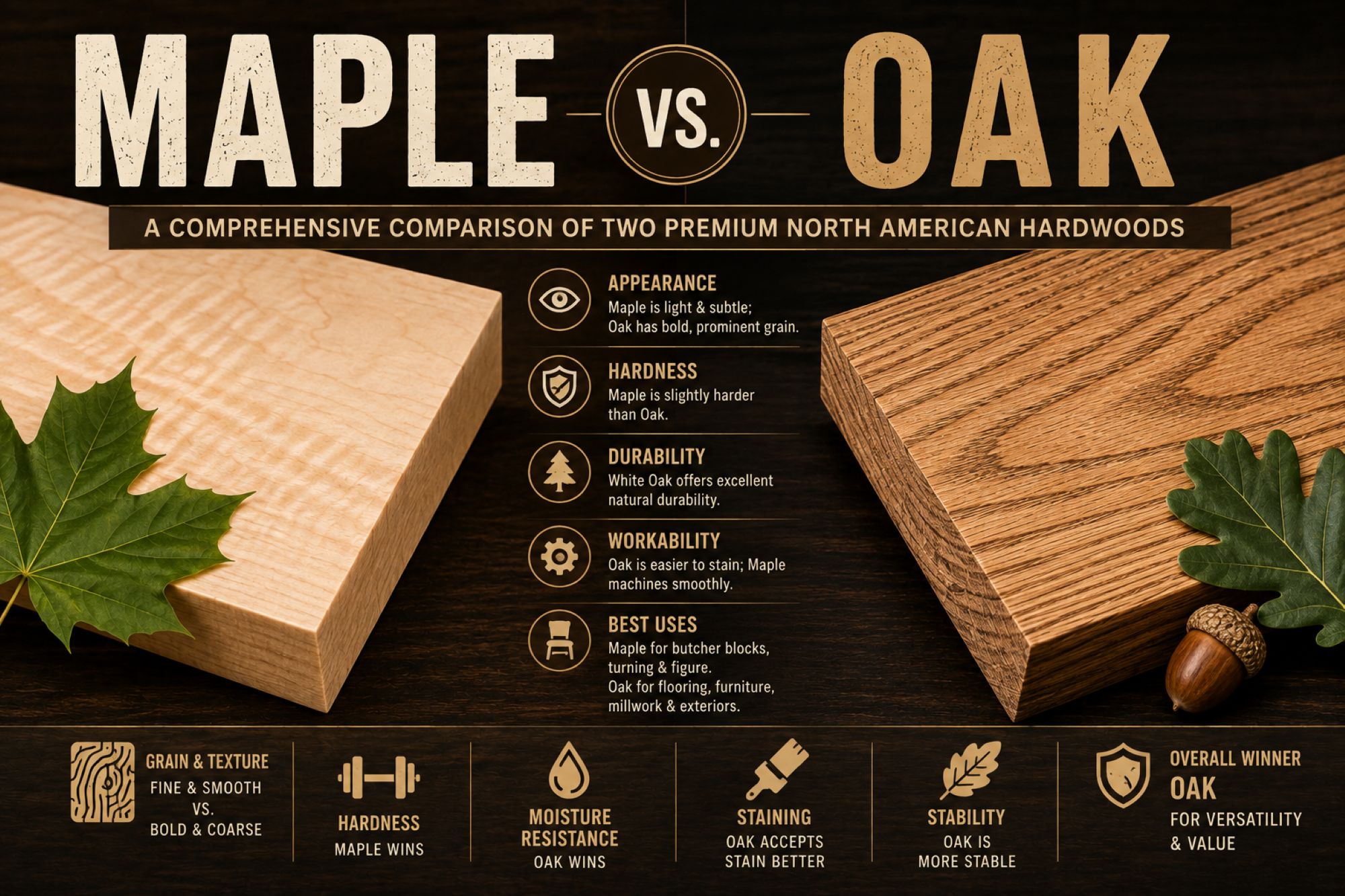
Maple vs. Oak
A side-by-side comparison of Maple and Oak, two of North America’s most important hardwood groups, examining their appearance, grain, hardness, durability, stability, workability, flooring performance, furniture applications, and overall value.
Overview
Maple and Oak are two of the most recognizable and widely used hardwoods in North America. Both have long histories in furniture making, cabinetry, flooring, millwork, architectural interiors, and general woodworking, but they offer distinctly different appearances and working characteristics.
Maple is generally known for its lighter color, smooth texture, subtle grain, hardness, and clean contemporary appearance. Oak is recognized for its more pronounced grain, prominent growth-ring structure, excellent strength, and traditional appearance.
One complication when comparing Maple and Oak is that both names represent groups containing multiple species. For a practical woodworking comparison, this guide primarily considers Hard Maple (Acer saccharum) and the major commercial Oaks, particularly Red Oak (Quercus rubra) and White Oak (Quercus alba).
Understanding these differences can help determine which hardwood is better suited for flooring, furniture, cabinetry, turning, interior millwork, and other woodworking projects.
Species Overview
| Characteristic | Maple | Oak |
|---|---|---|
| Primary Comparison | Hard Maple | Red Oak & White Oak |
| Scientific Name | Acer saccharum | Quercus rubra / Quercus alba |
| Family | Sapindaceae | Fagaceae |
| Native Range | North America | North America |
| Wood Type | Hardwood | Hardwood |
Appearance
Maple
Hard Maple typically has pale cream to nearly white sapwood, sometimes with subtle reddish or golden tones. Its heartwood may range from light reddish-brown to considerably darker brown.
Maple generally produces a clean, understated appearance.
Characteristics
- Cream to pale tan coloration
- Fine, even texture
- Subtle grain
- Smooth appearance
- Occasional dramatic figure
- Excellent contemporary appearance
Maple can also develop highly desirable figures such as:
- Curly
- Fiddleback
- Quilted
- Birdseye
Oak
Oak generally has a warmer tan to medium brown appearance with much more visible grain.
Red Oak often has pinkish or reddish undertones, while White Oak commonly displays tan, brown, or slightly olive coloration.
Characteristics
- Strong grain pattern
- Prominent growth rings
- Medium to coarse texture
- Warm coloration
- Distinctive ray figure
- Traditional hardwood appearance
Quarter-sawn White Oak can produce particularly dramatic ray fleck.
🏆 Appearance Winner: Tie
Maple is preferable for a clean, refined appearance, while Oak is better when prominent natural grain is desired.
Grain & Texture
Maple
Maple generally has:
- Fine texture
- Close grain
- Mostly straight grain
- Smooth surface
- Subtle growth-ring definition
Figured Maple can display dramatically different patterns.
Oak
Oak generally has:
- Medium to coarse texture
- Open, prominent grain
- Visible pores
- Strong growth-ring patterns
- Prominent rays
Oak provides considerably more visible grain character.
🏆 Grain & Texture Winner: Oak
Oak wins when natural grain character is the priority.
Hardness
Approximate Janka hardness values:
- 1,450 lbf
- 1,360 lbf
- 1,290 lbf
Hard Maple is harder than either of the two major commercial North American Oaks.
🏆 Hardness Winner: Maple
Density
All three woods are relatively dense North American hardwoods.
Hard Maple generally compares closely with White Oak and is somewhat denser than Red Oak, although exact density varies by tree and moisture content.
🏆 Density Winner: Maple
Maple receives a slight advantage when comparing typical Hard Maple with the major commercial Oaks.
Dimensional Stability
Maple is hard and durable but can experience considerable movement as environmental moisture changes.
Oak also moves with seasonal humidity, but White Oak in particular has a strong history in applications requiring good long-term performance.
Proper drying and acclimation are important with either wood.
🏆 Stability Winner: Oak
Durability
For interior applications, both woods provide excellent service life.
The major difference appears when natural decay resistance becomes important.
Hard Maple has relatively poor natural decay resistance.
White Oak heartwood offers substantially better natural durability and moisture resistance.
Red Oak should not be assumed to have the same exterior durability as White Oak.
🏆 Durability Winner: Oak
Moisture Resistance
This category particularly favors White Oak.
White Oak develops tyloses that block many of the vessels within the heartwood, greatly reducing permeability.
This characteristic contributed to White Oak’s historic use in:
- Barrels
- Boats
- Exterior joinery
- Marine applications
Hard Maple lacks comparable natural moisture resistance.
🏆 Moisture Resistance Winner: Oak
Workability
Maple
Hard Maple machines well but its density can make it demanding on cutting tools.
Potential challenges include:
- Burning during machining
- Tear-out in figured grain
- Difficulty staining evenly
- Greater effort with hand tools
Sharp cutters are especially important.
Oak
Oak generally machines well with both power and hand tools.
Its coarse grain can occasionally splinter, but it remains one of the most familiar woodworking hardwoods.
Oak also:
- Glues well
- Sands well
- Accepts stains readily
- Responds well to many finishes
🏆 Workability Winner: Oak
Staining
This is one of the more significant practical differences.
Maple
Maple’s dense, tight grain can absorb stain unevenly.
Improper staining may produce:
- Blotching
- Uneven coloration
- Dark patches
Woodworkers frequently use dyes, conditioners, toners, or specialized finishing schedules when coloring Maple.
Oak
Oak’s open pores readily accept stain.
Different stains can dramatically alter its appearance while allowing the grain to remain visible.
🏆 Staining Winner: Oak
Natural Finishing
Maple performs exceptionally well when a light, natural appearance is desired.
Clear finishes emphasize its:
- Pale coloration
- Smooth texture
- Figure
- Clean appearance
Oak also responds beautifully to clear finishes but produces a warmer and more visibly grained surface.
🏆 Natural Finish Winner: Maple
Furniture
Both woods are excellent furniture materials.
Maple Furniture
Maple works particularly well for:
- Contemporary furniture
- Tables
- Chairs
- Dressers
- Beds
- Work surfaces
Its hardness makes it highly resistant to everyday wear.
Oak Furniture
Oak has centuries of furniture-making history and performs particularly well for:
- Traditional furniture
- Mission furniture
- Arts and Crafts furniture
- Tables
- Chairs
- Cabinets
- Benches
🏆 Furniture Winner: Tie
The choice largely depends on desired appearance.
Cabinetry
Maple and Oak are both major cabinetry woods.
Maple Cabinetry
Maple provides:
- Smooth surfaces
- Light coloration
- Clean lines
- Excellent painted finishes
- Contemporary styling
Oak Cabinetry
Oak provides:
- Strong visible grain
- Excellent staining
- Traditional appearance
- Durable surfaces
🏆 Cabinetry Winner: Tie
Maple is particularly strong for modern cabinetry, while Oak excels where visible grain is part of the design.
Flooring
Both Maple and Oak are major hardwood flooring species.
Hard Maple offers greater Janka hardness, giving it excellent resistance to dents and wear.
Oak offers several other advantages:
- Strong grain that can disguise minor scratches
- Excellent staining characteristics
- Broad availability
- Proven long-term flooring performance
- Easier refinishing and color customization
🏆 Flooring Winner: Oak
Despite Maple’s greater hardness, Oak’s overall combination of performance, appearance, finishing versatility, and widespread use gives it the advantage.
Turning
Both woods can be turned successfully.
Maple’s fine texture allows:
- Crisp details
- Smooth surfaces
- Excellent polished finishes
Oak turns well but its coarse grain can make extremely fine details somewhat less crisp.
🏆 Turning Winner: Maple
Carving
Hard Maple’s density makes carving more demanding.
Oak is also relatively hard, but generally offers somewhat easier working characteristics.
Neither would normally be considered as easy to carve as softer carving woods such as Basswood.
🏆 Carving Winner: Oak
Butcher Blocks and Work Surfaces
Hard Maple has a major advantage in this category.
Its:
- Fine grain
- Hardness
- Wear resistance
- Smooth surface
have made it one of the traditional standards for butcher blocks and heavy-use work surfaces.
🏆 Butcher Block Winner: Maple
Figured Wood
Maple is one of the world’s most important figured woods.
Highly desirable Maple figure includes:
- Birdseye
- Curly
- Fiddleback
- Quilted
These figures can display exceptional chatoyance and are prized for furniture, musical instruments, veneers, and decorative woodworking.
Oak develops its own distinctive figure, particularly the ray fleck visible in quarter-sawn lumber.
However, Maple offers greater diversity of highly prized commercial figure.
🏆 Figured Wood Winner: Maple
Outdoor Use
This comparison requires an important distinction between Red Oak and White Oak.
Hard Maple is generally unsuitable for prolonged exterior exposure without substantial protection.
Red Oak also has poor natural resistance to outdoor conditions.
White Oak, however, is one of North America’s important naturally durable hardwoods.
🏆 Outdoor Use Winner: Oak
Specifically, White Oak is the preferred choice.
Availability
Maple and Oak are both widely available throughout North America.
Oak, particularly Red Oak and White Oak, is available in an enormous range of:
- Lumber dimensions
- Flooring
- Veneer
- Molding
- Millwork
- Furniture components
🏆 Availability Winner: Oak
Value
Pricing varies significantly according to:
- Species
- Grade
- Thickness
- Figure
- Region
- Lumber quality
Common Red Oak can provide particularly strong value.
Premium White Oak and highly figured Maple can command significantly higher prices.
For general woodworking, Oak usually offers a broader range of economical options.
🏆 Value Winner: Oak
Best Uses
Maple
Maple is particularly well suited for:
- Furniture
- Contemporary cabinetry
- Butcher blocks
- Workbenches
- Flooring
- Turning
- Musical instruments
- Cutting surfaces
- Interior millwork
- Decorative figured woodworking
- Veneer
- Sports equipment
Oak
Oak is particularly well suited for:
- Furniture
- Flooring
- Cabinetry
- Architectural millwork
- Doors
- Interior trim
- Traditional furniture
- Exterior projects using White Oak
- Boatbuilding using White Oak
- Cooperage using White Oak
- Tables
- Benches
Pros & Cons
Maple
Pros
- Greater hardness
- Fine, smooth texture
- Excellent wear resistance
- Clean appearance
- Outstanding figured varieties
- Excellent turning properties
- Excellent butcher-block material
Cons
- Can stain unevenly
- Hard on cutting tools
- Limited natural decay resistance
- Can burn during machining
- Figured grain may tear out
Oak
Pros
- Strong and durable
- Distinctive grain
- Excellent stain acceptance
- Widely available
- Excellent flooring material
- Long furniture-making history
- White Oak offers excellent moisture resistance
Cons
- Coarser texture
- Prominent grain may not suit every design
- Red Oak has poor exterior durability
- Can splinter along coarse grain
- Premium White Oak can be expensive
Which Wood Should You Choose?
Choose Maple if you want:
- Greater hardness
- Light coloration
- Fine texture
- Contemporary appearance
- Butcher blocks
- Smooth turned objects
- Highly figured wood
- A clear natural finish
Choose Oak if you want:
- Prominent grain
- Easier staining
- Hardwood flooring
- Traditional furniture
- Architectural millwork
- Wider availability
- Better overall value
- Exterior performance when using White Oak
Final Verdict
| Category | Winner |
|---|---|
| Appearance | Tie |
| Grain & Texture | Oak |
| Hardness | Maple |
| Density | Maple |
| Stability | Oak |
| Durability | Oak |
| Moisture Resistance | Oak |
| Workability | Oak |
| Staining | Oak |
| Natural Finish | Maple |
| Furniture | Tie |
| Cabinetry | Tie |
| Flooring | Oak |
| Turning | Maple |
| Carving | Oak |
| Butcher Blocks | Maple |
| Figured Wood | Maple |
| Outdoor Use | Oak |
| Availability | Oak |
| Value | Oak |
🏆 Overall Winner: Oak
Oak earns the overall victory because of its exceptional versatility. It performs extremely well in furniture, cabinetry, flooring, architectural woodworking, and general woodworking, while White Oak extends the group’s usefulness into exterior, marine, and moisture-exposed applications.
Oak is also easier to stain than Maple and offers a distinctive grain that has remained popular across centuries of furniture and architectural design.
That does not make Maple an inferior hardwood.
Hard Maple actually surpasses Oak in several important categories, including hardness, fine texture, butcher-block applications, turning, and the diversity of highly prized figured wood. For projects requiring a smooth, light-colored, hard-wearing surface or spectacular curly, birdseye, or quilted figure, Maple may be the superior choice.
The final decision therefore depends heavily on the project: choose Maple for hardness, smoothness, and figure; choose Oak for grain, versatility, finishing flexibility, and broader application range.
Related Guides
Continue exploring the Exotic Woods of the World guide library:
- Maple Species Guide
- Oak Species Guide
- Red Oak vs. White Oak
- Wood Comparison Guides
- Best Woods for Furniture
- Best Woods for Flooring
- Best Woods for Outdoor Use
- Understanding Chatoyance in Wood
- Wood Grain Patterns and Figure Explained
- Wood Density and Janka Hardness Chart
- Understanding Wood Movement and Seasonal Expansion
Collector Notes
Maple and Oak demonstrate how two hardwood groups can achieve similar commercial importance while possessing very different visual identities.
Maple’s fine texture, pale coloration, hardness, and ability to produce spectacular birdseye, curly, fiddleback, and quilted figure have made it important for everything from butcher blocks to musical instruments and fine furniture.
Oak achieves its character through prominent growth rings, large rays, coarse texture, strength, and exceptional versatility. Quarter-sawn Oak can produce dramatic ray figure, while White Oak adds natural durability and moisture resistance rarely associated with Maple.
For collectors, samples of both woods provide an excellent demonstration of the diversity possible among North American hardwoods and show why grain structure, figure, hardness, and anatomy can matter just as much as color when evaluating a species.