
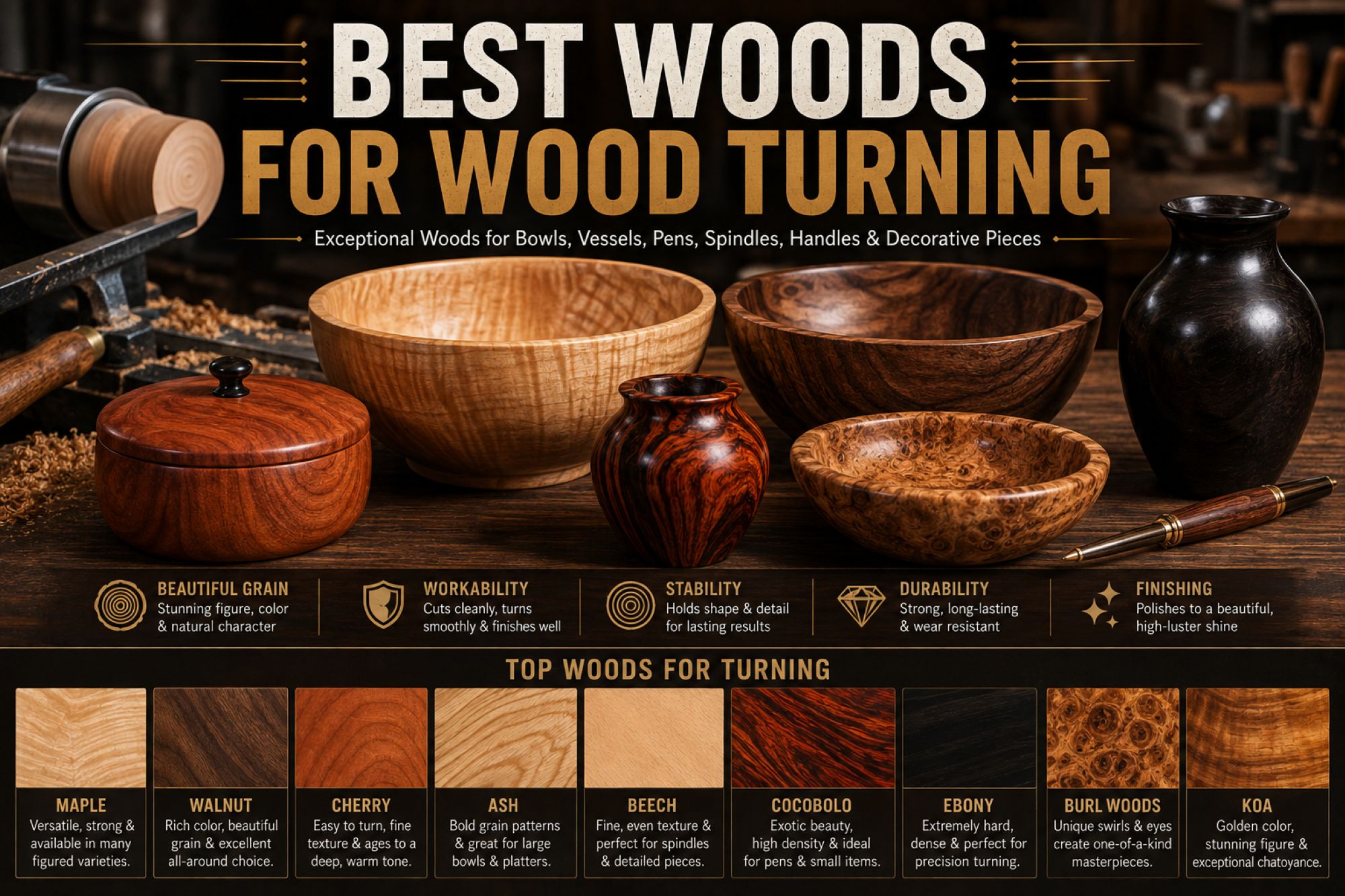
Best Woods for Wood Turning
Explore the best woods for wood turning, including domestic and exotic species selected for workability, grain, hardness, stability, figure, finishing characteristics, and their suitability for bowls, vessels, pens, spindles, handles, and decorative turned objects.
Overview
Woodturning reveals wood in a way few other woodworking disciplines can. As a piece rotates on the lathe, the cutting tool continuously encounters changing grain orientation, while the finished object exposes grain patterns from angles that may never appear on a conventional flat board.
The best turning wood depends heavily on the project.
A large bowl may benefit from a stable, moderately hard wood that cuts cleanly. Pens and small decorative objects can take advantage of extremely dense exotic hardwoods. Beginners often benefit from inexpensive, forgiving species, while experienced turners may deliberately seek highly figured, interlocked, or burl material for spectacular one-of-a-kind pieces.
Important factors include:
- Workability
- Grain structure
- Hardness
- Density
- Dimensional stability
- Ability to hold fine detail
- Figure
- Chatoyance
- Availability in turning blanks
- Finishing characteristics
- Intended project
This guide examines some of the best woods for different types of woodturning and explains where each performs best.
What Makes a Good Wood for Turning?
Good turning wood generally combines several desirable characteristics.
Clean Cutting
The wood should respond predictably to sharp turning tools without excessive tearing or crumbling.
Stability
Turned pieces can contain rapidly changing grain orientation. Stable woods reduce the risk of excessive warping, checking, and cracking.
Grain and Figure
Turning can expose grain from continuously changing angles, making figured woods especially dramatic.
Hardness
Moderate hardness generally provides a good balance between easy cutting and crisp detail.
Extremely hard woods can produce exceptional surfaces but require sharper tools and greater effort.
Fine Texture
Fine-textured woods can produce exceptionally smooth surfaces directly from the tool and hold intricate details.
Finishing
Good turning woods should sand and finish cleanly.
Many dense species can be polished to an exceptionally smooth surface.
Best Overall Wood for Turning
Hard Maple (Acer saccharum)
Hard Maple is one of the most versatile turning woods.
It offers:
- Fine, even texture
- Good hardness
- Excellent strength
- Crisp detail
- Smooth finished surfaces
- Wide availability
- Excellent figured varieties
Maple can be used for:
- Bowls
- Platters
- Spindles
- Pens
- Handles
- Vases
- Decorative objects
Figured Maple dramatically expands its visual possibilities.
Curly, quilted, fiddleback, and birdseye material can produce spectacular turned objects.
🏆 Best Overall Turning Wood: Hard Maple
Its combination of availability, hardness, fine texture, figure, and versatility makes Maple an excellent benchmark turning wood.
Best Wood for Beginners
Cherry (Prunus serotina)
Black Cherry is an excellent wood for developing turning skills.
It generally cuts cleanly and offers:
- Moderate hardness
- Fine texture
- Good workability
- Attractive coloration
- Good availability
- Excellent finishing
Cherry is suitable for:
- Bowls
- Spindles
- Boxes
- Handles
- Vessels
- Decorative turning
Its warm reddish-brown color also deepens with age and exposure to light.
🏆 Best Beginner Turning Wood: Cherry
Cherry offers a forgiving balance between workability and finished appearance.
Maple
Maple deserves special attention because of the variety of material available to turners.
Hard Maple
Excellent for:
- Bowls
- Platters
- Handles
- Spindles
- Pens
- Decorative objects
Curly Maple
Wavy grain can create strong chatoyance as a turned object rotates under changing light.
Quilted Maple
Quilted figure can produce exceptional depth, particularly in bowls and hollow forms.
Birdseye Maple
The small eye-like figures create highly distinctive decorative turning.
🏆 Best Turning Wood for Variety of Figure: Maple
Few wood groups provide as many visually distinct figured forms.
Walnut
Black Walnut (Juglans nigra)
Black Walnut is one of the classic North American turning woods.
Advantages include:
- Rich chocolate-brown heartwood
- Moderate hardness
- Good workability
- Attractive grain
- Good stability
- Excellent finishing
Common turned projects include:
- Bowls
- Vases
- Platters
- Pens
- Handles
- Boxes
- Decorative vessels
Walnut can also produce:
- Curl
- Crotch figure
- Burl
- Feather figure
🏆 Best Dark Domestic Turning Wood: Black Walnut
Cherry
Cherry’s combination of fine grain, warm color, and moderate hardness makes it particularly useful for elegant turned objects.
It works especially well for:
- Bowls
- Lidded boxes
- Vases
- Spindles
- Decorative vessels
Fresh Cherry may appear relatively light, but the heartwood typically darkens substantially over time.
🏆 Best Turning Wood for Aging Color: Cherry
Ash
Ash is a strong, open-grained hardwood that can produce bold turned pieces.
Its pronounced growth rings create dramatic patterns in:
- Bowls
- Platters
- Tool handles
- Large vessels
Ash also responds well to texturing, coloring, and other decorative techniques.
🏆 Best Turning Wood for Bold Open Grain: Ash
Oak
Oak can be successfully turned, although its coarse grain creates a very different experience from Maple or Cherry.
Quarter-sawn material may expose distinctive ray figure.
Oak works well for:
- Bowls
- Platters
- Large vessels
- Architectural turnings
- Furniture components
Its large pores can remain prominent after finishing.
Beech
Beech is a traditional turning wood valued for:
- Fine, even texture
- Good strength
- Moderate hardness
- Excellent machining
- Wide availability
It is particularly suitable for:
- Spindles
- Handles
- Furniture components
- Bowls
- Utility objects
🏆 Best Traditional Utility Turning Wood: Beech
Best Woods for Turning Bowls
Bowls place particular demands on wood because grain direction changes continuously around the piece.
Excellent bowl woods include:
- Maple
- Cherry
- Walnut
- Ash
- Beech
- Elm
- Sycamore
- Birch
- Mesquite
- Fruitwoods
🏆 Best Overall Bowl Wood: Maple
Maple combines clean cutting, strength, availability, and enormous potential for figure.
Elm for Bowl Turning
Elm deserves special attention for bowls.
Its interlocked grain makes the wood resistant to splitting and can create attractive irregular patterns when turned.
Elm can produce excellent:
- Bowls
- Platters
- Vessels
- Rustic turnings
The interlocked grain may require sharp tools to prevent tear-out.
🏆 Best Interlocked-Grain Bowl Wood: Elm
Sycamore
Sycamore can produce attractive turned objects and is particularly interesting when quarter-sawn or cut to expose ray figure.
It is suitable for:
- Bowls
- Platters
- Vases
- Decorative vessels
Its relatively light color also makes it useful for coloring and decorative finishing techniques.
Best Woods for Spindle Turning
Spindle turning generally follows the grain rather than cutting across it as dramatically as bowl turning.
Good spindle woods include:
- Maple
- Beech
- Cherry
- Birch
- Ash
- Mahogany
Common projects include:
- Chair legs
- Table legs
- Balusters
- Handles
- Candlesticks
- Furniture components
🏆 Best Spindle Turning Wood: Beech
Its fine texture, strength, and long history in turned furniture components make Beech particularly suitable.
Best Woods for Pens
Pen turning allows woodworkers to use small pieces of rare, expensive, or highly figured material.
Excellent choices include:
- Cocobolo
- African Blackwood
- Ebony
- Desert Ironwood
- Bocote
- Rosewood
- Ziricote
- Snakewood
- Amboyna Burl
- Maple Burl
🏆 Best Overall Pen Wood: Cocobolo
Cocobolo combines exceptional color, density, fine finishing characteristics, and dramatic grain in the small amount of material required for a pen.
African Blackwood
African Blackwood (Dalbergia melanoxylon)
African Blackwood is one of the world’s premier dense turning woods.
It offers:
- Extremely high density
- Very fine texture
- Exceptional hardness
- Excellent wear resistance
- Superb polishing
- Dark coloration
It is particularly well suited for:
- Pens
- Finials
- Small boxes
- Handles
- Instrument components
- Precision turning
Its extreme density makes large projects expensive and physically demanding.
🏆 Best Precision Turning Wood: African Blackwood
Ebony
Ebony is another classic premium turning wood.
Its:
- Extreme density
- Fine texture
- Hardness
- Dark coloration
- Excellent polish
make it ideal for small precision projects.
Common applications include:
- Pens
- Finials
- Chess pieces
- Handles
- Decorative knobs
- Small vessels
- Jewelry
🏆 Best Black Turning Wood: Ebony
Cocobolo
Cocobolo is exceptionally popular among turners because a small blank can contain dramatic combinations of:
- Orange
- Red
- Brown
- Purple
- Black
The wood is dense and can polish beautifully.
It is especially suitable for:
- Pens
- Handles
- Small vessels
- Boxes
- Decorative objects
Its natural oils and potential sensitizing effects require appropriate handling and dust protection.
Bocote
Bocote is another excellent small-project turning wood.
It commonly displays:
- Golden-brown coloration
- Dark brown to black lines
- Swirling grain
- Attractive natural luster
Bocote is particularly effective for:
- Pens
- Bottle stoppers
- Handles
- Boxes
- Small vessels
- Decorative objects
🏆 Best Turning Wood for Bold Grain: Bocote
Ziricote
Ziricote is prized for its spectacular dark spiderweb-like figure.
Its visual characteristics make it excellent for:
- Pens
- Boxes
- Handles
- Small vessels
- Decorative turnings
Because premium material can be expensive, turning allows relatively small pieces to create exceptional finished objects.
🏆 Best Turning Wood for Spiderweb Figure: Ziricote
Desert Ironwood
Desert Ironwood is exceptionally hard, dense, and naturally durable.
It can produce beautiful polished surfaces and is particularly effective for:
- Pens
- Handles
- Small bowls
- Decorative objects
- Specialty turning
Its density makes machining demanding.
🏆 Best Turning Wood for Extreme Density: Desert Ironwood
Best Woods for Handles
Turned handles require:
- Strength
- Wear resistance
- Good grip
- Stability
- Durability
Excellent choices include:
🏆 Best Heavy-Duty Turned Handle Wood: Hickory
Hickory’s exceptional shock resistance makes it particularly suitable for working handles.
Best Woods for Lidded Boxes
Small turned boxes benefit from woods capable of holding crisp details and precise-fitting lids.
Excellent choices include:
Boxwood
Boxwood has historically been prized for precision turning because of its:
- Extremely fine texture
- Uniform grain
- Hardness
- Ability to hold fine detail
🏆 Best Traditional Wood for Precision Boxes: Boxwood
Best Woods for Large Turnings
Large bowls and vessels require wood available in substantial dimensions.
Good choices include:
Availability of large blanks can be just as important as species characteristics.
🏆 Best Large Turning Wood: Maple
Best Woods for Figured Turning
Turning is one of the best ways to showcase figured wood because the object’s curved surface continuously changes the viewing angle.
Excellent figured woods include:
- Curly Maple
- Quilted Maple
- Maple Burl
- Walnut Burl
- Amboyna Burl
- Curly Koa
- Figured Australian Blackwood
- Pommele Bubinga
- Spalted Maple
🏆 Best Overall Figured Turning Wood: Maple
Its combination of curly, quilted, birdseye, burl, and other figured forms makes Maple exceptionally versatile.
Burl Wood for Turning
Burls are among the most desirable turning materials.
Their irregular grain can produce:
- Eyes
- Swirls
- Curls
- Color variation
- Strong chatoyance
- Highly unpredictable patterns
Popular turning burls include:
- Amboyna Burl
- Maple Burl
- Walnut Burl
- Redwood Burl
- Buckeye Burl
- Mallee Burl
🏆 Best Luxury Turning Burl: Amboyna Burl
Amboyna Burl is famous for its rich reddish coloration, dense eye figure, and exceptional visual depth.
Spalted Wood
Spalting occurs when fungal activity creates distinctive dark zone lines and color changes within wood.
Spalted Maple is particularly popular among turners.
However, advanced decay can significantly weaken wood.
Turners should carefully inspect spalted blanks before mounting them on a lathe.
Soft or structurally compromised areas may require stabilization.
🏆 Best Spalted Turning Wood: Spalted Maple
Green Wood Turning
Many bowl turners intentionally work with freshly cut or green wood.
Advantages can include:
- Easier cutting
- Less dust
- Access to large blanks
- Reduced tool resistance
However, green wood shrinks as it dries.
A common technique is twice turning:
- Rough-turn the bowl while the wood is green.
- Leave additional wall thickness.
- Allow the rough bowl to dry.
- Remount it after drying.
- Turn it to final dimensions.
This process allows the blank to distort during drying before final shaping.
Dry Wood Turning
Dry blanks offer greater dimensional predictability.
Advantages include:
- Reduced post-turning movement
- Immediate final finishing
- More predictable dimensions
Disadvantages can include:
- Harder cutting
- Greater dust production
- Increased tool wear
The best approach depends on the project.
End-Grain Turning
End-grain turning places the wood fibers primarily parallel with the lathe axis.
Common examples include:
- Goblets
- Boxes
- Cups
- Hollow forms
Fine-grained woods such as Maple, Cherry, Boxwood, and African Blackwood can perform particularly well.
Face-Grain Turning
Face-grain or side-grain orientation is common in bowl turning.
The cutting tool repeatedly encounters changing grain direction as the blank rotates.
This makes sharp tools and proper cutting technique especially important.
Chatoyance in Turned Wood
Turning can dramatically enhance chatoyance.
Because the surface curves continuously, differently oriented fibers reflect light as the object rotates.
Particularly chatoyant turning woods include:
- Curly Maple
- Koa
- Australian Blackwood
- Bubinga
- Figured Mahogany
A highly figured bowl can appear to shift and shimmer even when viewed from a relatively small change in angle.
Finishing Turned Wood
Turned objects can accept many different finishes.
Common choices include:
- Oil
- Wax
- Shellac
- Lacquer
- Oil-varnish blends
- Friction polish
The ideal finish depends on the object.
A decorative vessel has different requirements from:
- A salad bowl
- Tool handle
- Pen
- Children’s toy
Food-contact items should use finishes appropriate for their intended use.
Woods That Can Be Difficult to Turn
Some woods are beautiful but present additional challenges.
Wenge
Can produce sharp splinters and has coarse grain.
Ebony
Extremely hard and dense.
Snakewood
Beautiful but notoriously prone to checking and cracking.
Very Hard Rosewoods
Can rapidly dull tools.
Highly Interlocked Woods
May tear out if tools are not exceptionally sharp.
Heavily Spalted Wood
Can become structurally weak when decay is advanced.
These woods are generally better suited to experienced turners.
Woodturning Safety
Lathe work requires special attention to blank integrity.
Before mounting wood, inspect for:
- Cracks
- Loose bark
- Voids
- Rotten areas
- Unstable inclusions
- Loose knots
Appropriate face and eye protection should always be used.
Dust protection is particularly important when turning woods known to cause respiratory or skin irritation.
Best Woods by Turning Project
| Project | Recommended Woods |
|---|---|
| Beginner Turning | Cherry, Maple, Beech |
| Bowls | Maple, Walnut, Cherry, Elm, Ash |
| Large Bowls | Maple, Walnut, Elm, Sycamore |
| Spindles | Beech, Maple, Cherry, Ash |
| Pens | Cocobolo, Ebony, Bocote, African Blackwood, Ziricote |
| Lidded Boxes | Boxwood, Maple, Ebony, African Blackwood |
| Tool Handles | Hickory, Ash, Maple, Beech |
| Decorative Vessels | Maple, Walnut, Koa, Bubinga |
| Precision Turning | African Blackwood, Boxwood, Ebony |
| Figured Turning | Curly Maple, Koa, Bubinga, Walnut Burl |
| Burl Turning | Amboyna Burl, Maple Burl, Walnut Burl |
| Dark Turning | Walnut, Ebony, African Blackwood |
| Bold Grain | Bocote, Ash, Wenge |
| Green-Wood Bowls | Maple, Cherry, Elm, Walnut |
Overall Winners
🏆 Best Overall Turning Wood
Hard Maple
Versatile, strong, fine textured, widely available, and capable of spectacular figure.
🏆 Best Beginner Wood
Cherry
Forgiving to work, attractive, and capable of producing excellent finished projects.
🏆 Best Bowl Wood
Maple
Excellent availability, strength, workability, and figured options.
🏆 Best Spindle Wood
Beech
Fine textured, strong, predictable, and historically proven for turned furniture components.
🏆 Best Pen Wood
Cocobolo
Dense, colorful, highly polished, and visually dramatic in small pieces.
🏆 Best Precision Turning Wood
African Blackwood
Extremely dense and fine textured with outstanding ability to hold detail.
🏆 Best Black Turning Wood
Ebony
Exceptional hardness, smoothness, polish, and naturally dark coloration.
🏆 Best Figured Turning Wood
Maple
Curly, quilted, birdseye, burl, and other forms provide extraordinary variety.
🏆 Best Luxury Burl
Amboyna Burl
Rich coloration and spectacular eye figure make it one of the premier decorative turning materials.
🏆 Best Heavy-Duty Handle Wood
Hickory
Exceptional shock resistance and strength make it ideal for functional turned handles.
Choosing the Right Turning Wood
For a first bowl, consider:
- Cherry
- Maple
- Beech
For a large decorative bowl, consider:
- Maple
- Walnut
- Elm
For a premium pen, consider:
- Cocobolo
- African Blackwood
- Ebony
- Bocote
- Ziricote
For a highly figured showpiece, consider:
- Curly Maple
- Koa
- Amboyna Burl
- Walnut Burl
- Bubinga
For a precision lidded box, consider:
- Boxwood
- African Blackwood
- Ebony
- Hard Maple
For a tool handle, consider:
- Hickory
- Ash
- Hard Maple
- Beech
Related Guides
Continue exploring the Exotic Woods of the World guide library:
- Best Woods for Furniture
- Best Woods for Knife Handles
- Best Woods for Guitar Building
- Best Woods for Flooring
- Best Woods for Outdoor Use
- Understanding Chatoyance in Wood
- Wood Grain Patterns and Figure Explained
- Wood Density and Janka Hardness Chart
- Understanding Wood Movement and Seasonal Expansion
- Understanding Wood Shrinkage Values Explained
- Sapwood vs. Heartwood Explained
- Wood Toxicity and Allergies Guide
Collector Notes
Woodturning provides one of the most revealing ways to study wood because a single turned object can expose face grain, side grain, end grain, figure, color variation, and changing fiber orientation.
The curved surfaces of bowls, vessels, pens, and spindles also make chatoyance particularly visible. Figured woods can appear to move as the object is rotated under light, revealing optical characteristics that may be far less obvious in a flat board.
A turning collection can therefore demonstrate an extraordinary range of wood characteristics. Fine-grained Boxwood illustrates precision, Ebony and African Blackwood demonstrate extreme density, Bocote displays bold grain, Walnut provides rich natural color, and figured Maple demonstrates how dramatically fiber orientation can transform the appearance of wood.
For woodworkers interested in exploring the diversity of the world’s woods, few disciplines provide as many opportunities to work with different species as woodturning.