
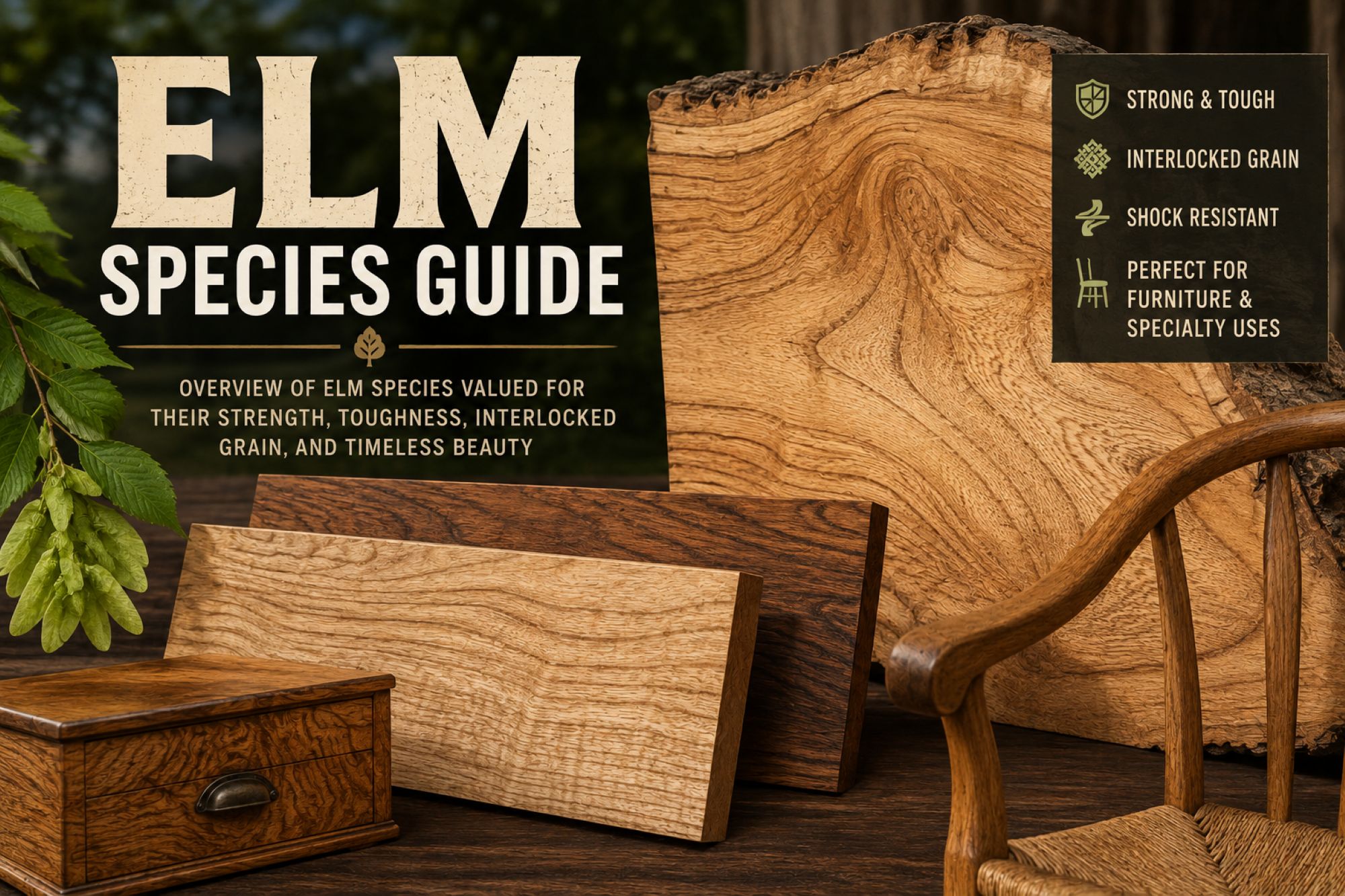
Elm Species Guide
Overview of major Elm species valued for their distinctive interlocked grain, toughness, shock resistance, bending properties, and traditional use in furniture, flooring, chair making, turning, and specialty woodworking.
Overview
The Ulmus genus, commonly known as Elm, represents an important group of hardwood trees distributed throughout North America, Europe, and Asia. Elm wood has historically been valued for its unusual combination of toughness, flexibility, shock resistance, and attractive grain.
One of Elm’s defining characteristics is its frequently interlocked grain, which can make the wood more difficult to split than many other hardwoods. This characteristic helped make Elm particularly valuable for applications such as chair seats, wheel hubs, agricultural implements, flooring, boxes, and other objects subjected to impact or stress.
Elm species vary considerably in density, hardness, color, and commercial importance. Several species have also been severely affected by Dutch elm disease, which dramatically changed Elm populations throughout Europe and North America during the twentieth century.
This page serves as an overview of the Ulmus genus and its most notable timber-producing species.
The Ulmus Genus
Ulmus belongs to the Ulmaceae family. The genus contains several dozen recognized species distributed primarily throughout temperate regions of the Northern Hemisphere.
Many Elm species are known for:
- Tough, resilient wood
- Interlocked grain
- Good shock resistance
- Resistance to splitting
- Good bending properties
- Attractive grain patterns
- Good turning characteristics
- Useful wear resistance
- Distinctive heartwood and sapwood contrast
Although different Elm species can vary substantially, several have historically been marketed simply as Elm.
Distribution and Habitat
Elm species occur naturally across large portions of:
- North America
- Europe
- Western Asia
- Central Asia
- Eastern Asia
They occupy a variety of environments ranging from floodplains and river valleys to mixed hardwood forests and upland sites.
Several Elm species tolerate moist soils particularly well, while others are adapted to relatively dry environments.
Notable Elm Species
The Elm group contains numerous species important to forestry, woodworking, landscaping, and conservation.
American Elm (Ulmus americana)
One of North America’s most historically significant shade trees, American Elm once dominated streets and town centers throughout much of the eastern United States.
Its wood is tough, moderately hard, and strongly interlocked, making it resistant to splitting. Historically it was used for furniture, flooring, boxes, crates, agricultural implements, and bent components.
Slippery Elm (Ulmus rubra)
Native to eastern North America, Slippery Elm produces strong, durable wood with the characteristic interlocked grain associated with the genus.
The species is also notable for its mucilaginous inner bark, which has a long history of traditional use.
Rock Elm (Ulmus thomasii)
Rock Elm is among the hardest, strongest, and heaviest North American Elms.
Its excellent shock resistance and toughness historically made it valuable for:
- Tool handles
- Furniture
- Agricultural equipment
- Wheel components
- Heavy-duty applications
English Elm (Ulmus procera)
English Elm has a long history of use in British woodworking. Its tough, interlocked grain made it particularly suitable for applications requiring resistance to splitting.
Traditional uses included:
- Furniture
- Chair seats
- Coffins
- Wheel hubs
- Boat components
- Structural applications
Wych Elm (Ulmus glabra)
Native to Europe and western Asia, Wych Elm produces attractive timber with good strength and bending properties.
It has historically been used for furniture, flooring, cabinetry, turning, and decorative woodworking.
Siberian Elm (Ulmus pumila)
Native to Central and eastern Asia, Siberian Elm is highly adaptable and has been widely planted outside its natural range.
Its wood is generally used for furniture, flooring, turning, and general utility applications where available.
Chinese Elm (Ulmus parvifolia)
Chinese Elm is native to eastern Asia and is particularly well known as an ornamental and bonsai species.
Its wood is hard, tough, and attractive and can be used for furniture, turning, cabinetry, and specialty woodworking.
Additional Elm Species
Other notable members of the Ulmus genus include:
- Cedar Elm (Ulmus crassifolia)
- Winged Elm (Ulmus alata)
- September Elm (Ulmus serotina)
- Florida Elm (Ulmus americana var. floridana)
- European Elm (Ulmus minor)
- European White Elm (Ulmus laevis)
- Dutch Elm (Ulmus × hollandica)
- David Elm (Ulmus davidiana)
- Japanese Elm (Ulmus davidiana var. japonica)
- Himalayan Elm (Ulmus wallichiana)
- Large-Fruited Elm (Ulmus macrocarpa)
As additional Elm species are added to the Exotic Woods of the World archive, they can be incorporated into this guide and linked to their individual species pages.
Common Characteristics of Elm Woods
Although individual species differ, many Elm woods share recognizable characteristics.
Common Elm Traits
- Interlocked or irregular grain
- Medium to coarse texture
- Good toughness
- Strong shock resistance
- Resistance to splitting
- Moderate to high density
- Good bending properties
- Attractive growth-ring figure
- Good turning characteristics
The interlocked grain that makes Elm difficult to split can also make machining more challenging.
Color and Appearance
Elm heartwood commonly ranges from:
- Light brown
- Medium brown
- Reddish-brown
- Grayish-brown
Sapwood is generally considerably lighter and may range from cream to pale yellowish-white.
The contrast between heartwood and sapwood can create attractive visual variation in finished projects.
Growth rings are often prominent, giving flatsawn Elm a bold grain pattern.
Grain and Texture
Elm is especially recognizable for its interlocked grain.
Instead of fibers running consistently in one direction, the grain may reverse direction during successive periods of growth.
This produces several important characteristics:
- Increased resistance to splitting
- Attractive irregular grain
- Good toughness
- Greater resistance to impact
However, interlocked grain can also cause tear-out during planing and machining.
Sharp cutting tools and careful grain reading are recommended.
Hardness and Density
Elm hardness varies considerably by species.
Some Elms are moderately hard, while species such as Rock Elm can be substantially harder and denser.
This variation allows Elm to serve applications ranging from furniture and decorative woodworking to flooring and heavy-duty utility components.
Species-level hardness and density information should therefore be considered when selecting Elm for a particular project.
Workability
Elm generally machines reasonably well, although its interlocked grain can create challenges.
Common woodworking considerations include:
- Potential tear-out
- Moderate tool dulling
- Good turning performance
- Good steam-bending properties
- Generally good gluing
- Good finishing characteristics
Sharp tools are especially important when working figured or heavily interlocked boards.
Steam Bending
Elm has historically been valued for its bending characteristics.
Its toughness and resistance to splitting make selected Elm lumber suitable for bent components such as:
- Chair parts
- Furniture frames
- Boat components
- Agricultural equipment
- Traditional wheel components
This combination of flexibility and toughness helped establish Elm as an important traditional utility hardwood.
Common Uses
Elm has been used for an exceptionally broad range of woodworking applications.
Common Applications
- Furniture
- Flooring
- Cabinetry
- Chair seats
- Bent furniture components
- Turning
- Decorative boxes
- Veneer
- Interior millwork
- Tool handles
- Agricultural implements
- Wheel hubs
- Crates
- Boat components
- Specialty woodworking
Historically, Elm’s resistance to splitting made it especially valuable where other woods might fracture under repeated stress.
Elm in Furniture Making
Elm has a long history in furniture production.
Its bold grain and warm coloration work particularly well for:
- Dining tables
- Chairs
- Cabinets
- Benches
- Rustic furniture
- Decorative furniture
- Turned components
Wide Elm slabs can also display highly distinctive grain patterns and are increasingly appreciated for natural-edge furniture.
Elm for Flooring
Several Elm species can produce attractive hardwood flooring.
Advantages include:
- Good wear resistance
- Distinctive grain
- Warm coloration
- Good toughness
Hardness varies between species, so the specific Elm should be evaluated before selecting it for high-traffic flooring.
Elm Identification Characteristics
Common wood identification traits include:
- Light to medium brown heartwood
- Pale sapwood
- Prominent growth rings
- Interlocked grain
- Medium to coarse texture
- Irregular grain patterns
- Strong heartwood/sapwood contrast in some boards
Species-level identification may require examination of:
- Leaves
- Bark
- Seeds
- Buds
- Geographic origin
- Microscopic wood anatomy
Wood alone may not always allow reliable identification between closely related Elm species.
Dutch Elm Disease
No discussion of Elm is complete without considering Dutch elm disease.
Dutch elm disease is a fungal disease spread primarily by elm bark beetles. It devastated populations of mature Elm trees across Europe and North America during the twentieth century.
American Elm was particularly affected, resulting in the loss of millions of trees from forests, streets, parks, and residential landscapes.
Modern conservation efforts include:
- Disease-resistant cultivars
- Selective breeding
- Monitoring programs
- Sanitation practices
- Preservation of surviving genetic lines
Elm populations continue to survive, and disease-resistant selections have helped restore the genus to many landscapes.
Sustainability and Conservation
Conservation status varies considerably among Elm species.
Important considerations include:
- Species
- Geographic origin
- Disease pressure
- Habitat loss
- Forest management
- Local population trends
Some Elm species remain widespread and abundant, while others have experienced substantial declines.
Responsibly sourced lumber and reclaimed Elm can provide excellent woodworking material while reducing pressure on vulnerable populations.
Reclaimed Elm
Reclaimed Elm has become increasingly desirable for furniture and architectural woodworking.
Sources may include:
- Old barns
- Historic buildings
- Agricultural structures
- Salvaged urban trees
- Disease-removed trees
Reclaimed material can display exceptional color, patina, and grain developed over decades of service.
Woods Commonly Confused With Elm
Several woods can resemble Elm because of their coarse grain or coloration.
Possible look-alikes include:
Careful examination of pore arrangement, grain structure, rays, color, and end grain can help distinguish these woods.
Related Wood Family and Species Guides
Explore additional wood family and species guides:
- Oak Species Guide
- Hickory Species Guide
- Walnut Species Guide
- Maple Species Guide
- Pine Species Guide
- Fir Species Guide
- Wood Families & Trade Groups
Compare Wood Properties
Compare Elm species alongside hundreds of hardwoods and softwoods using the Exotic Woods of the World database.
Related resources include:
- Wood Density and Janka Hardness Chart
- Wood Grain Patterns and Figure Explained
- Understanding Wood Movement and Seasonal Expansion
- Understanding Wood Shrinkage Values Explained
- Wood Toxicity and Allergies Guide
- Best Woods for Furniture
- Best Woods for Flooring
Collector Notes
Elm represents one of the more distinctive hardwood groups because its value comes not simply from hardness or appearance but from its unusual combination of toughness, flexibility, and resistance to splitting.
The interlocked grain that can challenge woodworkers during machining is also responsible for many of Elm’s greatest strengths. Historically, these properties made Elm invaluable for chairs, wheel components, agricultural implements, flooring, furniture, and other objects subjected to repeated stress.
The devastation caused by Dutch elm disease also gives Elm an important place in forestry and conservation history. Surviving trees, disease-resistant cultivars, reclaimed lumber, and the many Elm species found throughout North America, Europe, and Asia ensure that the Ulmus genus remains an important group for woodworkers, collectors, and tree enthusiasts to understand.